The President's State Inspection Board today released its report on the assassination of Hrant Dink. The 649-page report comes one month after the court hearing the case of 18 defendants accused of organizing the plot found no evidence to establish a connection that Dink's murder was not but a random act of violence carried out by a few ultra-nationalist youth--not the state-linked conspiracy which Dink's lawyers and supporters have alleged was at work. For background, click here. The report, though not binding, sends a powerful message to the Supreme Court of Appeals to re-open the investigation and commence a new trial, a decision that should come by year's end.
The State Inspection Board decided to release its report following the public outcry after the Dink trial came to a close, which at the time the president and other AKP officials cautiously denounced while urging the public to wait for the appeals process to come to an end. Its contents blame Dink's death in part on the negligence of state officials, and suggests that the trial of those officials should have never occurred separate from the trial of the 18 defendants, a point argued by Dink's lawyers from the very beginning.
According to Milliyet, the report also documents lack of coordination between the gendarme in Trabzon and police in Trabzon and Istanbul, as well as calls into question the Samsun police officers who were shown posing with Dink's young killer, Ogun Samast, days after the murder. Just as importantly, it calls into doubt the work of the Istanbul court and its verdict, citing that the investigation failed to take into account possible connections between the accused conspirators and state officials.
UPDATE I (2/25) -- The full verdict of the Istanbul court has been released one month after being announced. It points to the possible existence of links between the conspirators and the state, but as the chief judge Rustem Erilyilmaz told media soon after the trial's conclusion, argues the court lacked evidence to issue a ruling on the matter.
Perhaps no issue is more revealing of the struggle for liberal democracy in Turkey than the assassination of Turkish Armenian journalist Hrant Dink and the trial of members of a likely state-linked organization that gunned him down on Jan. 19, 2007.
Almost five years to the date of what was a very calculated murder, the Istanbul court hearing the case of 19 defendants accused of participating in the conspiracy to slay Dink ruled on Jan. 17 that there was indeed no organization, no conspiracy. Instead, the court portrayed the assassination as a random act of violence carried out by two ultra-nationalist youths acting alone. The court did not even touch the issue of links between state officials and the organization that have been revealed in the five years following the assassination. For more on the verdict from Reporters Without Borders, click here.
Not a Random Act of Violence
Dink presaged his murder, telling friends before his murder "that his heart was a 'timid pigeon' waiting for bad things to happen (see June 26, 2008 post). Dink had begun receiving threats from ultra-nationalists in 2004 following an article he wrote for the Turkish Armenian paper Agos, over which he presided as editor. In the article, Dink claimed that Sabiha Gokcen, Ataturk's much beloved adopted daughter, was an Armenian orphan. The article earned him the scorn of then Chief of General Staff Yasar Buyukanit, who denounced the article as a crime against national unity.
Before 2006, Dink had been subject to numerous court cases because of his questioning of an ethno-national conception of Turkish identity and his writing on the 1915 massacre of tens of thousands of Armenians. Throughout his work, Dink tried to bridge divides between Turks, Armenians, and Turkish Armenians, challenging both Turkish and Armenian identity, polarizing approaches to the genocide issue, and the general recalcitrance of the two sides. He did this as only a Turkish Armenian could, and his thinking challenged fellow Turkish citizens and ethnic Armenians alike. Most of all, Dink represented the expression of difference -- not just being different, but expressing it, and doing so always as an individual guided by free thought and its commensurate dignities. His writing, and that he attracted so many fans, Turkish and Armenians, is a testament to where Turkey has come since its founding and the longing for liberalism shared by so many of its citizens.
Yet not all were so content with Dink's ideas, his constant challenging of Turkish state and society. In 2004, Dink began receiving numerous death threats. The gravity of their danger to Dink's life prompted the deputy director of security in Istanbul to order police in Bakirkoy, where he lived, and Sisli, where he worked at Agos, to make provide for his protection.
In February 2006, intelligence of the murder conspiracy to which he would soon fall victim made their way from police in Trabzon to Istanbul. The memo from security officials in Trabzon stated, and quite simply, that Yasin Hayal, a known ultra-nationalist in the Black Sea province, was going to kill Dink. Less than one year later, Hayal, acting alongside 17-year-old gunman Ogun Samast, gunned down Dink outside Agos's offices.
Yet it seems the memo, ranked "low priority" by Trabzon police chief Ramazan Akyurek, was not paid much attention, if any, by Istanbul police, and little action was taken by either authority nor the gendarme in Trabzon, who were also watching the conspirators, to halt the assassination. Akyurek has since been promoted to head the Board of Inspectors in the General Directorate for Security. Dink knew his death was coming, and so did members of the Istanbul and Trabzon police, as well as the Trabzon gendarme. Meanwhile, Nedim Sener, one of the journalists who took the Dink investigation seriously and documented what the police knew before the murder, has been jailed on charges of being linked to the Ergenekon terrorist organization.
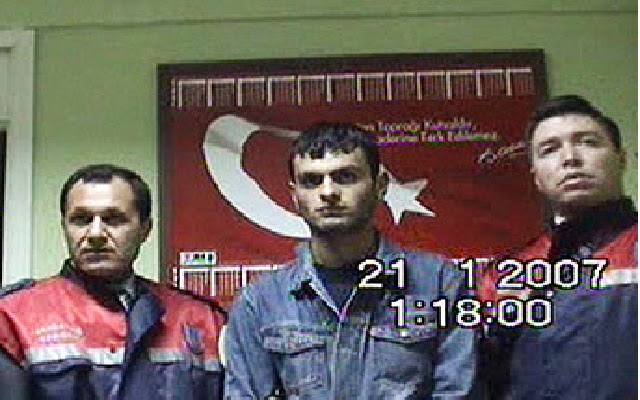
To offer further damning evidence of the neglect -- and quite possibly, involvement -- of elements within the Turkish security forces, one of Dink's assassins, young trigger-man Ogun Samast, posed with police officers in Samsun behind a Turkish flag just two days after the murder. While government officials have complimented themselves on apprehending Samast and other conspirators soon after the murder, adequate explanations for this photograph and the events before the murder have yet to come to the forefront, and according to many of Dink's supporters, have indeed been subject to a massive cover-up in which the state is complicit.
Where Does the Government Fit In?
Indeed, the more than four-year trial of Dink's conspirators has been hindered from the beginning due to an inability, and perhaps unwillingness, to procure evidence from state security offices, as well as government agencies such as the Telecommunications Board (TIB), which only last December turned over evidence documenting phone conversations and text message exchanges between the conspirators. TIB, citing a 2007 provision by the Justice Ministry related to the use of phone records in criminal investigations, had refused to turn over evidence for more than four years following the murder. Video footage of the street on which Dink was shot was erased from cameras soon after the incident, another fact that has led to accusations against the police ranging from neglect to complicity.
As Hurriyet columnist Sedat Ergin points out, efforts, or lack thereof, to hold state officials to account for their role in the murder have given way to serious misgivings on the part of the Turkish public. In 2008, and administrative court acquitted police of neglect while failing to really delve into the events in the days and months before the murder, and in 2009, another effort to investigate the role of security officials was blocked by the Interior Ministry, which at the time and just as today, was controlled by the ruling Justice and Development Party (AKP). The gendarme is the only state organ wherein an official has been found responsible for neglecting to prevent Dink's murder.
Though AKP government officials are always careful to point to the independence and integrity of judicial processes, the fact that the government now has firmer control of the judiciary has caused many critics, both of the government and the investigation into Dink's murder, to point their finger at the government. When the Dink investigation started in 2007, the government did not have the control over judicial organs, such as the Supreme Board of Judges and Prosecutors (HSYK), that it currently wields. (Click here for a bit of insight as to how the AKP has gained more control through amending the constitution to give its elected representatives the ability to appoint members to this body and Turkey's high courts. See also this past post.) The HSYK is currently investigating the presiding judge in the case, Rustem Eryilmaz, as well as prosecutor Hikmet Usta, though on grounds that the two inappropriately spoke out publicly after the verdict rather than that they mishandled the case.
More cogent criticism centers on the government's relation to the police. As Milliyet columnist Metin Munir indicates (luckily, Hurriyet Daily News has translated this column into English, and so it can be read here), the real blame should be placed on the government's failure to prevent the police from hindering the investigation. According to Munir,
Nobody is blaming the government for not interfering with the judiciary; its guilt is in not intervening with the police, with the intelligence organization and in not demonstrating the necessary attention to bring out the truth. In Turkey, judges and prosecutors are not as strong and independent as, for example, in the United States, the United Kingdom or Italy.
While in the West the prosecutor commands the police, in Turkey the police command the prosecutor. This is the truth in practical terms, especially in politically sensitive cases.
The judges are also bound to prosecute whatever is in the indictments presented to them. The government does not command the courts and prosecutors. But it does command the security forces. For this reason, it has its share of responsibility in the verdict the court has ruled. It could have put pressure on the police to provide that a more comprehensive and a stronger file be handed over to the prosecutor. It did not.
The government is still boasting about catching the murderer in 32 hours. This is not a matter to be proud of; it a matter to be ashamed of. Who was going to kill Dink and when it was going to happen were known by security forces days before the murder. If the incident was stopped at that time and the murder was prevented, then yes, it could have been a matter of which to boast. But it is not hugely ingenious to identify the assassin and then catch the killer.
This is what the government has to explain: Why isn’t the entire organization, the one for which the killer acted as a hit man, foiled and punished even if it is five years that have passed since the murder? What is the reason for the systematic reluctance on this matter?
Mustafa Akyol, generally more sympathetic of the AKP, explains that this reluctance might be driven by the fact that many of the bureaucrats and police who neglected to properly investigate Dink's murder (and, my words, not his, but perhaps even cover up critical aspects of the killing) are now aligned with the AKP and have been appointed to key positions within the government. These include not only Akyurek, but also former Istanbul police chief Celalettin Cerrah, headed the Istanbul police at the time of Dink's murder. The government has never allowed Cerrah to be questioned in relation to the case, and in 2009, he was appointed a provincial governorship in Osmaniye. Similarly, the failure of the AKP to put pressure on TIB and the obstructive role of the Interior Ministry throughout the investigation give great cause for concern.
A Chance for Redemption?
Soon after the verdict, Dink family lawyer Fethiye Cetin declared that the effort to unveil the truth behind Dink's murder had only just begun, and it is quite possible this is the case. An indignant Cetin has already appealed to the Supreme Court, which will likely render a decision in one year's time. Hikmet Usta, the Istanbul prosecutor charged with the case, has also made an appeal, joining Cetin in denouncing the court's inability to find evidence that the crime was the premeditated work of a criminal organization as a complete oversight of the facts presented.
New evidence presented on Tuesday to judges overseeing the Hrant Dink case has given further credence to the claim of Dink's lawyers that the Turkish Armenian journalist's murder was the work of an organized effort that included state elements.
Telephone records long sought by Dink's lawyers revealed conversations between the assassins currently on trial and five other people in the vicinity of the crime scene, in addition to 14 other people who were called from the crime scene and had connections to the defendants and other suspects in the case (for Bianet's more detailed report of the evidence presented, click here). For a full account of the hearing from Birgün, which has closely covered the case and positioned itself firmly in line with Dink's lawyers, click here.
The new evidence raises the possibility of another investigation, though judges hearing the unwieldy trial have expressed their desire to conclude it on Jan. 17. If this occurs, even more suspects could be named and evidence put forward that would further link suspects to police in Istanbul and gendarme officers in Trabzon, from where the murder plot was hatched.
Dink's lawyers have long demanded the release of the telephone records at the heart of the new discovery, though the police and the Turkish Telecommunications Directorate (TIB) have been reluctant to turn them over. The records were released to Dink's lawyers just this November after a months-long ordeal and plenty of conflicting excuses from the TIB. Prosecutors in the case maintain there is nothing new in the records, a claim with which the judges hearing it on Tuesday seemed to concur, though this seems hardly the case.
The New York Times gave coverage yesterday to the issue of press freedom in Turkey in light of the ongoing trial against journalists Ahmet Şık (use Turkish letters when spelling!) and Nedim Sener (click here for past post). Both are world renown journalists, and Sener, in 2010, won the International Press Institute's World Press Hero award.
Both men have been in prison for 309 days since their arrest in March on charges of being "terrorists" affiliated with the shadowy Ergenekon network. They are being tried by an Istanbul court along with eight journalists in the employ of Oda TV. The charges against the journalists stem from a file that police reportedly found on a computer at Oda TV's offices, but which defense lawyers and expert witnesses say were electronically planted using malware. The file tied the journalists to the shadowy Ergenekon network, alleged to constitute the "deep state" and be behind numerous attempts to overthrow the government. The court did task the Scientific and Technological Research Council (TUBITAK) with carrying out analysis on the computer disks at the center of the investigation. Another hearing is expected on Jan. 23.
Sener says his arrest is revenge for working to reveal the forces behind the assassination of Armenian journalist Hrant Dink in 2007, which contrary to the charges against Sener, is thought to be the work of the deep state. Neither Sener nor Şık have anything in common with the ultra-nationalist ideology with which the Ergenekon network is associated -- both are devout leftists with a long history of writing and political activity.
At the time of Şık's arrest, the journalist was working on a book about the infiltration of members of the also shadowy Gulen religious network, which is headed by Fethullah Gulen, a reclusive cleric based in Pennsylvania who preaches a moderate version of Islam and whose ideas and influence have deeply penetrated Turkish state and society (for a foreign journalist's take on Gulen, see Financial Times reporter Delphine Strauss's take last April).
Gulen's intentions and influence in Turkish politics are widely debated, and he no doubt wields a great amount of power among elements of the ruling AKP government (for more, see past post). Indeed, tension between Gulenists and non-Gulenists in the AKP is speculated to run quite high and was on display last spring when Prime Minister Erdogan dismissed Zekeriya Oz, the prosecutor formerly responsible for the Ergenekon investigation, including the arrests of Şık and Sener; last fall when the AKP divided itself over a law aimed to reduce the penalty for fixing soccer matches; and in recent days, in coverage of the Uludere tragedy that has appeared in Zaman, which is owned by Gulen (for an example, see Aziz Istegun's analysis soon after the attack) and Gulen's declaration that the strike was coordinated by people intent to undermine "harmony."
The case has become a rallying cry in a country where, according to the Organization for Security and Cooperation in Europe (OSCE) last April, at least 57 journalists are currently imprisoned (more than in China; the New York Times put the number at 97 in this report). The government has asserted that of these journalists are not in prison for anything they have written, but for being members of terrorist organizations, though the argument has failed to convince waves of protestors that have assembled since Şık and Sener's arrest, in addition to international critics (for the OSCE's report in April, click here).
Journalist Ahmet Şık has been detained in the Ergenekon investigation. Most ironically, Şık helped to expose the Ergenekon group as well as past coups against the government. Colleagues say it is highly unlikely he had anything to do with Ergenekon. More likely: He was working on a book on links between the Gulen Movement and the Turkish police . . . playing with fire indeed.
Turkish police Thursday targeted more journalists as part of a controversial probe into alleged coup plots, among them a prominent award-winning reporter, Anatolia news agency reported.
Police were searching the homes of 11 people in Istanbul and Ankara, following a similar raid targeting the media last month that sparked an outcry over press freedom in EU-hopeful Turkey and drew a U.S. rebuke, Agence France-Presse reported.
A prosecutor issued a detention order for the suspects, and journalist Ahmet Şık was detained after his home was searched for six hours, daily Hürriyet reported on its website. Nine others, mostly journalists, were also detained, The Associated Press reported.
Şık already faces prosecution for co-writing a critical book about the crackdown on the so-called Ergenekon network, broadcaster NTV reported.
Police had reportedly discovered a draft book by Şık that allegedly focuses on the religious groupings within the police force on the hard disk of one computer seized in last month's raid on Oda TV, several news websites said.
Also among the suspects was Nedim Şener, an investigative reporter for daily Milliyet and author who last year received the International Press Institute's "World Press Freedom Hero" award for a book that put blame on the security forces in the 2007 murder of Turkish-Armenian journalist Hrant Dink.
Şık (use Turkish letters when spelling!) and Sener have both been in-and-out of the news in recent years, and neither can be loved much by the government. Radikal journalist Şık's most recent investigation of links between the Turkish police and the Gulen movement, a most controversial subject in Turkey, has certainly not won the journalist any friends, and many have speculated in the Turkish media that this was the reason for his arrest.
The government has taken a lot of domestic and international heat for its treatment of the press, and many have long accused the government of using the Ergenekon investigation to silence its critics, including journalists.
The current situation is “ridiculous and tragic,” said journalist Ertuğrul Mavioğlu, noting that Ahmet Şık, one of the journalists whose homes were searched, had been instrumental in opening the Ergenekon case in the first place. The diaries in Şık’s “Coup Diaries” story for weekly Nokta in 2007, an article that led to the magazine being shut down, were among the key evidence that led to the investigation, Mavioğlu said.
It is a very “immoral accusation to place Ahmet Şık next to the ‘deep state’ and Ergenekon,” said Mavioğlu, a journalist with daily Radikal and co-author with Şık of a two-volume book about the Ergenekon case. Speaking to the Daily News while in front of Şık’s house as the search continued, he said he cannot compare the situation to anything but McCarthyism.
For more reaction against the arrests, including a strong denunciation by CHP leader Kemal Kilicdaroglu and CHP deputy leader in charge of human rights (who I interviewed last summer), click here. For more on Sener and the trumped up charges he faced last year for leaking state secrets (that could be found in public documents), click here.
Shame, shame, the whole way round . . .
UPDATE I (3/4) -- The Turkish Journalists Association (TGD) has issued a statement in regard to the press raids (thanks to Bianet): 60 journalists are currently detained in prison; more than 2,000 journalists are being prosecuted. Investigations have been launched against 4,000 journalists. Death threats against journalists and trials carrying hundreds of years of imprisonment and are continuing.
. . . .
The government seems to remain a passive spectator of the threats against press freedom and journalists by giving the impression that they are not disturbed by the situation that the source of the threats is not being removed. Crimes of thought are on the rise again in this country with journalists being taken into custody, arrested and tried.
Head of the Turkey-EU Joint Parliamentary Commission Helene Flautre has made the following statement on the arrests: "The professional orientation and research carried out by the journalists do not give the impression that they are affiliated with nationalists and supporters of a coup like the Ergenekon organization, I think."
UPDATE II (3/5) -- The New York Times' Sebnem Arsu has the story here.
Dink assassin Ogun Samast posing with police officers who arrested him just two days after Dink's murder.
The Istanbul Chief Prosecutor's Office have granted the request of Dink family lawyers that an investigation be launched into the involvement of high-level security officials into the 2007 assassination of Turkish Armenian journalist Hrant Dink. FromHurriyet Daily News:
This is an extremely good, positive development. I hope there will be a result [from] this,” Dink family lawyer Fethiye Çetin told a crowd of journalists during the court recess. She said they were expecting the investigation as they had applied to the prosecutor’s office Jan. 17, demanding that rulings made on the case by the European Court of Human Rights be implemented in Turkey.
The Dink family recently made a new plea for state, police and gendarmerie officials not questioned during the initial investigation to be brought into the scope of the case, basing their request on the European court decision finding Turkey guilty of failing to protect Dink and his freedom of speech and of not properly investigating civil servants suspected of being negligent in the murder and its investigation.
. . . .
The 28 public officials whose testimonies are expected to be taken by Public Prosecutor with Special Authority Mustafa Çavuşoğlu in the coming days include former Istanbul Gov. Muammer Güler; Ramazan Akyürek, the former top head of police intelligence; former Istanbul Police Chief Celalettin Cerrah; Ahmet İlhan Güler, the former Istanbul head of police intelligence; former Trabzon Police Chief Reşat Altay; Col. Ali Öz, the former Gendarmerie Trabzon regiment commander; and Metin Yıldız, the former Trabzon head of gendarmerie intelligence.
Last week President Gul announced that the State Audit Board (DDK) open a separate investigation into Dink's murder. Both investigations are indicators that the government is getting serious about resolving the facts behind Dink's murder. For more on Dink, see past posts.
UPDATE I (2/10) -- Interior Minister Besir Atalay is denying reports that the Istanbul Chief Proescutor's Office has opened up an investigation. Meanwhile newly released phone records verify long-time allegations that police exchanged text messages in the months prior to Dink's assassination. Previous evidence existed that police exchanged phone messages with Tuncel just two hours before Dink's assassination.
UPDATE II (2/15)-- In a new development in the ongoing Dink trial in Istanbul, the Trabzon Chief Prosecutor's Office has announced that it would allow the Istanbul court to question Trabzon police officers in communication with Tuncel up to the day of Dink's murder. Previous requests had been denied.
It was four years ago today that Turkish Armenian Hrant Dink was gunned down in the street and the botched investigation and unwieldy series of trials since have only added to the despair of the loss. On Monday, Dink family lawyers filed another petition with the Istanbul Chief Prosecutor's Office seeking an investigation into the event surrounding his death and implementation of the European Court of Human Rights decision Dink lawyers won last September. The Court found that the Turkish government had failed to conduct an effective investigation into his death, fell short of protecting his right to life, and had violated his rights to freedom of expression. From Hurriyet Daily News:
The family demanded investigations of the police and gendarmerie officials allegedly responsible for the murder, either directly or by neglecting their duties. In their application, they argued that the European court’s decision canceled the authority of certain domestic laws that had previously blocked the path of putting such officials on trial.
Dink, a Turkish citizen of Armenian origin, was murdered in front of the office of the weekly Armenian-Turkish newspaper Agos on Jan. 19, 2007. Confessed killer Ogün Samast was transferred to a juvenile court in October, and his trial separated from the main murder case, due to a legal change he benefited from because he was under the age of 18 on the day of the assassination.
Yasin Hayal, who is accused of abetting the murder, and Erhan Tuncel, a former police informant who claims innocence on the grounds that he told security forces everything he knew months before the murder, are still on trial under arrest. The only suspects left after three years of the trial, they will be released next year if they are not convicted by that time under a recent legal change that limits arrest periods without conviction to a maximum of five years.
From the beginning, lawyers for the Dink family have stated that the murder was not the work of “three to five nationalist youth,” but even the official inspector’s reports concluded that the National Intelligence Organization, or MİT, should be investigated were not enough to allow the questioning of high-ranking suspects from the police, gendarmerie and the MİT.
As they have every year since the first anniversary of Dink's murder, thousands gathered on the street where he was shot to call for the government to hold those responsible to account. For more on Dink and his family's attempts to uncover the details of his assassination, see past posts. For an excellent documentary produced in 2009 on the event surrounding the murder and the subsequent attempts by authorities to cover up their involvement, clickhere.
The European Court of Human Rights (ECHR) has found Turkey to have violated numerous human rights both before and after the assassination of Turkish Armenian journalist Hrant Dink. Dink was assassinated in January 2007 and the investigation that has followed has been tainted by a series of cover-ups and serious judicial mishandling. (For background, click here).
The Court found Turkey to have failed to protect Dink's right to life and freedom of expression, as well as to have fallen short of its obligations to provide for an effective investigation of his murder. In the weeks, months, and years after Dink's murder, numerous high-ranking state security officials and police have been implicated as either falling far short of their duties to protect Dink, at best, and at worst, actively conspiring with Dink's murderers.
During its defense at the ECHR, Turkey argued that Dink did not fear for his life or else would have asked for private police protection. A recent book by journalist Nedim Sener, who this year escaped criminal charges brought against him in relation to a book he published revealing details of the Dink murder and subsequent cover-up, alleges that security officials warned Dink of threats to his life before the assassination. Security officials have denied such knowledge.
The Turkish Foreign Ministry has said it will not appeal the court's decision. It is yet to be seen whether Turkey will provide for a remedy to its previous failure to effectively investigate Dink's assassination.
The Greek Orthodox orphanage now in disrepair at Buyukada is Europe's iggest remaining wooden building. PHOTO by Hasan Altinisk / Hurriyet Daily News
A European Court of Human Rights (ECHR) decision ordering the Turkish government to return an abandoned orphanage and its grounds back to the Greek Orthodox Patriarchate after it was seized in 1995 has again brought attention to the issue of real estate owned by religious minorities in Turkey. From Hurriyet Daily News:
The 112-year-old orphanage, Europe’s biggest remaining wooden building, was built in 1898 as a hotel and casino on the largest of Istanbul’s Princes’ Islands, then purchased by a prominent Greek family that donated it to the patriarchate for use as an orphanage.
“The orphanage was opened in 1903 by Sultan Abdülhamid and remained so for a long time,” Osman Doğru, a law professor at Marmara University, told the Hürriyet Daily News & Economic Review. “Yet in 1964, it was emptied for security reasons and then left to its destiny.” For almost 30 years, the building simply rotted away. In 1995, Turkey’s General Directorate of Foundations took over ownership – and the court cases began.
“The decision to transfer the orphanage building’s ownership to the foundations directorate was based on the claim that the Greek Patriarchate didn’t do any maintenance work on it. However, it was the Turkish state that didn’t allow any restorations during that period,” said Kezban Hatemi, a lawyer for the patriarchate.
“Such a transfer is legally very problematic, and this case is not the only one,” Hatemi told the Daily News. “Since the 1960s, there have been many violations to the rights of properties owned by minority foundations.”
According to a 2009 report by the Turkish Economic and Social Studies Foundation, or TESEV, there are approximately 1,000 “immovable properties,” essentially land parcels and buildings, in the country that originally belonged to Greek foundations but were confiscated by the Turkish state.
Foundations administered by other minority groups have been affected as well; some 30 properties belonging to Armenian foundations have likewise been seized, an issue that Turkish-Armenian journalist Hrant Dink tried to raise awareness about before his assassination in 2007.
“In 1936, the Turkish government asked all minority foundations to declare their properties. Yet, in 1975, the Supreme Court of Appeals decided that minority foundations do not have the right to hold any property and ordered all properties gained after 1936 to be returned,” Dink once said. “Yet these immovable properties weren’t returned to their [original] donators either, because they were already dead. So many of these properties were transferred to the General Directorate of Foundations.”
According to law professor Doğru, the case of the Büuükada Orphanage was complicated by the fact that the patriarchate claimed the building in 1936, when the government asked minority foundations to report their holdings. “However, the Supreme Court of Appeals found a very creative solution to the issue and said the building was actually claimed by the orphanage foundation, not the patriarchate itself, so they could transfer it to the General Directorate of Foundations,” he said.
After the building was confiscated in 1995, the Fener Greek Patriarchate applied to have the court decision cancelled. When this application was rejected, the patriarchate took the issue to the European Court of Human Rights.
“Minority foundations in Turkey did not have any property problems until the mid-1960s,” said patriarchate lawyer Hatemi. “But this situation completely changed when the Cyprus crisis started during that period. Only then were the declarations of 1936 remembered and minority foundations were used as a tool to gain power over Greece.”
In spring 2008, the Turkish parliament passed major reforms of Turkey's Foundations Law, under which both the Greek and Armenian minorities are governed, though the reforms are largely argued to have not gone far enough in addressing such issues as real estate.
For more on how minority foundations are governed in Turkey, see also Today's Zaman columnist Orhan Kemal Cengiz's two-part op/ed series. In the first part, Cengiz lays out the history of minority foundations, while turning his attention in the second part to the 2008 reforms -- which the CHP, in one of its more overtly nationalist overtures, opposed -- and the current climate for further reform.
With eyes focused on Turkey-Israel relations, Turkey's recent vote on Iranian sanctions, and increased PKK violence, the Ergenekon investigation continues onward, as do the trials it has brought in its wake. Among these are of the 33 suspects charged with participating the Cage Action Plan, the mysterious designs of which the Turkish daily Taraf revealed last November. The first hearing for the Cage suspects got underway in Istanbul yesterday.
According to Taraf and a susequent investigation, active and retired military staff plotted to commit mass acts of violence against Turkey's non-Muslim communities in a premeditated effort to cause enough chaos and discontent with the AKP government to force it out of power. These acts of violence allegedly included the assassination of Hrant Dink, as well as the murders of three Christian missionaries working at Zirve publishing house in Malatya and Catholic priest Andrea Santoro in Trabzon. The group is thought to have also been hatching further actions.
At yesterday's hearing, the 12th High Criminal Court in Istanbul granted the Turkish-Armenian Agos newspaper, of which Dink had been the editor, joint plaintiff status, allowing Dink lawyers to participate in the hearings. Fethiye Cetin, who has long advocated on behalf of the Dink family and the Hrant Dink Foundation to bring the shadowy operation surrounding Dink's murder to light, argued that the alleged conspirators had long waged a campaign of intimidation against the paper and was responsible for Dink's murder. Two separate trials involving Dink's murder ae currently ongoing, and have been plagued with problems and continued coverups.
The defendants denied the allegations, arguing the document laying out the plan is a hoax. They had requested to e tried in military court, stating that the civilian court in which the case is being tried had no jurisdiction. The court denied their request while granting that of Agos. For an account of the hearing, see this report from Bianet.
The Cage suspects face 7 to 15 years in prison for being memers of an armed terrorist organization.
For more on the Cage Action Plan, see Jan. 25 post.
UPDATE I (6/18) -- The second hearing took place yesterday at which alleged "Cage Plan" ring leader retired Vice Admiral Ahmet Feyyaz Ögütçü gave his defense, dismissing the charges against him as based on a series of fabrications and hoaxes that are part of a conspiracy designed to weaken the Turkish Armed Forces (TSK). For an account of the hearing, see this report from Bianet. A third hearing is taking place today.
Milliyet journalist Nedim Sener was acquitted Friday after being charged in relation to his book looking into the Dink murder and subsequent investigation. From Hurriyet Daily News:
The journalist faced trial for “making targets of civil servants,” “obtaining secret documents” and “exposing secret documents” in his book, “Hrant Dink Cinayeti ve İstihbarat Yalanları” (The Hrant Dink Murder and Intelligence Lies).
The court concluded that some of the plaintiff names were already known by the public before the book’s release and that the so-called secret documents in the book were accessible in the Dink assassination case before its publication.
“I do not approve of the case’s participants washing their dirty hands with this file,” said Şener, who attended the hearing, as did one of the plaintiffs, security officer Muhittin Zenit. Two of the case’s other plaintiffs, security officers Ali Fuat Yılmazer and Faruk Sarı, were represented by their lawyer at the hearing. The lawyer of plaintiff Ramazan Akyürek did not attend the hearing.
“Since my code name was uncovered, I have become a target of terror organizations. The change of my code name will not amend the situation,” Zenit said at the hearing.
Public Prosecutor Celal Kara repeated his request on the case, demanding a one- to three-year prison sentence for Şener on the count of “making targets of civil servants fighting terrorism.” He dropped the other charges since the “secret” documents in the book were no longer classified.
Şener’s lawyer Yücel Döşemeci said Zenit’s name and code name were mentioned in the indictment at the court dealing with the Hrant Dink assassination, and that Akyürek’s assignment was announced in the Official Gazette. “My client has not written on anything other than what is already known by the Istanbul court,” Döşemeci added.
For more in-depth coverage of the trial, see Bianet. Sener's trial helped bring Dink's murder back into the public conscience when former Intelligence Unit Chief Sabri Uzun's testimony in his trial verified information in Sener's book: some intelligence officers working surveillance on Dink's assassins had hidden/falsified information before Dink's murder (see April 29 post). For more background, see Feb. 11 and June 28, 2009 posts.
In other news on the Dink front, Dink family lawyer Hakan Karadag was found dead in his house on Friday, though initial reports from those close to him indicate that Karadag probbably committed suicide. Additionally, the trial of eight gendarmerie officers in Trabzon continued on Monday, and is expected to wrap up with the defense of the officers of July 28. Dink lawyers are still requesting that the Trabzon case be merged with the case in Istanbul, but to no avail.
In relation to his coverage of the Ergenekon investigation, Radikal journalist Ismail Saymaz faces 54 years in prison. From Bianet:
A total of six trials have been filed against Radikal newspaper reporter İsmail Saymaz on the grounds of his news about the interrogations of İlhan Cihaner, detained Chief Public Prosecutor of Erzincan (north-eastern Anatolia), and İbrahim Şahin, former Deputy Head of the Special Operations Department.
Both Cihaner and Şahin are part of the Eregekon investigation carried out in Erzurum. The clandestine ultra-national Ergenekon organisation, nested within the stated and the military, allegedly planned to create chaos in the country with murders and attacks and to overthrow the government.
The cases were opened on 8, 13, 15, 16 and 21 April at the 2nd Criminal Court of First Instance in Bakırköy, Istanbul. Journalist Saymaz is facing imprisonment of up to 54 years under charges of "attempting to influence a fair trial" and "violating the secrecy of an investigation" according to articles 285 and 288 respectively of the Turkish Criminal Code (TCK).
Saymaz will appear at court on 23 June related to the allegations based on the article entitled "What Prosecutor Cihaner was asked" published in Radikal newspaper on 18 February 2010. On 15 July, he will be at court for his news item "Assassination with a tick, coup of the tea vendors" from 12 February 2010; he is summoned to court for 21 July by reason of his articles "Cihaner: I do not know Çiçek, I did not see him - Ciçek: I do not know anybody in Erzincan" and "I do not know Çiçek, that is your set up" published on 20 February. For his article "Did you meet Dursun Çiçek?" from 22 February Saymaz will have to appear at court on 20 September.
Another reason for the prosecution of Saymaz was the article entitled "The most reckless state of Ergenekon is in Erzincan" related to the defence of former İliç Public Prosecutor Bayram Bozkurt which was sent to the Ministry of Justice. Bozkurt is tried at the Erzincan High Criminal Court under allegations of "misconduct in office".
Prosecutors Remzi Yaşar Kızılhan and Pircan Barut Emre prepared the indictments that make Saymaz a defendant. The journalist told bianet that another trial has been launched against him based on his article entitled "Is Berk the leader of the organization?" published on 1 March.
Saymaz, author of the book "The postmodern Jihad", concerned with the Erzurum-Erzincan connections of the Ergenekon investigation, received a letter from the Ministry of Justice about three weeks ago, in which he was asked to reveal his source.
If the government and the prosecutors involved in the Ergenekon investigation want to allay fears about the Ergenekon investigation and open up the process, going after journalists is certainly not the way to do it. See also the case of Milliyet journalist Nedim Sener, who is also on trial for his coverage of the Hrant Dink investigation.
The AKP has submitted a proposal to parliament to open a parliamentary investigation into the murder of Hrant Dink. Prosecutors involved in the Cage Action Plan, part of the larger Ergenekon investigation, have said that the Dink investigation is going nowhere and does not include all of the suspects involved. The Dink case emerged once more into the public conscience earlier this month when former Intelligence Unit Chief Sabri Uzun testified in the case of journalist Nedim Sener, who stands accused of " "identifying officials on anti-terrorist duties as targets." Uzun's testimony verified that intellgence officers involved in the case hid vital information about the murder before it happened and falsified reports. For more on Uzun's testimony in the context of the Sener case, see Bianet's report. In other Dink-related news, the 2nd Magistrate Criminal Court in Trabzon still refuses to merge the case of eight intelligence officers charged with negligence with the case currenty underway in Istanbul. For more on the Dink case, see past posts.
The lawyers of the family of murdered Turkish-Armenian journalist Hrant Dink filed a criminal complaint against Istanbul Deputy Governor Mustafa Güran because he refused to hand them a copy of attachments of the report regarding the murder. Dink, then editor-in-chief of the Armenian Agos newspaper, was shot in front of his office in Istanbul on 19 January 2007.
Joint attorney Fethiye Çetin said that they applied to the Istanbul Public Chief Prosecution for an investigation related to allegations of "misconduct in office," requesting a trial eventually be launched.
The coming hearing in the murder case will be held on 10 May. On the same day, the "Friends of Hrant" will come together once more at the Beşiktaş Pier in Istanbul to call for justice.
UPDATE II (5/11) -- The tenth hearing of the Hrant Dink trial that took place yesterday included testimony from a secret witness who confirmed that Ogun Samast did not act alone, but was accompanied by Yasin and Osman Hayal. For the story from Today's Zaman, click here.
UPDATE III (5/17) -- The Istanbul Public Prosecutor's Office has rejected Dink lawyer Fethiye Cetin's application for a special prosecutor to look into what Dink's attorneys assert was an unquestionably wide-reaching and organized assassination operation.
In the past two weeks following Hurriyet columnist Yilmaz Ozdil's seeming praise of the April 12 attack on Ahmet Turk, a lively debate emerged in the Turkish press about the value of a new law regulating hate speech in the Turkish press (for a short summary, see Today's Zaman columnist Fatma Disli Zibak). Some opinion leaders argue that Article 215 of the Turkish Penal Code (TCK), which criminalizes speech that "incites hatred and hostility amongst the public" is simply not enough. For instance, Today's Zaman columnist Yavuz Baydar argues that
Article 216 of the Penal Code, covering ‘inciting hatred’, must be more clearly formulated as to include racism and anti-Semitism. It must be rigorously implemented. But in order to avoid, court rulings, the media outlets must set a filter mechanism inside newsrooms.
. . . .
Columns that contain hate speech must be prevented from going to print or edited out. Each media outlet must internally ‘educate’ its reporters and editors on the subject. And, both ombudsmen and the press councils must pay attention to violations. Lastly, civil society must display vigilance and monitor the media on a daily basis and publicly complain or file for indictment.
At a conference held earlier this month by the Hrant Dink International Foundation, a study was unveiled that documented hate speech in the Turkish press among members of ethnic and religious minority groups. The study did not include other marginalized groups, such as women, LGBT people, or people with disabilities, nor did it cover all minority groups subject to hate speech or claim to do so. From Today's Zaman:
The study, which made public the results of the foundation’s study of the Turkish national press, looked into 24 newspapers with high levels of circulation, leaving aside their supplements.
The most targeted groups were Turkish citizens of Kurdish and Armenian origin. Greeks, Christians in general and Jews were also often the subjects of news stories or columns that contained hate speech.
The study considered bad language/defamation/insult; animosity/wartime discourse; exaggeration/ascribing/distortion; and stereotyping while examining the articles.
Three quarters of the hate speech identified by the researchers was found in columns; the rest was in news articles. The study examined newspapers published in August, September, October and November of last year.
While hate speech found its way easily to the pages of the H.O. Tercüman, Ortadoğu, Vakit, Yeniçağ, Sözcü and Türkiye dailies -- considered nationalist and conservative, and somewhat marginalized with their limited circulation -- it was also in the mainstream Hürriyet and Star dailies, although less so in the latter.
For more on the conference, see this Bianet report. For Baydar's op/ed on the subject in Today's Zaman, wherein the columnist also points a strong accusative finger at Hurriyet and the Dogan Media Group, click here.
For more on the lawsuit filed by the Diyarbakir Bar Association against Yilmaz Ozdil, see this Bianet report.
Further, it should be noted that Article 216 has been used against minority groups before. While a new law may well be needed, I am skeptical as to just how it would work and who all might be using it. For more on this point, see Jan. 24 post. Hate speech legislation is rarely easy, even with a well-functioning judiciary.
Turks extend messages of mourning for the Armenian victims of the 1915 Ottoman massacres of an estimated 1.5 million people during a series of forced deportations. AFP Photo from Hurriyet Daily News
For the second time in his presidency, President Obama avoided using the word "genocide" in his Aprl 24 commemoration of the massacres and mass deportations of over one million Armenians living in Ottoman Anatolia in 1915. While some might take this as a victory for Turkey, such a reading is sadly mis-informed. The real victory for Turkey is that a debate is occurring in this country, the proportions of which are not appreciated to the degree that they should be in Western countries passing these resolutions.
While Obama eschewed the word "genocide" yesterday, a group of Turks went to Taksim Square to commemorate the massacres, marking the day with memorials to victims and messages of reconciliation, both with the past and with Armenians in the present. The message of the protest: "This is our pain. This is a miurning for all of us." Additionally, a group of Turkish intellectuals issued a statement reiterating their regret of the massacres, recognizing the pain of their Armenian brothers and sisters, and calling for solidarity between Turks and Armenians. Two years ago, the same group had organized a petition since circulated around Turkey apologizing for what Armenians themselves call "The Great Catastrophe," and though the petition did not mark the events with the legal label"genocide" (its signatories were largely not qualified in the fields of law and history to do so -- nor, importantly, are the politicians and lobbyists who work on this issue), the move was a risky one that was open to all of Turkish society -- an important fact, regardless of the number who signed. Additionally, hundreds of Turks continue to take great risks despite continued restrictions on the freedom of expression in order to write articles and discuss the massacres, opening up the debate and pushing it forward despite tremendous threats to themselves and their families (see Dec. 8, 2008 post). Let us also not forget the huge masses of people that came out onto the streets to honor Hrant Dink, carry signs blazoned with the memorable and still repeated phrase, "are are all Armenian." As the coverup of Dink's assassination continues, a large number of these supporters continue to protest the government's lacking investigation into Dink's murder, marking Jan. 19, the date of Dink's assassination, with as much importance in Turkey as April 24 (for this year's protests, see Jan. 23 post).
Talking about the grave sins of one's past is always the most difficult thing for people to do, and this is exactly what is happening in Turkey. Those who lobby on the Armenian question, whether Turks or Armenians, are but mere tools in the game. The real heroes, the true free-thinkers, are those on the Turkish and Armenian sides that have taken steps to question their own history, build cross-border contacts and connections, and step outside of themselves and the nationalist understandings of history they received as children to move their respective societies forward. While the politics of Washington is focused on which congressman supports what for whatever particular reason (almost all strategic, whether in terms of getting the vote of the Armenian diaspora or protecting/advancing bilateral ties with Turkey), the debate in Turkey is something more soulful, more inspiring, and without a doubt, important to watch and encourage. Protocols or no protocols, resolutions or no resolutions, I am confident this debate in Turkey will continue and advance over the coming years.
UPDATE I (4/27) --Today's Zaman columnist Ihsan Dagi has a striking piece today on the issues I discussed in this post An excerpt:
For the last couple of years, a debate has been opened in Turkey. Conferences have been held, public gatherings have been organized and articles and commentaries have been published discussing different aspects of the Armenian massacre. Even the Turkish prime minster declared last May that “through fascistic approaches, we forced many to leave this country,” and he asked, “Did we do any good?”
As Turkey proceeds along the path of democratization, it has become common to debate Turkey’s past, including the Armenian question. An authoritarian regime with a monopoly on the interpretation of history and with its control of civil society does not allow free research and free debate. The past is presented in a way to legitimize the position of the established regime. This is fortunately changing. The democratization of Turkish politics and the liberation and diversification of civil society is allowing the emergence of plural ideas on the past including the Armenian massacre.
This process will certainly continue. But the critical point is that if debating 1915 is reduced to naming the events genocide, it may block the whole process. Such a strategy provokes Turkish nationalism, preventing the Turkish masses from being attentive to the thesis that contravenes the dominant view in the country. Thus to unlock the hearts and minds of the Turks at large necessitates abandoning the attitude of categorical accusation against the Turks over the 1915 events.
Of course the belief of Armenians should be respected, but they should also understand that the genocide claims make the reconciliation efforts between the Turks and Armenians almost impossible to attain. We can get out of the imprisonment of the past atrocities not by labeling but disclosing it. Calling it a genocide is the shortest way to close the debate. I think both societies should learn more about the time when disasters hit both the Armenians in Anatolia and the Turks in Anatolia and the Balkans. Thus the first thing to do is to let the sides share their stories without a language of accusation, to create empathy, understanding. This is possible.
UPDATE I (4/29) -- Another example of expanded debate in Turkey is the conference in Ankara that kicked off April 24. Katchdig Mouradian gives an account of it at Asbarez.com:
The conference, organized by the Ankara Freedom of Thought Initiative, was held under tight security measures. The hall where the conference was held was thoroughly searched in the mornings by policemen and security dogs, metal detectors were installed at the entrance of the hotel, and all members of the audience had to be cleared by the organizers before entering. Unlike the commemoration events in Istanbul, however, no counter-demonstrations were allowed to materialize.
The conference attracted around 200 attendees, mostly activists and intellectuals who support genocide recognition. Among the prominent names from Turkey at the conference were Ismail Besikci, Baskin Oran, Sevan Nishanian, Ragip Zarakolu, Temel Demirer and Sait Cetinoglu.
Besikci is the first in Turkey to write books about the Kurds “at a time when others did not even dare to use the ‘K’ word,” as one Turkish scholar put it. Besikci has spend years in Turkish prison for his writings. Oran is a professor of political science. He was one of the initiators of the apology campaign launched by Turkish intellectuals. Nishanian is a Turkish Armenian scholar who has authored several books and also writes for Agos. Zarakolu is a publisher who has been at the forefront of the struggle for Armenian Genocide recognition in Turkey with the books he has published over the years. Demirer is an author who has been prosecuted for his daring writings and speeches. Cetinoglu is a scholar and activist and one of the key organizers of the conference.
. . . .
was the first time that a conference on the Armenian Genocide that did not host any genocide deniers was held in Ankara. Moreover, the conference did not simply deal with the historical aspect of 1915. For the first time in Turkey, a substantial part of the proceedings of a conference was dedicated to topics such as confiscated Armenian property, reparations, and the challenges of moving forward and confronting the past in Turkey.
Three significant developments unfolded in the past two weeks in regard to Armenia. One, on March 12 the Swedish Riksdag voted by a margin of one vote to define the 1915 massacres of Armenians genocide in a non-binding resolution that the Swedish government has flatly denounced. Two, Obama Administration officials in the State Department have backed off affirmations that the genocide resolution passed in the House Foreign Affairs Committee will not come to a floor vote. Three, Prime Minister Erdogan, in an interview with BBC's Turkish-language service, seemed to threaten to crack down on undocumented Armenians working in Turkey.
Sweden
Following the unexpected March 12 vote, Turkey recalled its ambassador to Sweden, Zeygun Korkuturk, and Prime Minister cancelled a trip he was planning to make to Stockholm on March 17 to sign a strategic partnership with the country that would resemble partnerships already in place with Spain and Italy. The partnership has been put on hold despite assurances from the Swedish government that the resolution has no legal bearing nor will it be adopted as official policy by Sweden's center-reight government. Swedish Prime Minister Fredrik Reinfeldt and Foreign Minister Carl Bildt assured Turkey that they thought the resolution unwise, and adopted the Turkish government's position that genocide resolutions passed by foeign parliaments threaten reconciliation with Armenia. Significantly, the Swedish genocide resolution did not limit itself to the Armenian community living in the Ottoman Empire in 1915, but also recognized atrocities committed against other Christian communities. This week the Swedish government announced that it would be providing financial assistance to Turkey to help it along with the EU accession process, including increased funding to Turkish civil society groups. Swedish Minister for International Development Cooperation Gunilla Carlsson said, “Turkish EU membership is strategically important for the European Union. Sweden is in a position to provide support in connection with these needs and can help strengthen civil society by supporting organizations working for the rights of minorities and other groups in need.”
United States
Turkey has yet to send back Ambassador to the United States Namik Tan though three weeks have passed since the U.S. House committee vote on March 2. Erdogan has said that he wants a clear signal from the United States that the resolution will not be passed, and still publicly blames the Obama Administration for not doing more against the resolution. Yet, so far the Obama Administration has proven unwilling or unable to send such a clear signal. At an event held at the Brookings Institution, Assistant Secretary of State Philip Gordon said Congress was an independent body and that "they are going to do what they decide to do." Gordon did echo the Turkish government's position that the resolution is an obstacle to reconciliation. Following an invitation to a summit on nuclear energy to be held on April 13-14, Erdogan said he will not be attending, indiciating that he will send someone lower in the government chain-of-command. With Turkish officials still unwilling to visit Washington in the current climate, the American-Turkish Council and the Turkish-American Business Council have pulled the plans to hold their annual conference on April 11-14. Similarly, the Turkish Industrialists and Businessmen’s Association (TUSIAD) called off a trip to the US that was scheduled for March 16-17. An issue of some curiousity occured when Virgina Foxx, who heads the Congressional Turkey Caucus, told Turkish journalists that House Foreign Affairs Committee Chair Howard Berman had told her that the resolution would not move to a floor vote, though Berman strongly denied that such a message was made. When Tan will be sent back to Washington remains unclear, though all eyes will be turned to Washington as April 24 approaches. For an understanding of the genocide resolution's place in American politics, see former Ambasador to Turkey and Century Foundation Senior Fellow Mort Abramowitz' piece in The National Interest.
Perhaps Some of Us Are Not So Armenian After All
In the heat following the Swedish resolution, Erdogan's inclusion to brin undocumented Armenian workers in Turkey into the discussion earned the prime minister domestic and international condemnation (see interview, in Turkish). Erdogan remarked,
Look, there are 170,000 Armenians in my country -- 70,000 of them are my citizens, but we are managing [tolerating] 100,000 of them in our country. So, what will we do tomorrow? If it is necessary, I will tell them, ‘Come on, back to your country.' I will do it. Why? They are not my citizens. I am not obliged to keep them in my country. I mean these are [defenders of the Armenian claims of genocide], their attitude is affecting our sincere attitude in a negative way, and they are not aware of it.
For an excellent report on the Turkish reaction to Erdogan's remarks, see Ayse Karabat's reporting in Today's Zaman. From Karabat:
Leaving aside foreign policy considerations, civil society organizations criticized Erdoğan's remarks on several grounds: first, he mentioned Armenian Turkish citizens together with the citizens of Armenia, and secondly, he was using foreign workers as a tool of foreign policy and neglecting the humanitarian side of the problem.
But Suat Kınıklıoğlu, deputy chairman of the AK Party Foreign Affairs Committee, underlined that Erdoğan was trying to explain that Turkey tolerates the irregular Armenian workers. “As has been known for many years, there are Armenians illegally living and working in Turkey, and as a reflection of our goodwill and efforts toward normalization which started in 2005, we do not really touch them.
We tolerate them and take their difficult circumstances into consideration. In particular, we are not questioning their status due to the acceleration of the normalization process in Turkish-Armenian relations. The prime minister needed to draw this fact to people’s attention, especially now, when resolutions have been accepted which damage normalization. I think Turkey’s magnanimity is being ignored,” he said, and added that the prime minister did not mean he would immediately send those workers back to their country.
Öztürk Türkdoğan, the chairman of the Human Rights Association (İHD), said Erdoğan’s remarks could easily be considered a “threat” and as discrimination. “These remarks could lead some people to think that to expel people is a 2010 version of forced migration. This mentality is far from human rights-oriented thinking. People have the right to work, and this is universal. There are many Turkish workers all over the world; does it mean that Turkey will accept their expulsion when there is an international problem? Secondly, these remarks are discriminatory; there are many workers in Turkey of different nationalities,” he said.
As Karabat goes onto examine, the 100,000 number Erdogan gave the BBC is also quite controversial. A recent study by the Eurasia Partnership Foundation puts the number at between 12,000 and 13,000 Armenian citizens working in Turkey, and CHP leader Deniz Baykal, citing numbers from the Ministry of Labor, put the number at an estimated 14,000. BDP member Ufak Uras also criticized the remarks: “The prime minister’s remarks reflect the deportation concept of the 21st century. While we consider similar remarks as racist or xenophobic when directed to Turkish immigrants living in Europe, it is unacceptable to talk in this manner about the immigrants in our country."
The press' reaction was also quite strong, the Armenian newspaper Agos running the headline, "A Lot of Unionists, But No Progress" (see Today's Zaman columnist Sahin Alpay on the media reaction, as well as his inclusion of more positive statements Erdogan has made on the Armenian Question). Arguing that his comments were taken out of context, Erdogan blamed the media for inflating/maliciously reporting the story.
31 Turkish NGOs signed a joint condemnation of Erdogan's remarks, from which Bianet extracts the following points:
* Nobody abandons the place where he/she was born for insignificant reasons; and nobody stays in a country where they cannot find work.
* The Armenian immigrant workers have the right to humane treatment just as anybody else.
* It is unacceptable to make thousands of defenseless people subject to bargaining in order to dismiss the decisions that might be taken by third countries parliaments.
* Erdoğan is the Prime Minister of a country that alleges to bring together civilizations, to sort out the quarrels and normalize relations with Armenia which are international demands. In these terms, Erdoğan's statement carved out a huge contrast.
For another hearty response to Erdogan's comments, see the Armenian Weekly's Katchdig Mouradian's post on a blog he is writing to chronicle his experiences as a member of an American delegation of analysts and commentators visiting Turkey organized by Economic Policy Research Foundation of Turkey (TEPAV). Also worth a glimpse is Today's Zaman columnist Orhan Kemal Cengiz's look at the work of Turkish historian Taner Akcam. In his column, Cengiz excerpts part of a leter Akcer addressed to Erdogan and Deputy Prime Minister Bulent Arinc, part of which I have excerpted here:
Mr. Prime Minister and Mr. Arınç, the answers to the problems that are the legacy of 1915 can’t be found in the denialist policies of Veli Küçük, Doğu Perinçek, Şükrü Elekdağ and Yusuf Halaçoğlu. Don’t search for the answers there. You won’t get anywhere repeating the chorus they’ve been singing for 95 years. They are your adversaries on the issue of 1915, just as they are when it comes to the Kurdish issue and the issue of the military’s place in politics. You cannot construct your response to 1915 by holding rank with those who want to drag the country into chaos, who murdered Hrant Dink, who have planned massacres against Christians and who have been plotting coups against you.
“If you are going to respond to 1915, you need to search for an answer different from the answers given by Ergenekon or by those who plotted the coups. To do this, you should follow your Muslim roots in Anatolia that have grown alongside your party and take a closer look at what these roots did during 1915.
. . . .
Mr. Arınç, you can’t build a future on the backs of murderers. You can build a future on the backs of those righteous Muslims in Anatolia who challenged the murderers. In the same way that you can’t resolve today’s problems by supporting Hrant’s murderers, the ‘Samasts’ and the ‘Veli Küçüks,’ you won’t get anywhere supporting the murderers of the Hrants of the past. The answers to 1915 can’t be found in the answers of Doğu Perinçek or Veli Küçük. They are members of the Ergenekon gang that killed Hrant Dink; it’s natural that they defend the murderers of the Hrants of the past. Let the ‘Veli Küçüks’ defend the murderer Samast of today and the murderers Talat, Enver and Kemal of yesterday. Your place is not at the side of Veli Küçük. Your duty is to stand by the side of the ‘Haji Halils,’ to stand up for those Muslims who put themselves and their families at risk by opposing the massacres.
As for the status of the protocols, which seem most certainly dead in the water, Armenian President Serzh Sarksyan continues to accuse Ankara of using the genocide resolutions as another pretext not to introduce ratification. With the prime minister's most recent remarks, ratification might indeed prove all the more difficult in Armenia, the diaspora and Armenian nationalists having been handed a huge propaganda gift.
UPDATE I (3/24) -- Deputy Prime Minister Bulent Arinc announced plans to make new policies ensuring that the children of Armenian immigrants receive proper education in Turkish schools.
Also, TUSIAD has announced that it will send a delegation to the United States after all. The visit will occur April 19-20, just days before Obama will issue a statement addressed to the Armenian community on April 24 in which all eyes will be on the American president to see if he uses the word "genocide" to label the massacres of 1915. Last year, he chose to refer to the events as the "Great Catastophe (Metz Yeghern in Armenian)," a phrase many Armenians have for years used, and which recently some Turks have employed, albeit quite controversially.
UPDATE II (3/26) -- Prime Minister Erdogan has announced that Korkuturk will return to Stockholm next week. Also, Today's Zaman columnist Etyen Mahcupyan, with whom Bulent is likely to disagree, argues that the reaction of the press and of some AKP supporters was quite critical of Erdogan. From the column:
The prime minister’s unfortunate remarks served as a litmus test that brought to surface the change in Turkey. All media organizations reported his remarks along with interviews with Armenians. All human rights associations condemned Erdoğan, and perhaps as a more important indication, Muslim readers sent messages protesting or criticizing him. This incident indicates once again the risks before the Justice and Development Party (AK Party). Today, the AK Party does not face serious competition in the political spectrum, but its supporting demographic are freeing themselves more quickly from the party.
And, on the issue of formerly Armenian property:
If, in addition to this policy of denial, Turkey shows extraordinary resistance to returning the properties that belonged to the foundations of non-Muslim minorities, this possibility of attaching the “genocide” label to the incidents will increase further. This is because the story of 1915 and its aftermath is not only one of the people who were displaced or killed, but also one of a community whose cultural assets and properties were usurped. Turkey not only refuses to carry the burden of the dead people, but also continues to hold a handful of their properties as spoils. This inevitably adds credence to the genocide-still-continues discourse.
UPDATE I (4/2) -- Erdogan announced that Tan will be returning to Washington next week. The primme minister also confirmed plans to attend a summit on nuclear proliferation to be held April 12-13.
Another small bit of justice was issued to the Dink family this week when a an Istanbul court found the state-owned Turkish Radio and Television Broadcasting Corporation guily of defamation for airing a documentary making unfounded accusations that Dink was responsible for the 1978 Maras massacres. After a long court battle (TRT ran the documentary in December 2008), the court ordered TRT, Bey Productions Company (the company that produced the documentary), and Maras MP Okkes Sandiller (a prime suspect of the Maras massacres who made the accusation) to pay a total of 20,000 TL in compensation. For more on the case, see this article from Bianet.
Last week resulted in another small victory. Criticizing the Interior Ministry's report of the Hrant Dink investigation as cursory and artificial, the Prime Ministerial Review Committee (BTK) has opened up the possibility of a new investigation -- a long-time demand of of the Dink family and those supporters and activists who continue to demand justice fromthe state. From Radikal's Tarik Isik (translated by Hurriyet Daily News):
The board objected to the report on the grounds that “its findings just skimmed the surface.” The Interior Ministry’s inspectors completed the report about the 19 police officers, including head of the Central Police Intelligence Unit Ramazan Akyürek, on Nov. 9. Akyürek was the police chief of Trabzon prior to Dink’s murder in Istanbul three years ago.
Hrant Dink’s wife, Rakel Dink, had applied to the BTK, which released a report. After the board’s report, the Interior Ministry prepared another report saying it was not necessary to start an investigation of the 19 police officers.
BTK wrote a statement on Jan. 18 saying it did not agree with the results of the ministry’s report. The statement said the role of the head of the Central Police Intelligence Unit to prevent the murder cannot be ignored.
“It is still doubtful whether the necessary measures were taken upon the notices given by former police informer Erhan Tuncel in Trabzon before the murder of Dink,” read the statement, which added that there are still doubts the intelligence information has been carefully evaluated. Tuncel said he warned the Trabzon police about Dink’s murder.
BTK also said the civil inspectors of the Interior Ministry exceeded their authority by preparing a “research report,” as they were only asked to make a preliminary investigation about the 19 officers. A preliminary investigation includes collecting information and documents about the investigated people and submitting it with the opinions of the inspectors. But the “research report” is more detailed than that.
The Prime Ministry’s statement does not make the Interior Ministry’s report invalid, according to the law. But, it is a message to the ministry. Interior Minister Beşir Atalay plans to prepare a new report upon the BTK’s statement said some sources.
The BTK is directly tied to the prime minister and one of its duties is to investigate, research and control public occupational institutions.
For more on the Dink investigation, see past posts.
Turkey is in a state of flux. Founded in 1923 amidst the ruins of the Ottoman Empire and very much a product of modern nation-state ideology, the emergence of Turkey is one of the great stories of the last century.
Although the Turkish state is still quite strong, an increasingly globalized, albeit incipient, civil society has come to challenge its hegemony and singular notions of "Turkishness." Growing numbers of Turks are demanding human rights reform and a more democratic society. At the same time, politics remains a largely elite affair, minority and cultural rights go largely unrecognized, nationalism remains a potently virulent force, and political stability is still a matter of concern. Unrest in the Kurdish southeast, anti-democratic maneuverings to curb civil liberties and close political parties, repression of political dissent, and a questionable human rights regime raise real concerns for the future of Turkish democracy.
A candidate for accession into the European Union, Turkey stands at a crossroads—will it move toward the postmodernity of Europe, or will it forge an ultimately separate path? Will Turkey provide one of the amazing political stories of the twenty-first century, and what does its political development and changing geopolitics have to say about the future of world politics?
Ragan Updegraff has closely followed Turkish politics for over six years, working as a political consultant, journalist, and analyst along the way. His work has appeared in the Journal of Democracy and the Jerusalem Post, among various other publications, and he has been interviewed by Voice of America, The Guardian, and The Telegraph. In 2009-2010, he was a United States Fulbright Research Fellow and studied the impact that Turkish legal reforms undertaken as part of Turkey's European accession process were having in transforming Turkey's relations with minority groups, in particular its nationalist Kurdish population. He also studied EU assistance to Turkish NGOs working on minority right issues. He continues to closely monitor events in Turkey from Washington, D.C.
Email Me




 Posts
Posts

