The President's State Inspection Board today released its report on the assassination of Hrant Dink. The 649-page report comes one month after the court hearing the case of 18 defendants accused of organizing the plot found no evidence to establish a connection that Dink's murder was not but a random act of violence carried out by a few ultra-nationalist youth--not the state-linked conspiracy which Dink's lawyers and supporters have alleged was at work. For background, click here. The report, though not binding, sends a powerful message to the Supreme Court of Appeals to re-open the investigation and commence a new trial, a decision that should come by year's end.
The State Inspection Board decided to release its report following the public outcry after the Dink trial came to a close, which at the time the president and other AKP officials cautiously denounced while urging the public to wait for the appeals process to come to an end. Its contents blame Dink's death in part on the negligence of state officials, and suggests that the trial of those officials should have never occurred separate from the trial of the 18 defendants, a point argued by Dink's lawyers from the very beginning.
According to Milliyet, the report also documents lack of coordination between the gendarme in Trabzon and police in Trabzon and Istanbul, as well as calls into question the Samsun police officers who were shown posing with Dink's young killer, Ogun Samast, days after the murder. Just as importantly, it calls into doubt the work of the Istanbul court and its verdict, citing that the investigation failed to take into account possible connections between the accused conspirators and state officials.
UPDATE I (2/25) -- The full verdict of the Istanbul court has been released one month after being announced. It points to the possible existence of links between the conspirators and the state, but as the chief judge Rustem Erilyilmaz told media soon after the trial's conclusion, argues the court lacked evidence to issue a ruling on the matter.
Perhaps no issue is more revealing of the struggle for liberal democracy in Turkey than the assassination of Turkish Armenian journalist Hrant Dink and the trial of members of a likely state-linked organization that gunned him down on Jan. 19, 2007.
Almost five years to the date of what was a very calculated murder, the Istanbul court hearing the case of 19 defendants accused of participating in the conspiracy to slay Dink ruled on Jan. 17 that there was indeed no organization, no conspiracy. Instead, the court portrayed the assassination as a random act of violence carried out by two ultra-nationalist youths acting alone. The court did not even touch the issue of links between state officials and the organization that have been revealed in the five years following the assassination. For more on the verdict from Reporters Without Borders, click here.
Not a Random Act of Violence
Dink presaged his murder, telling friends before his murder "that his heart was a 'timid pigeon' waiting for bad things to happen (see June 26, 2008 post). Dink had begun receiving threats from ultra-nationalists in 2004 following an article he wrote for the Turkish Armenian paper Agos, over which he presided as editor. In the article, Dink claimed that Sabiha Gokcen, Ataturk's much beloved adopted daughter, was an Armenian orphan. The article earned him the scorn of then Chief of General Staff Yasar Buyukanit, who denounced the article as a crime against national unity.
Before 2006, Dink had been subject to numerous court cases because of his questioning of an ethno-national conception of Turkish identity and his writing on the 1915 massacre of tens of thousands of Armenians. Throughout his work, Dink tried to bridge divides between Turks, Armenians, and Turkish Armenians, challenging both Turkish and Armenian identity, polarizing approaches to the genocide issue, and the general recalcitrance of the two sides. He did this as only a Turkish Armenian could, and his thinking challenged fellow Turkish citizens and ethnic Armenians alike. Most of all, Dink represented the expression of difference -- not just being different, but expressing it, and doing so always as an individual guided by free thought and its commensurate dignities. His writing, and that he attracted so many fans, Turkish and Armenians, is a testament to where Turkey has come since its founding and the longing for liberalism shared by so many of its citizens.
Yet not all were so content with Dink's ideas, his constant challenging of Turkish state and society. In 2004, Dink began receiving numerous death threats. The gravity of their danger to Dink's life prompted the deputy director of security in Istanbul to order police in Bakirkoy, where he lived, and Sisli, where he worked at Agos, to make provide for his protection.
In February 2006, intelligence of the murder conspiracy to which he would soon fall victim made their way from police in Trabzon to Istanbul. The memo from security officials in Trabzon stated, and quite simply, that Yasin Hayal, a known ultra-nationalist in the Black Sea province, was going to kill Dink. Less than one year later, Hayal, acting alongside 17-year-old gunman Ogun Samast, gunned down Dink outside Agos's offices.
Yet it seems the memo, ranked "low priority" by Trabzon police chief Ramazan Akyurek, was not paid much attention, if any, by Istanbul police, and little action was taken by either authority nor the gendarme in Trabzon, who were also watching the conspirators, to halt the assassination. Akyurek has since been promoted to head the Board of Inspectors in the General Directorate for Security. Dink knew his death was coming, and so did members of the Istanbul and Trabzon police, as well as the Trabzon gendarme. Meanwhile, Nedim Sener, one of the journalists who took the Dink investigation seriously and documented what the police knew before the murder, has been jailed on charges of being linked to the Ergenekon terrorist organization.
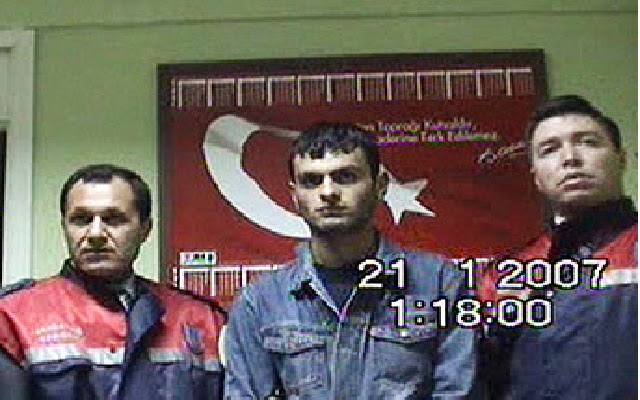
To offer further damning evidence of the neglect -- and quite possibly, involvement -- of elements within the Turkish security forces, one of Dink's assassins, young trigger-man Ogun Samast, posed with police officers in Samsun behind a Turkish flag just two days after the murder. While government officials have complimented themselves on apprehending Samast and other conspirators soon after the murder, adequate explanations for this photograph and the events before the murder have yet to come to the forefront, and according to many of Dink's supporters, have indeed been subject to a massive cover-up in which the state is complicit.
Where Does the Government Fit In?
Indeed, the more than four-year trial of Dink's conspirators has been hindered from the beginning due to an inability, and perhaps unwillingness, to procure evidence from state security offices, as well as government agencies such as the Telecommunications Board (TIB), which only last December turned over evidence documenting phone conversations and text message exchanges between the conspirators. TIB, citing a 2007 provision by the Justice Ministry related to the use of phone records in criminal investigations, had refused to turn over evidence for more than four years following the murder. Video footage of the street on which Dink was shot was erased from cameras soon after the incident, another fact that has led to accusations against the police ranging from neglect to complicity.
As Hurriyet columnist Sedat Ergin points out, efforts, or lack thereof, to hold state officials to account for their role in the murder have given way to serious misgivings on the part of the Turkish public. In 2008, and administrative court acquitted police of neglect while failing to really delve into the events in the days and months before the murder, and in 2009, another effort to investigate the role of security officials was blocked by the Interior Ministry, which at the time and just as today, was controlled by the ruling Justice and Development Party (AKP). The gendarme is the only state organ wherein an official has been found responsible for neglecting to prevent Dink's murder.
Though AKP government officials are always careful to point to the independence and integrity of judicial processes, the fact that the government now has firmer control of the judiciary has caused many critics, both of the government and the investigation into Dink's murder, to point their finger at the government. When the Dink investigation started in 2007, the government did not have the control over judicial organs, such as the Supreme Board of Judges and Prosecutors (HSYK), that it currently wields. (Click here for a bit of insight as to how the AKP has gained more control through amending the constitution to give its elected representatives the ability to appoint members to this body and Turkey's high courts. See also this past post.) The HSYK is currently investigating the presiding judge in the case, Rustem Eryilmaz, as well as prosecutor Hikmet Usta, though on grounds that the two inappropriately spoke out publicly after the verdict rather than that they mishandled the case.
More cogent criticism centers on the government's relation to the police. As Milliyet columnist Metin Munir indicates (luckily, Hurriyet Daily News has translated this column into English, and so it can be read here), the real blame should be placed on the government's failure to prevent the police from hindering the investigation. According to Munir,
Nobody is blaming the government for not interfering with the judiciary; its guilt is in not intervening with the police, with the intelligence organization and in not demonstrating the necessary attention to bring out the truth. In Turkey, judges and prosecutors are not as strong and independent as, for example, in the United States, the United Kingdom or Italy.
While in the West the prosecutor commands the police, in Turkey the police command the prosecutor. This is the truth in practical terms, especially in politically sensitive cases.
The judges are also bound to prosecute whatever is in the indictments presented to them. The government does not command the courts and prosecutors. But it does command the security forces. For this reason, it has its share of responsibility in the verdict the court has ruled. It could have put pressure on the police to provide that a more comprehensive and a stronger file be handed over to the prosecutor. It did not.
The government is still boasting about catching the murderer in 32 hours. This is not a matter to be proud of; it a matter to be ashamed of. Who was going to kill Dink and when it was going to happen were known by security forces days before the murder. If the incident was stopped at that time and the murder was prevented, then yes, it could have been a matter of which to boast. But it is not hugely ingenious to identify the assassin and then catch the killer.
This is what the government has to explain: Why isn’t the entire organization, the one for which the killer acted as a hit man, foiled and punished even if it is five years that have passed since the murder? What is the reason for the systematic reluctance on this matter?
Mustafa Akyol, generally more sympathetic of the AKP, explains that this reluctance might be driven by the fact that many of the bureaucrats and police who neglected to properly investigate Dink's murder (and, my words, not his, but perhaps even cover up critical aspects of the killing) are now aligned with the AKP and have been appointed to key positions within the government. These include not only Akyurek, but also former Istanbul police chief Celalettin Cerrah, headed the Istanbul police at the time of Dink's murder. The government has never allowed Cerrah to be questioned in relation to the case, and in 2009, he was appointed a provincial governorship in Osmaniye. Similarly, the failure of the AKP to put pressure on TIB and the obstructive role of the Interior Ministry throughout the investigation give great cause for concern.
A Chance for Redemption?
Soon after the verdict, Dink family lawyer Fethiye Cetin declared that the effort to unveil the truth behind Dink's murder had only just begun, and it is quite possible this is the case. An indignant Cetin has already appealed to the Supreme Court, which will likely render a decision in one year's time. Hikmet Usta, the Istanbul prosecutor charged with the case, has also made an appeal, joining Cetin in denouncing the court's inability to find evidence that the crime was the premeditated work of a criminal organization as a complete oversight of the facts presented.
New evidence presented on Tuesday to judges overseeing the Hrant Dink case has given further credence to the claim of Dink's lawyers that the Turkish Armenian journalist's murder was the work of an organized effort that included state elements.
Telephone records long sought by Dink's lawyers revealed conversations between the assassins currently on trial and five other people in the vicinity of the crime scene, in addition to 14 other people who were called from the crime scene and had connections to the defendants and other suspects in the case (for Bianet's more detailed report of the evidence presented, click here). For a full account of the hearing from Birgün, which has closely covered the case and positioned itself firmly in line with Dink's lawyers, click here.
The new evidence raises the possibility of another investigation, though judges hearing the unwieldy trial have expressed their desire to conclude it on Jan. 17. If this occurs, even more suspects could be named and evidence put forward that would further link suspects to police in Istanbul and gendarme officers in Trabzon, from where the murder plot was hatched.
Dink's lawyers have long demanded the release of the telephone records at the heart of the new discovery, though the police and the Turkish Telecommunications Directorate (TIB) have been reluctant to turn them over. The records were released to Dink's lawyers just this November after a months-long ordeal and plenty of conflicting excuses from the TIB. Prosecutors in the case maintain there is nothing new in the records, a claim with which the judges hearing it on Tuesday seemed to concur, though this seems hardly the case.
Dink assassin Ogun Samast posing with police officers who arrested him just two days after Dink's murder.
The Istanbul Chief Prosecutor's Office have granted the request of Dink family lawyers that an investigation be launched into the involvement of high-level security officials into the 2007 assassination of Turkish Armenian journalist Hrant Dink. FromHurriyet Daily News:
This is an extremely good, positive development. I hope there will be a result [from] this,” Dink family lawyer Fethiye Çetin told a crowd of journalists during the court recess. She said they were expecting the investigation as they had applied to the prosecutor’s office Jan. 17, demanding that rulings made on the case by the European Court of Human Rights be implemented in Turkey.
The Dink family recently made a new plea for state, police and gendarmerie officials not questioned during the initial investigation to be brought into the scope of the case, basing their request on the European court decision finding Turkey guilty of failing to protect Dink and his freedom of speech and of not properly investigating civil servants suspected of being negligent in the murder and its investigation.
. . . .
The 28 public officials whose testimonies are expected to be taken by Public Prosecutor with Special Authority Mustafa Çavuşoğlu in the coming days include former Istanbul Gov. Muammer Güler; Ramazan Akyürek, the former top head of police intelligence; former Istanbul Police Chief Celalettin Cerrah; Ahmet İlhan Güler, the former Istanbul head of police intelligence; former Trabzon Police Chief Reşat Altay; Col. Ali Öz, the former Gendarmerie Trabzon regiment commander; and Metin Yıldız, the former Trabzon head of gendarmerie intelligence.
Last week President Gul announced that the State Audit Board (DDK) open a separate investigation into Dink's murder. Both investigations are indicators that the government is getting serious about resolving the facts behind Dink's murder. For more on Dink, see past posts.
UPDATE I (2/10) -- Interior Minister Besir Atalay is denying reports that the Istanbul Chief Proescutor's Office has opened up an investigation. Meanwhile newly released phone records verify long-time allegations that police exchanged text messages in the months prior to Dink's assassination. Previous evidence existed that police exchanged phone messages with Tuncel just two hours before Dink's assassination.
UPDATE II (2/15)-- In a new development in the ongoing Dink trial in Istanbul, the Trabzon Chief Prosecutor's Office has announced that it would allow the Istanbul court to question Trabzon police officers in communication with Tuncel up to the day of Dink's murder. Previous requests had been denied.
It was four years ago today that Turkish Armenian Hrant Dink was gunned down in the street and the botched investigation and unwieldy series of trials since have only added to the despair of the loss. On Monday, Dink family lawyers filed another petition with the Istanbul Chief Prosecutor's Office seeking an investigation into the event surrounding his death and implementation of the European Court of Human Rights decision Dink lawyers won last September. The Court found that the Turkish government had failed to conduct an effective investigation into his death, fell short of protecting his right to life, and had violated his rights to freedom of expression. From Hurriyet Daily News:
The family demanded investigations of the police and gendarmerie officials allegedly responsible for the murder, either directly or by neglecting their duties. In their application, they argued that the European court’s decision canceled the authority of certain domestic laws that had previously blocked the path of putting such officials on trial.
Dink, a Turkish citizen of Armenian origin, was murdered in front of the office of the weekly Armenian-Turkish newspaper Agos on Jan. 19, 2007. Confessed killer Ogün Samast was transferred to a juvenile court in October, and his trial separated from the main murder case, due to a legal change he benefited from because he was under the age of 18 on the day of the assassination.
Yasin Hayal, who is accused of abetting the murder, and Erhan Tuncel, a former police informant who claims innocence on the grounds that he told security forces everything he knew months before the murder, are still on trial under arrest. The only suspects left after three years of the trial, they will be released next year if they are not convicted by that time under a recent legal change that limits arrest periods without conviction to a maximum of five years.
From the beginning, lawyers for the Dink family have stated that the murder was not the work of “three to five nationalist youth,” but even the official inspector’s reports concluded that the National Intelligence Organization, or MİT, should be investigated were not enough to allow the questioning of high-ranking suspects from the police, gendarmerie and the MİT.
As they have every year since the first anniversary of Dink's murder, thousands gathered on the street where he was shot to call for the government to hold those responsible to account. For more on Dink and his family's attempts to uncover the details of his assassination, see past posts. For an excellent documentary produced in 2009 on the event surrounding the murder and the subsequent attempts by authorities to cover up their involvement, clickhere.
The European Court of Human Rights (ECHR) has found Turkey to have violated numerous human rights both before and after the assassination of Turkish Armenian journalist Hrant Dink. Dink was assassinated in January 2007 and the investigation that has followed has been tainted by a series of cover-ups and serious judicial mishandling. (For background, click here).
The Court found Turkey to have failed to protect Dink's right to life and freedom of expression, as well as to have fallen short of its obligations to provide for an effective investigation of his murder. In the weeks, months, and years after Dink's murder, numerous high-ranking state security officials and police have been implicated as either falling far short of their duties to protect Dink, at best, and at worst, actively conspiring with Dink's murderers.
During its defense at the ECHR, Turkey argued that Dink did not fear for his life or else would have asked for private police protection. A recent book by journalist Nedim Sener, who this year escaped criminal charges brought against him in relation to a book he published revealing details of the Dink murder and subsequent cover-up, alleges that security officials warned Dink of threats to his life before the assassination. Security officials have denied such knowledge.
The Turkish Foreign Ministry has said it will not appeal the court's decision. It is yet to be seen whether Turkey will provide for a remedy to its previous failure to effectively investigate Dink's assassination.
With eyes focused on Turkey-Israel relations, Turkey's recent vote on Iranian sanctions, and increased PKK violence, the Ergenekon investigation continues onward, as do the trials it has brought in its wake. Among these are of the 33 suspects charged with participating the Cage Action Plan, the mysterious designs of which the Turkish daily Taraf revealed last November. The first hearing for the Cage suspects got underway in Istanbul yesterday.
According to Taraf and a susequent investigation, active and retired military staff plotted to commit mass acts of violence against Turkey's non-Muslim communities in a premeditated effort to cause enough chaos and discontent with the AKP government to force it out of power. These acts of violence allegedly included the assassination of Hrant Dink, as well as the murders of three Christian missionaries working at Zirve publishing house in Malatya and Catholic priest Andrea Santoro in Trabzon. The group is thought to have also been hatching further actions.
At yesterday's hearing, the 12th High Criminal Court in Istanbul granted the Turkish-Armenian Agos newspaper, of which Dink had been the editor, joint plaintiff status, allowing Dink lawyers to participate in the hearings. Fethiye Cetin, who has long advocated on behalf of the Dink family and the Hrant Dink Foundation to bring the shadowy operation surrounding Dink's murder to light, argued that the alleged conspirators had long waged a campaign of intimidation against the paper and was responsible for Dink's murder. Two separate trials involving Dink's murder ae currently ongoing, and have been plagued with problems and continued coverups.
The defendants denied the allegations, arguing the document laying out the plan is a hoax. They had requested to e tried in military court, stating that the civilian court in which the case is being tried had no jurisdiction. The court denied their request while granting that of Agos. For an account of the hearing, see this report from Bianet.
The Cage suspects face 7 to 15 years in prison for being memers of an armed terrorist organization.
For more on the Cage Action Plan, see Jan. 25 post.
UPDATE I (6/18) -- The second hearing took place yesterday at which alleged "Cage Plan" ring leader retired Vice Admiral Ahmet Feyyaz Ögütçü gave his defense, dismissing the charges against him as based on a series of fabrications and hoaxes that are part of a conspiracy designed to weaken the Turkish Armed Forces (TSK). For an account of the hearing, see this report from Bianet. A third hearing is taking place today.
Milliyet journalist Nedim Sener was acquitted Friday after being charged in relation to his book looking into the Dink murder and subsequent investigation. From Hurriyet Daily News:
The journalist faced trial for “making targets of civil servants,” “obtaining secret documents” and “exposing secret documents” in his book, “Hrant Dink Cinayeti ve İstihbarat Yalanları” (The Hrant Dink Murder and Intelligence Lies).
The court concluded that some of the plaintiff names were already known by the public before the book’s release and that the so-called secret documents in the book were accessible in the Dink assassination case before its publication.
“I do not approve of the case’s participants washing their dirty hands with this file,” said Şener, who attended the hearing, as did one of the plaintiffs, security officer Muhittin Zenit. Two of the case’s other plaintiffs, security officers Ali Fuat Yılmazer and Faruk Sarı, were represented by their lawyer at the hearing. The lawyer of plaintiff Ramazan Akyürek did not attend the hearing.
“Since my code name was uncovered, I have become a target of terror organizations. The change of my code name will not amend the situation,” Zenit said at the hearing.
Public Prosecutor Celal Kara repeated his request on the case, demanding a one- to three-year prison sentence for Şener on the count of “making targets of civil servants fighting terrorism.” He dropped the other charges since the “secret” documents in the book were no longer classified.
Şener’s lawyer Yücel Döşemeci said Zenit’s name and code name were mentioned in the indictment at the court dealing with the Hrant Dink assassination, and that Akyürek’s assignment was announced in the Official Gazette. “My client has not written on anything other than what is already known by the Istanbul court,” Döşemeci added.
For more in-depth coverage of the trial, see Bianet. Sener's trial helped bring Dink's murder back into the public conscience when former Intelligence Unit Chief Sabri Uzun's testimony in his trial verified information in Sener's book: some intelligence officers working surveillance on Dink's assassins had hidden/falsified information before Dink's murder (see April 29 post). For more background, see Feb. 11 and June 28, 2009 posts.
In other news on the Dink front, Dink family lawyer Hakan Karadag was found dead in his house on Friday, though initial reports from those close to him indicate that Karadag probbably committed suicide. Additionally, the trial of eight gendarmerie officers in Trabzon continued on Monday, and is expected to wrap up with the defense of the officers of July 28. Dink lawyers are still requesting that the Trabzon case be merged with the case in Istanbul, but to no avail.
The AKP has submitted a proposal to parliament to open a parliamentary investigation into the murder of Hrant Dink. Prosecutors involved in the Cage Action Plan, part of the larger Ergenekon investigation, have said that the Dink investigation is going nowhere and does not include all of the suspects involved. The Dink case emerged once more into the public conscience earlier this month when former Intelligence Unit Chief Sabri Uzun testified in the case of journalist Nedim Sener, who stands accused of " "identifying officials on anti-terrorist duties as targets." Uzun's testimony verified that intellgence officers involved in the case hid vital information about the murder before it happened and falsified reports. For more on Uzun's testimony in the context of the Sener case, see Bianet's report. In other Dink-related news, the 2nd Magistrate Criminal Court in Trabzon still refuses to merge the case of eight intelligence officers charged with negligence with the case currenty underway in Istanbul. For more on the Dink case, see past posts.
The lawyers of the family of murdered Turkish-Armenian journalist Hrant Dink filed a criminal complaint against Istanbul Deputy Governor Mustafa Güran because he refused to hand them a copy of attachments of the report regarding the murder. Dink, then editor-in-chief of the Armenian Agos newspaper, was shot in front of his office in Istanbul on 19 January 2007.
Joint attorney Fethiye Çetin said that they applied to the Istanbul Public Chief Prosecution for an investigation related to allegations of "misconduct in office," requesting a trial eventually be launched.
The coming hearing in the murder case will be held on 10 May. On the same day, the "Friends of Hrant" will come together once more at the Beşiktaş Pier in Istanbul to call for justice.
UPDATE II (5/11) -- The tenth hearing of the Hrant Dink trial that took place yesterday included testimony from a secret witness who confirmed that Ogun Samast did not act alone, but was accompanied by Yasin and Osman Hayal. For the story from Today's Zaman, click here.
UPDATE III (5/17) -- The Istanbul Public Prosecutor's Office has rejected Dink lawyer Fethiye Cetin's application for a special prosecutor to look into what Dink's attorneys assert was an unquestionably wide-reaching and organized assassination operation.
Another small bit of justice was issued to the Dink family this week when a an Istanbul court found the state-owned Turkish Radio and Television Broadcasting Corporation guily of defamation for airing a documentary making unfounded accusations that Dink was responsible for the 1978 Maras massacres. After a long court battle (TRT ran the documentary in December 2008), the court ordered TRT, Bey Productions Company (the company that produced the documentary), and Maras MP Okkes Sandiller (a prime suspect of the Maras massacres who made the accusation) to pay a total of 20,000 TL in compensation. For more on the case, see this article from Bianet.
Last week resulted in another small victory. Criticizing the Interior Ministry's report of the Hrant Dink investigation as cursory and artificial, the Prime Ministerial Review Committee (BTK) has opened up the possibility of a new investigation -- a long-time demand of of the Dink family and those supporters and activists who continue to demand justice fromthe state. From Radikal's Tarik Isik (translated by Hurriyet Daily News):
The board objected to the report on the grounds that “its findings just skimmed the surface.” The Interior Ministry’s inspectors completed the report about the 19 police officers, including head of the Central Police Intelligence Unit Ramazan Akyürek, on Nov. 9. Akyürek was the police chief of Trabzon prior to Dink’s murder in Istanbul three years ago.
Hrant Dink’s wife, Rakel Dink, had applied to the BTK, which released a report. After the board’s report, the Interior Ministry prepared another report saying it was not necessary to start an investigation of the 19 police officers.
BTK wrote a statement on Jan. 18 saying it did not agree with the results of the ministry’s report. The statement said the role of the head of the Central Police Intelligence Unit to prevent the murder cannot be ignored.
“It is still doubtful whether the necessary measures were taken upon the notices given by former police informer Erhan Tuncel in Trabzon before the murder of Dink,” read the statement, which added that there are still doubts the intelligence information has been carefully evaluated. Tuncel said he warned the Trabzon police about Dink’s murder.
BTK also said the civil inspectors of the Interior Ministry exceeded their authority by preparing a “research report,” as they were only asked to make a preliminary investigation about the 19 officers. A preliminary investigation includes collecting information and documents about the investigated people and submitting it with the opinions of the inspectors. But the “research report” is more detailed than that.
The Prime Ministry’s statement does not make the Interior Ministry’s report invalid, according to the law. But, it is a message to the ministry. Interior Minister Beşir Atalay plans to prepare a new report upon the BTK’s statement said some sources.
The BTK is directly tied to the prime minister and one of its duties is to investigate, research and control public occupational institutions.
For more on the Dink investigation, see past posts.
Özgür Mumcu (L), the son of slain journalist Uğur Mumcu; Rakel Dink (2nd from L), the widow of journalist Hrant Dink; Sezen Öz (2nd from R), the widow of prosecutor Doğan Öz; and Nukhet İpekçi (R), the daughter of the late journalist Abdi İpekçi, attended the 12th hearing of the Dink trial on Monday. PHOTO from Today's Zaman
The twelfth hearing of the Hrant Dink murder case is taking place in Istanbul this week, and the concealing of evidence continues. At the hearing, joint attorneys of the Dink family repeated requests that the security institutions indicated to have played a role in the murder be investigated. These include the National Intelligence Organization, the Istanbul Police Directorate, the Trabzon Police Directorate, the Trabzon Gendarmerie Command and the Intelligence Office Branch of the Police General Directorate. Past government investigations made at the behest of the family have cleared security services of any such role, but evidence that might indicate otherwise remains unavailable to prosecutors, classified as "state secrets" critical to national security. The court rejected requests that statements be taken from Head of Intelligence Department Ramazan Akyurek and Muhettin Zenit.
The Dink lawyers also requested that invetigations be made of persons who had concealed evidence, including just how footage from the AK Bank security camera documenting activity on the street where Dink was shot came to be deleted. Also requested was an investigation into a group that legally targeted Dink and might well have incited his murder. Members of this group have tried to disrupt past hearings, as well as harassed Dink's attorneys. Also significant were requests that the Dink investigation be looked into as possibly part of the Cage Plan (part of the Ergenekon investigation), which was allegedly devised by the Naval Forces Command and laid out plans to create disorder by assassinating members of Turkish minority groups.
This hearing had many of the same problems as previous hearings, including trouble attaining testimony from a secret witness to the murder. "Secret Witness #1" watched two men shoot Dink, one from in front (Ogun Samast) and one from behind (Yasin Hayal). The same witness saw Yasin's brother, Osman Hayal, at the murder scene. Osman is among twenty defendants, but is not being detained.
Rakel Dink, Hrant's widow, was joined by relatives of other political murder victims whose cases remain unsolved. Filiz Ali, daughter of prominent author Sabahattin Ali, who was assassinated in 1948, read out a joint press statement. It has been translated by Bianet. (I am not sure if the translation is of the entire statement, or simply contains excerpts. I suspect it is the latter, and so have used ellipses between what Bianet quotes.)
Most of our cases have already been closed since they reached the statute of limitation. As far as the Dink case is concerned, it is still in the process of being concealed. The crimes have not yet fallen under their statute of limitation.
. . . .
The state has still got the possibility to dissociate itself from the infiltrated and destructive focus in order to reveal the truth. Even with a murder as well concealed as this one, we still have the opportunity not to hand down this contempt of the state to the generations coming behind us, these affiliated crimes constituted after the murder.
. . . .
We are not here based on feelings of hatred, anger and revenge. We are here because of our responsibilities as citizens and because of our never-ending demand for justice. We are part of an ever growing family living in a country where people are getting killed constantly. We do not want the number of our family to increase any further. We hold all state institutions responsible for revealing the organizations behind the murders of our relatives. They will all remain guilty in our eyes until the truth will have been revealed. And they will convey the thought that they can easily commit this kind of crime any time.
. . . .
We came here to make our voices heard to the ones carrying the official capacity, addressing the ones in responsible positions. We are not addressing the people in despair who are sensitive about this issue. We came here to be together with Rakel Dink and our friends Arat, Delal and Sera. We are interveners in this trial as well and today we will follow up that the list of demands submitted by the lawyers will be taken into account by the court.
. . . .
We did not come here to have the pain and sorrow of our families depicted in the press but to pass on our demand for justice.
The next hearing is set for May 10.
UPDATE I (2/12) -- 19 representatives of the "Deep Families" are meeting with members of parliament to discuss a petition to establish a parliamentary investigate commission to look into their relatives' unsolved murders. Also, a bit of disturbing news: the website of Agos newspaper, of which Dink was editor-in-chief from its found in 1996 to his murder in 2007, was hacked by someone who posted a picture of Samast in praise of Dink's assassination. The hacker also made threats against supporters of the paper. Agos has long been subject to intimidation and illegal harassment, which lawyer for the paper and the Dink family, Fethiye Cetin, claims have and are not receiving the attention by the judiciary and police they deserve.
UPDATE II (2/12) -- The Greater Istanbul Municipal Assembly has rejected a proposal to officially change "Ergenekon Street" in Sisli to "Hrant Dink Street." (For history, see Jan. 23 post). The proposal was submitted by Ozgen Nama from the CHP, and had the support of most other (if not all) CHP representatives. However, a majority of the seats in the assembly are controlled by the AKP, and these representatives voted down the proposal. The name of "Ergenekon Street" will stay as it is. Today's Zaman's Orhan Kemal Cengiz has a column condeming the AKP assembly members for their vote. Why did these AKP assembly members, most of whom are undoubtedly supportive of the Ergenekon investigation, vote against the CHP proposal?
UPDATE III (2/20) -- Vatan journalist Kemal Goktas is facing five eyars in prison following the publication of an investigative book about Dink's assassination, including allegtions against Akyurek, who initiated the criminal charges against Goktas. At a hearing on Tuesday, Goktas' lawyer,Filiz Aydin, argued the case was not filed properly, exceeding a statute limiting the time frame in which charges may be brought. Goktas will have another hearing on May 11, at which time judges should rule on the merits of Aydin's argument. Goktas is on trial for publishing a classified document revealing information about Hayal passed between the Trabzon Police Directorate and the Istanbul Intelligence Branch Directorate.
In another case, Milliyet journalist Nedim Sener is facing at least 20 years in prison for charges stemming from his own investigative book into the murder. Samast, a juvenile at the time he was involved in the Dink assassination, faces a sentence of 18-24 years, though there are indications it might be less. Samast was recently married to a young woman from Trabzon at the F-type prison in Kocaeli where he is awaiting trial. Last summer, Samast threatened members of the Dink family, telling them to "wait five years." See this statement from PEN in regard to Sener.
Bianet has now released its full annual report of media freedom violations in 2009. From the release:
The process of the "Kurdish initiative" imposed a muzzle to freedom of expression. The 2009 Media Monitoring Report by the Independent Communication Network (BİA) Media Monitoring Desk revealed that 323 people, among them 123 journalists, were tried in the context of freedom of thought and freedom of expression.
Three years after the murder of Turkish-Armenian journalist Hrant Dink, the state's indifference to violence against journalists lead to the death of Güney Marmara Yaşam newspaper editor-in-chief Cihan Hayırsevener. Hayırsevener was writing about organized crime and corruption in tenders.
The Anti-Terror Act (TMY), which was not accounted for as "in contrary to the Constitution" by the Constitutional Court, silenced nine newspapers and magazines: Günlük, Özgür Yorum, Politika, Ayrıntı, Azadiya Welat, Özgür Mezopotamya, Demokratik Açılım and Atılım newspapers and Aydınlık magazine. One-month publication bans were imposed once or in some cases more than once.
The report tackles the struggles and cases of 978 people. Violations of freedom of expression are divided into the following sections: Attacks and Threats, Detentions and Arrests, Cases on Press Freedom and Freedom of Expression, Corrections and Seeking Justice, European Court of Human Rights, Reactions to Censorship and Punishments by RTÜK.
47 people, 22 of them journalists, were prosecuted in 2009 under charges of "publishing pronouncements of terror organizations", "spreading propaganda for an illegal organization" or "revealing people struggling against terrorism as targets". 23 people were sentenced to 58 years imprisonment and monetary fines of 9,749 Turkish Lira (TL) (€ 4,640). However, this is a small number compared to 44 convicts and thus twice as many convictions under the TMY in 2008.
. . . .
34 journalists among 101 Turkish citizens were sentenced to 98 years and five days imprisonment and compensation claims summing up to TL 1,408,680 (€ 670,800) under charges of "attacks on personal rights". Local courts in 2009 decreed for a total of nine years, three months and 6 days imprisonment and monetary fines of TL 41,290 (€ 19,660). In the previous year, 74 people received prison sentences of 77 years and faced compensation claims of TL 1,885,500.
The report also documents relevant decisions made at the European Court of Human Rights (ECHR), as well as new applications the ECHR received last year.
The European Court of Human Rights (ECHR) convicted Turkey to a total fine of TL 472,392 (€ 225,000) in compensation. In the previous year, this amount added up to TL 183,801 (€ 87,525). 11,100 complaint files concerned with Turkey are currently waiting to be dealt with at the ECHR.
26 employees of Ülkede Özgür Gündem, Gündem, Güncel ve Gerçek Demokrasi newspapers sought their rights at the ECHR together with Seyithan Demir, İsmail Kara, Ömer Bahçeci, Fikret Turan, Cihan Öztürk, Aziz Özer, İbrahim Güçlü, Sedat İmza, Ayhan Erdoğan, Mehmet Cevher İlhan, Rüya Kurtuluş, Erdinç Gök, Haşim Özgür Ersoy, İnci Açık, Serpil Ocak, Ayfer Çiçek, Nuri Günay and Murat Kaya.
The following new applications were made to the ECHR in 2009: the Hrant Dink murder, publication bans imposed to Özgür Mezopotamya, Özgür Görüş, Rojev, Siyasi Alternatif and Süreç newspapers, Internet Technology Association (INETD) in regard to the ban of youtube.com, Birecik'in Sesi newspaper official Şevket Demir, Siirt Mücadele newspaper owner Cumhur Kılıççıoğlu, Cumhuriyet newspaper journalist Alper Turgut, Cevat Düşün from Alternatif newspaper, Vakit newspaper writer Abdurrahman Dilipak and Taraf newspaper journalist Orhan Miroğlu.
Sigh.
I cannot find the full report, but when I get it, I will be sure to sidebar it under "Key Documents."
Human Rights Watch (HRW) recently released its World Report, a country-by-country survey of the status of human rights across the world. While HRW praises the Turkish government's recent Kurdish initiative, it notes problems in Turkish courts' treating of PKK supporters the same as armed militants under Turkey's Anti-Terrorism Law. Specifically, the report mentions the number of children who have been tried under the Law. HRW also criticizes the ease of bringing charges against supporters of Kurdish rights by claiming they are members of the PKK.
Torture, detention, killings by security forces, and prison conditions remain par for the course, as does impunity (including Hrant Dink's assasination) and restrictions on the freedom of expression. Of particular concern for HRW is the Court of Cassation's unwillingness to apply the European Convention on Human Right and Fundamental Freedoms in its case law, which continues to result in Turkish citizens submitting more petitions to the Court than the citizens of any other state in the Council of Europe.
On Europe, HRW continues to see Turkey's bid for European membership as "the most important international actor with the potential to foster respect for human rights in Turkey."
The report does laud the military courts law the government passed in June, but which was just last week overturned by the Constitutional Court.
A crowd of around 3,000 people gathered on Tuesday to commemorate the third anniversary of the murder of Hrant Dink, the prominent Turkish Armenian journalist who was slain outside his home by an ultranationalist youth in cooperation with a larger group of ultranationalists speculated to have links to local and national security forces. The Dink murder is speculated to have ties to deep state elements currently being investigated as part of the rather unwieldly and broadly encompassing Ergenekon investigaton. Dink's assassination and the possibility of a wide-reaching coverup have become a rallying cry for progressive reformers. At the end of the commemoration, demonstrators replaced a Sisli street sign reading reading "Ergenekon" with another, re-naming the street for Hrant Dink
The photo posted here is of Dink's assasin, Ogun Samast, and the officers who arrested him. This photo and similar video footage, along with withheld and disappeared evidence and documents like this one proving that security forces iknew about the assassination plot before it took place, have all given reason to think that Dink's assassination involved a large number of people, some perhaps deep within the state structure. The Dink murder trial is still underway, hampered by a variety of difficulties, including the harassment of Dink's family, supporters, and attorneys. Last July, the Prime Ministry Inspection Board released its report of an investigation into security forces' potential neglect/involvement in the Dink assassination. Though critics claimed the Ministry watered it down, the report does indicate that security officials had reason to think the assassination was impending. Much has been made of whether evidence was properly shared with police in Istanbul, and whether officials of the Istanbul Intelligence Unit were also involved.
20 suspects in addition to Samast are also on trial, but in different courts, including eight gendarmerie officers on trial in Trabzon for negligence. Dink's supporters want the trials merged and a comprehensive investigation into all possible elements involved in the murder, arguing that their own future security is also at stake as long as responsible parties enjoy impunity for their crimes. In July, a court in Istanbul ruled against a petition that an investigation be opened into the role of Istanbul Police Chief Celalettin Cerrah and seven other officers, one of many examples cited of officials' refusal to conduct a proper investigation. Friends of Hrant, an organization of Dink's supporters, this week issued a statement reiterating its demands. Lawyers have applied again to the European Court of Human Rights on the grounds that Dink's right to life was violated by the state's failure to protect him, as well as other rights that have been violated in the course of the investigation and trials.
For more on Dink's murder and its aftermath, see this excellent 2009 documentary, "For Hrant, For Justice," by Umit Kivanc. (Thanks to Jenny White and Bulent, who posts on this blog as well.)
UPDATE I (1/27) -- In a speech commemorating Hrant Dink, Canadian journalist and human rights activist Naomi Klein used the podium to argue the government of Turkey gives Israel a public relations weapon when it violates the rights of Kurds and Armenians while at the same time criticizing Israel. A strong critic of Israel, Klein lauded Prime Minister Erdogan's denunciations of Israeli war crimes, but noted what she considers the hypocrisy of the Turkish government's position. Hürriyet ran a piece covering the speech, though I doubt it got more attention outside of the English-language press.
UPDATE II (2/8) -- The investigation launched by the Interior Ministry at the behest of the Prime Ministry Inspection Board has cleared 19 police officers working in the National Police department's intelligence unit and the Trabzon local police. The Prime Ministry Inspection Board prompted the investigation at the petition of Dink's wife.
Nedim Şener, a columnist for Milliyet, faces a 28 year sentence for publishing a book documenting negligence of municipal police, the gendarmerie, and the Turkish secret service prior to the murder of rant Dink in January 2007. Şener's book, The Dink Murder and Intelligence Lies, was published in January, after which a police officer working in in the intelligence unit in Trabzon filed a complaint against Şener alleging the journalist had violated Turkish law by "targeting personnel in service of fighting terrorism, obtaining secret documents, disclosing secret documents, violating the secrecy of communication and attempting to influence fair trial." From Hürriyet:
After the investigation’s end, Prosecutor Selim Berna Altay charged Şener with "making targets of the personnel in service of fighting terrorism, and obtaining and declaring secret information that is forbidden to be declared," asking for a prison term of 20 years. Since they do not fall under his authority, Altay sent the dossier on "violation of the secrecy of communication" and "attempting to influence fair trial" to the Istanbul Second Court. In the meantime, it was also claimed the book contained the offense of "insulting governmental institutions," and that too was added to the second investigation. Prosecutor İsmail Onaran handled this investigation and filed a second case against Şener asking for his imprisonment for three to eight years.
Ogün Samast, the man charged with pulling the trigger in the Dink murder, faces a 20 year sentence by comparison. Some of the intelligence officers who have been made plaintiffs in the case against Şener are facing charges in relation to their negligence in the Dink murder in Trabzon.
The Council of Europe and the Organization for Security and Cooperation in Europe (OSCE) has condemned the trial as a violation of press freedom guaranteed in OSCE countries. In a letter to Foreign Minister Ahmet Davutoğlu, Miklos Haraszti, the OSCE Representative on Freedom of the Media, asked Turkish authorities to drop the charges.
Şener is prosecuted in defiance of freedoms that both OSCE commitments and Council of Europe standards grant to critical publications . . . . What he did was critically assess the events leading up to Hrant Dink's murder, and the deficiencies afterwards in the handling of the case and in the prosecution of the perpetrators.
Şener faces charges of violating state secrecy laws -- which he denies, claiming information he attained can be accessed via the Internet -- and for attempting to influence the judiciary, a charge under the Turkish Penal Code that has been levelled against numerous dissidents of state action. Milliyet editor Sedat Ergin has stood solidly beside Şener throughout the proceedings.
Although Şener may not be convicted, the fact that a prosecutor decided to press ahead with the case is very troubling, the message of the prosecution appearing to be that even publishing the truth can be a punishable offense. The case also serves as another indication that, despite training programs for prosecutors and judges and efforts at reform, Turkey's judiciary main concern remains protecting the state and its institutions, rather than safeguarding the rights of individuals.
Today marks the two-year anniversary of journalist Hrant Dink's death. Nationalist thugs shot down Dink outside his house, and after their arrest, appeared in posed photographs with smiling police. Police and security forces were involved in Dink's death, but so far only two gendarmerie officers have been put on trial. Charges widened this past December when the Trabzon Chief Prosecutor's Office launched a preliminary investigation into Ali Öz, former Trabzon Gendarme Regiment Commander. Speculation exists that the Ergenekon gang executed the assassination, though details -- as with other charges against the group -- are murky, and obscured by politics.
In Hürriyet, Dink's lawyer, Fethiye Çetin, recounts Dink's fear a few days before his death. Bianet offers a summary of trial proceedings thus far. Memorial demonstrations will occur throughout Turkey.
Worth re-posting on this occasion are Ece Temelkuran's reflections on Dink's death, excerpted from a column she wrote in the Guardian last January.
Recently, a couple of high school students sliced their fingers and made themselves bleed on purpose. They used their blood to paint a Turkish flag. It wasn't a small one, either. They framed the picture and sent it to the chief of military. He cried when he received the "bloody mail"; and reporters were there to witness and report about the sacred flag.
The story of the bleeding didn't end there, though. A few days ago, a conservative and nationalist newspaper (Tercüman) decided to print the picture of the flag drawn with children's blood. And so the blood multiplied as the circulation of the newspaper increased.
If this doesn't seem strange at first, a bit of perspective soon allows you to see the apocalyptic scenery here, which resembles Bosch's paintings of hell. And you realise that the apocalypse started when our friend the Armenian journalist Hrant Dink was shot. He was shot a year ago this week, and a Hollywood-like series of events ensued. People who were touched by the horrible incident were on streets, thousands of them shouting the slogan: "We are all Armenian, We are all Hrant Dink." The slogan touched the weakest link in Turkish nationalism and a counter-slogan by the established writers and prominent opinion leaders was brought to the public stage: "We are all Turks!"
The fever of McCarthyism, as we all know, is the most contagious fever of all and the Turkish public was contaminated overwhelmingly. Soon after this, and just before the elections, the protest demonstrations against the ruling party AKP's Islamisation policies - called "mild Islam" - were combined with this nationalist uprising under the name of "flag meetings". All of a sudden, things got out of control and the streets were full of young rednecks calling to account anyone who didn't hang flags from their balconies. One night Istanbul's Kurdish districts almost reached boiling point, as young men gathered in front of buildings and shouted for Kurdish people to come out. While the media didn't do anything to praise these scenes, it still - with the exception of a few columnists who dared to speak of their concern about the nationalist atmosphere - approved the driving force behind them. Things got so serious that I remember how one night, during a political meeting of intellectuals in Istanbul, we talked about establishing an emergency network so that if something should happen to one of us the others would find out about it.
After a little while we understood what this contrived crisis was about. The army, together with AKP, decided to carry out a big campaign against PKK. The war began. The news bulletins immediately took on the appearance of Fox TV during the Iraq invasion. "We" was the subject, "cleaning" was the verb and the targeted object was always "them", as if Kurds don't live in Turkey. As if the militants of PKK who are bombed don't have relatives in the Kurdish part of Turkey. But who would dare to ask such questions when the streets were strewn with flags and the nationalist gangs were made out to be the "legitimate" ones?
The war - or, as they call it, the "operation" - is still going on: a hygenic war where you see only the rifles, bombs and thermal camera footage broadcast on the TV news, accompanied by a primitive militaristic commentary. Not forgetting, of course, the footage of martyrs' coffins with sad music playing in the background, as if this whole thing is not happening to us but is part of some Middle Eastern version of Saving Private Ryan. But the film that began with the shooting of Hrant and the nationalist uprising that followed brought us to where we are now. Schoolchildren, probably with their parents' and teachers' consent, send their blood to the chief of the army in a glittering frame.
This is the apocalypse of Turkey. The apocalypse in which most of us cannot dare to say that blood only stains a flag.
And if the Turkish flag needed to be a deeper shade of red, Hrant's blood was more than enough. My dear friend was writing his last article 52 weeks ago, saying that his heart was a "timid pigeon" waiting for bad things to happen. Now, after his death, we have all stepped into an era where I can say: "They shoot the pigeons, don't they."
The sixth hearing of those accused of assassinating Armenian-Turkish journalist Hrant Dink took place in İstanbul yesterday. The investigation into Dink's murder and the trial of the arrested suspects has put on display systemic problems in Turkey's judiciary. As I posted in January, the investigation has been long criticized as weak-willed and has hit a number of brick walls, including the destruction of evidence (see Jan. 24 post). The trial has been little better.
Acting as the trigger-man in what is likely a very wide-reaching conspiracy, Ogün Samast gunned down Dink outside of his office in January 2007. Samast was accompanied in the assassination by Yasin Hayal, a 26-year-old ultra-nationalist with links to shady paramilitary groups (possibly Ergenekon) and the youth branch of the ultra-nationalist Grand Unity Party (BBP), the Alperens. At the beginning of his testimony, Hayal declared: "Dear Muslims and dear Alperens [BBP ultranationalist youth organization], be relaxed. We will have this situation continue until the BBP comes to power." Apart from Hayal and Samast, six others continue to be detained. Most significant of these is Erhan Tuncel, who is suspected to have played a key role in the premeditated conspiracy. A total of nineteen people are being tried in Dink's murder, but only Hayal and Tuncel are facing life sentences.
Yesterday's hearing was the first open to the press since the assassin has been under the age of 18 at each of the previous hearings and it proved a circus. Reports of past closed hearings characterized the proceedings as chaotic, confusing, and even light-hearted. Some of the defendants have grinned at each other and testimony has bordered on the ridiculous. Public observation of the sixth hearing indicates that these reports have been true and highlights a serious problem in terms of the state's ability to carry out highly complex and politically sensitive trials. Among such criticisms is the fact that trials concerning the same case have not been combined and that a great deal of finger-pointing and bizarre evidence has been enabled and has served only to further obfuscate what actually happened. Further, several of those involved have been handled with impunity. The feebleness reflected in the Dink trial evidences how hard it will be to carry out the trial of the Ergenekon suspects.
The most troubling note to come out of today's testimony is that members of the gendarmerie, a branch of the Turkish Armed Forces, were informed about the plans to kill Dink and did nothing. Testimony from the assassin's uncle, Coşkun Iğcı, revealed that gendarmerie forces in Trabzon were repeatedly warned of the conspiracy. It has been suggested that the plot was also known by members of the İstanbul police. Sadly, the truth may never be known. However, in a positive development, the court did decide to broaden the investigation into Hayal and is seeking critical records that might reveal important information about Hayal's connections, a move that deepens the investigation.
In his column in Today's Zaman, Yavuz Baydar discusses the growing despair surrounding the case.
Turkey is in a state of flux. Founded in 1923 amidst the ruins of the Ottoman Empire and very much a product of modern nation-state ideology, the emergence of Turkey is one of the great stories of the last century.
Although the Turkish state is still quite strong, an increasingly globalized, albeit incipient, civil society has come to challenge its hegemony and singular notions of "Turkishness." Growing numbers of Turks are demanding human rights reform and a more democratic society. At the same time, politics remains a largely elite affair, minority and cultural rights go largely unrecognized, nationalism remains a potently virulent force, and political stability is still a matter of concern. Unrest in the Kurdish southeast, anti-democratic maneuverings to curb civil liberties and close political parties, repression of political dissent, and a questionable human rights regime raise real concerns for the future of Turkish democracy.
A candidate for accession into the European Union, Turkey stands at a crossroads—will it move toward the postmodernity of Europe, or will it forge an ultimately separate path? Will Turkey provide one of the amazing political stories of the twenty-first century, and what does its political development and changing geopolitics have to say about the future of world politics?
Ragan Updegraff has closely followed Turkish politics for over six years, working as a political consultant, journalist, and analyst along the way. His work has appeared in the Journal of Democracy and the Jerusalem Post, among various other publications, and he has been interviewed by Voice of America, The Guardian, and The Telegraph. In 2009-2010, he was a United States Fulbright Research Fellow and studied the impact that Turkish legal reforms undertaken as part of Turkey's European accession process were having in transforming Turkey's relations with minority groups, in particular its nationalist Kurdish population. He also studied EU assistance to Turkish NGOs working on minority right issues. He continues to closely monitor events in Turkey from Washington, D.C.
Email Me




 Posts
Posts

