The President's State Inspection Board today released its report on the assassination of Hrant Dink. The 649-page report comes one month after the court hearing the case of 18 defendants accused of organizing the plot found no evidence to establish a connection that Dink's murder was not but a random act of violence carried out by a few ultra-nationalist youth--not the state-linked conspiracy which Dink's lawyers and supporters have alleged was at work. For background, click here. The report, though not binding, sends a powerful message to the Supreme Court of Appeals to re-open the investigation and commence a new trial, a decision that should come by year's end.
The State Inspection Board decided to release its report following the public outcry after the Dink trial came to a close, which at the time the president and other AKP officials cautiously denounced while urging the public to wait for the appeals process to come to an end. Its contents blame Dink's death in part on the negligence of state officials, and suggests that the trial of those officials should have never occurred separate from the trial of the 18 defendants, a point argued by Dink's lawyers from the very beginning.
According to Milliyet, the report also documents lack of coordination between the gendarme in Trabzon and police in Trabzon and Istanbul, as well as calls into question the Samsun police officers who were shown posing with Dink's young killer, Ogun Samast, days after the murder. Just as importantly, it calls into doubt the work of the Istanbul court and its verdict, citing that the investigation failed to take into account possible connections between the accused conspirators and state officials.
UPDATE I (2/25) -- The full verdict of the Istanbul court has been released one month after being announced. It points to the possible existence of links between the conspirators and the state, but as the chief judge Rustem Erilyilmaz told media soon after the trial's conclusion, argues the court lacked evidence to issue a ruling on the matter.
Perhaps no issue is more revealing of the struggle for liberal democracy in Turkey than the assassination of Turkish Armenian journalist Hrant Dink and the trial of members of a likely state-linked organization that gunned him down on Jan. 19, 2007.
Almost five years to the date of what was a very calculated murder, the Istanbul court hearing the case of 19 defendants accused of participating in the conspiracy to slay Dink ruled on Jan. 17 that there was indeed no organization, no conspiracy. Instead, the court portrayed the assassination as a random act of violence carried out by two ultra-nationalist youths acting alone. The court did not even touch the issue of links between state officials and the organization that have been revealed in the five years following the assassination. For more on the verdict from Reporters Without Borders, click here.
Not a Random Act of Violence
Dink presaged his murder, telling friends before his murder "that his heart was a 'timid pigeon' waiting for bad things to happen (see June 26, 2008 post). Dink had begun receiving threats from ultra-nationalists in 2004 following an article he wrote for the Turkish Armenian paper Agos, over which he presided as editor. In the article, Dink claimed that Sabiha Gokcen, Ataturk's much beloved adopted daughter, was an Armenian orphan. The article earned him the scorn of then Chief of General Staff Yasar Buyukanit, who denounced the article as a crime against national unity.
Before 2006, Dink had been subject to numerous court cases because of his questioning of an ethno-national conception of Turkish identity and his writing on the 1915 massacre of tens of thousands of Armenians. Throughout his work, Dink tried to bridge divides between Turks, Armenians, and Turkish Armenians, challenging both Turkish and Armenian identity, polarizing approaches to the genocide issue, and the general recalcitrance of the two sides. He did this as only a Turkish Armenian could, and his thinking challenged fellow Turkish citizens and ethnic Armenians alike. Most of all, Dink represented the expression of difference -- not just being different, but expressing it, and doing so always as an individual guided by free thought and its commensurate dignities. His writing, and that he attracted so many fans, Turkish and Armenians, is a testament to where Turkey has come since its founding and the longing for liberalism shared by so many of its citizens.
Yet not all were so content with Dink's ideas, his constant challenging of Turkish state and society. In 2004, Dink began receiving numerous death threats. The gravity of their danger to Dink's life prompted the deputy director of security in Istanbul to order police in Bakirkoy, where he lived, and Sisli, where he worked at Agos, to make provide for his protection.
In February 2006, intelligence of the murder conspiracy to which he would soon fall victim made their way from police in Trabzon to Istanbul. The memo from security officials in Trabzon stated, and quite simply, that Yasin Hayal, a known ultra-nationalist in the Black Sea province, was going to kill Dink. Less than one year later, Hayal, acting alongside 17-year-old gunman Ogun Samast, gunned down Dink outside Agos's offices.
Yet it seems the memo, ranked "low priority" by Trabzon police chief Ramazan Akyurek, was not paid much attention, if any, by Istanbul police, and little action was taken by either authority nor the gendarme in Trabzon, who were also watching the conspirators, to halt the assassination. Akyurek has since been promoted to head the Board of Inspectors in the General Directorate for Security. Dink knew his death was coming, and so did members of the Istanbul and Trabzon police, as well as the Trabzon gendarme. Meanwhile, Nedim Sener, one of the journalists who took the Dink investigation seriously and documented what the police knew before the murder, has been jailed on charges of being linked to the Ergenekon terrorist organization.
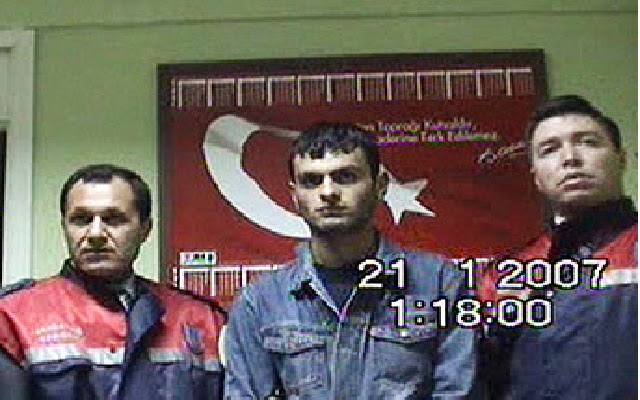
To offer further damning evidence of the neglect -- and quite possibly, involvement -- of elements within the Turkish security forces, one of Dink's assassins, young trigger-man Ogun Samast, posed with police officers in Samsun behind a Turkish flag just two days after the murder. While government officials have complimented themselves on apprehending Samast and other conspirators soon after the murder, adequate explanations for this photograph and the events before the murder have yet to come to the forefront, and according to many of Dink's supporters, have indeed been subject to a massive cover-up in which the state is complicit.
Where Does the Government Fit In?
Indeed, the more than four-year trial of Dink's conspirators has been hindered from the beginning due to an inability, and perhaps unwillingness, to procure evidence from state security offices, as well as government agencies such as the Telecommunications Board (TIB), which only last December turned over evidence documenting phone conversations and text message exchanges between the conspirators. TIB, citing a 2007 provision by the Justice Ministry related to the use of phone records in criminal investigations, had refused to turn over evidence for more than four years following the murder. Video footage of the street on which Dink was shot was erased from cameras soon after the incident, another fact that has led to accusations against the police ranging from neglect to complicity.
As Hurriyet columnist Sedat Ergin points out, efforts, or lack thereof, to hold state officials to account for their role in the murder have given way to serious misgivings on the part of the Turkish public. In 2008, and administrative court acquitted police of neglect while failing to really delve into the events in the days and months before the murder, and in 2009, another effort to investigate the role of security officials was blocked by the Interior Ministry, which at the time and just as today, was controlled by the ruling Justice and Development Party (AKP). The gendarme is the only state organ wherein an official has been found responsible for neglecting to prevent Dink's murder.
Though AKP government officials are always careful to point to the independence and integrity of judicial processes, the fact that the government now has firmer control of the judiciary has caused many critics, both of the government and the investigation into Dink's murder, to point their finger at the government. When the Dink investigation started in 2007, the government did not have the control over judicial organs, such as the Supreme Board of Judges and Prosecutors (HSYK), that it currently wields. (Click here for a bit of insight as to how the AKP has gained more control through amending the constitution to give its elected representatives the ability to appoint members to this body and Turkey's high courts. See also this past post.) The HSYK is currently investigating the presiding judge in the case, Rustem Eryilmaz, as well as prosecutor Hikmet Usta, though on grounds that the two inappropriately spoke out publicly after the verdict rather than that they mishandled the case.
More cogent criticism centers on the government's relation to the police. As Milliyet columnist Metin Munir indicates (luckily, Hurriyet Daily News has translated this column into English, and so it can be read here), the real blame should be placed on the government's failure to prevent the police from hindering the investigation. According to Munir,
Nobody is blaming the government for not interfering with the judiciary; its guilt is in not intervening with the police, with the intelligence organization and in not demonstrating the necessary attention to bring out the truth. In Turkey, judges and prosecutors are not as strong and independent as, for example, in the United States, the United Kingdom or Italy.
While in the West the prosecutor commands the police, in Turkey the police command the prosecutor. This is the truth in practical terms, especially in politically sensitive cases.
The judges are also bound to prosecute whatever is in the indictments presented to them. The government does not command the courts and prosecutors. But it does command the security forces. For this reason, it has its share of responsibility in the verdict the court has ruled. It could have put pressure on the police to provide that a more comprehensive and a stronger file be handed over to the prosecutor. It did not.
The government is still boasting about catching the murderer in 32 hours. This is not a matter to be proud of; it a matter to be ashamed of. Who was going to kill Dink and when it was going to happen were known by security forces days before the murder. If the incident was stopped at that time and the murder was prevented, then yes, it could have been a matter of which to boast. But it is not hugely ingenious to identify the assassin and then catch the killer.
This is what the government has to explain: Why isn’t the entire organization, the one for which the killer acted as a hit man, foiled and punished even if it is five years that have passed since the murder? What is the reason for the systematic reluctance on this matter?
Mustafa Akyol, generally more sympathetic of the AKP, explains that this reluctance might be driven by the fact that many of the bureaucrats and police who neglected to properly investigate Dink's murder (and, my words, not his, but perhaps even cover up critical aspects of the killing) are now aligned with the AKP and have been appointed to key positions within the government. These include not only Akyurek, but also former Istanbul police chief Celalettin Cerrah, headed the Istanbul police at the time of Dink's murder. The government has never allowed Cerrah to be questioned in relation to the case, and in 2009, he was appointed a provincial governorship in Osmaniye. Similarly, the failure of the AKP to put pressure on TIB and the obstructive role of the Interior Ministry throughout the investigation give great cause for concern.
A Chance for Redemption?
Soon after the verdict, Dink family lawyer Fethiye Cetin declared that the effort to unveil the truth behind Dink's murder had only just begun, and it is quite possible this is the case. An indignant Cetin has already appealed to the Supreme Court, which will likely render a decision in one year's time. Hikmet Usta, the Istanbul prosecutor charged with the case, has also made an appeal, joining Cetin in denouncing the court's inability to find evidence that the crime was the premeditated work of a criminal organization as a complete oversight of the facts presented.
Hranuysh Hagopyan, Armenia’s diaspora minister, walks with acting Patriarch Aram Atesyan after an award ceremony in Istanbul on Sunday. PHOTO by Hasan Altinisik / Hurriyet Daily News
A group of Turkish Armenians were recently honored in Istanbul in a ceremony involving Archbishop Aram Atesyan, and significantly, Armenia's minister responsible for dealing with the Armenian diaspora, Hranuysh Hagopyan. Many Turkish Armenian intellectuals, newspaper, and some of the honorees questioned whether the presence of the diaspora minister was desirable. From Hurriyet Daily News:
“I would prefer not to have a diaspora minister in Turkey,” author Mıgırdıç Margosyan told the Hürriyet Daily News before receiving his gold medal from Armenian minister Hranuysh Hagopyan.
“I’ve been living on the land that [we have] been living on for thousands of years. I am not in the diaspora. This is a terrible irony,” Margosyan said. The writer also directed his criticism toward the Turkish government, saying the lack of a Turkish state official at the ceremony was disappointing.
. . . .
After attending the Global Summit of Women in Istanbul, Hagopyan handed out medals to 15 Turkish Armenians, including Margosyan, composers Garo Mafyan and Cenk Taşkan and Alis Manukyan, the first Armenian female vocalist in Turkey’s State Opera and Ballet.
“We are living in the lands where we have to live. And we continue to pay our debt to these lands,” Mafyan, who is arguably the best-known popular music composer, told the Daily News. He added that he is ready to do everything he can to make sure dialogue continues between Turkey and Armenia.
“It is [still] very important to receive an award from Armenia for contributing to Turkish popular music,” he said.
Turks of Armenian descent or Turkish Armenians or Armenian Turks or however one would group them are a population of at least 60 million people. Most belong to the Armenian Orthodox Church, which has a Turkish Patriarchate in Istanbul apart from Yerevan. Some Turkish Armenians are Catholics, and there are yet others of Armenian descent that do not enjoy minority status under Turkish law and whose numbers are not counted in official government numbers. This "hidden" Armenian minority, consists of people, sometimes referred to as crypto-Armenians, who converted to Islam in the latter half of the nineteenth-century and early part of the twentieth-century when Armenians began to face sharp discrimination, and eventually, Ottoman state-engineered ethnic cleansing.
Under the 1923 Treaty of Lausanne, Armenians, along with Greek Orthodox Christians and Jews, enjoy "minority status" based on religion. The status granted these minorities rights certain rights vis-a-vis the new republican Turkish state, and essentially granted two separate legal regimes: one for ordinary Turkish citizens, and another for the minorities granted status under the Treaty of Lausanne. (Syriac Christians, Alevis, Caferis, as well as ethnic groups, such as the Kurds, were denied such rights.)
However, some Armenians, Greeks, and Jews complain of being treated as second-class citizens. These minorities are still sometimes accused of collaborating with foreign enemies, and even in the context of receiving EU accession monies designed to protect and promote minority rights, face criticism from some nationalist circles for seeking to undermine the Turkish state.Armenians, in particular, have long faced suspicion of being linked to Armenian terrorist groups and secretly desiring the dissolution of the Turkish state, which many Turks are taught has two main enemies: the external enemies of imperial Europe, and the internal enemies, i.e. minorities who see the disintegration of the country. To make matters worse, Turkish Armenians often get caught in the middle of Turkey's politics with Armenia and other countries, such as when Prime Minister Erdogan responded to a genocide resolution in Sweden by threatening to expel Armenian immigrants in radio interview last March. (This is not to say that the poor Armenian immigrants were not more caught.)
At the same time, Armenians also face criticism from Armenians in Armenia, as well as from the sizable Armenian diaspora. As a result, Turkish Armenians are torn between Turkish citizenship, their relation to the diaspora, of which they are not a part since, unlike even the vast majority of Armenians living in Armenia, they did not immigrate. The vast majority of Turkey's Armenian population are the descendents of Armenians who migrated to cosmopolitan Istanbul following the hard times of the 1890s and onward under the Ottoman Empire (and before 1915), and so escaped the massacres at the end of the Ottoman Empire and the mass dislocation into Syria, the Soviet Union, and scores of other countries that followed.
Vahe Sarukhanyan, writing for Heqt Online, has an interesting piece up discussing Istanbul Armenians as the "Diaspora's Outsiders." An excerpt:
Sociologist [Arus] Yumul says that for the worldwide Armenian diaspora, the Istanbul-Armenian community is akin to a "lost lamb", an "outsider". She says that other Armenians have taken them to task for being non-active in Armenian affairs and for cow-towing to the government in Ankara. Yumul says she agrees with these assessments when it comes to the Ottoman period, but that after Turkish independence Armenians not only didn’t get involved in Armenian politics but also Turkish affairs. It was kind of a survival strategy she noted.
Yumul added that the community is slowly integrating into the larger Turkish society and that mixed marriages are paving the way.
"At one time Armenian parents resisted but this too has faded. The next generation will be more like a hybrid, free to chose whether they are Armenian, Turk..."
She was quick to add that this doesn’t mean that Armenians will disappear in Turkey.
However, the use of Armenian as a daily language of communication is also on the decline; the number of Armenians who can’t speak the mother tongue is growing. Parents send their kids to Armenian elementary schools but afterwards many go to private or foreign high schools so that they won’t have problems with the Turkish language in college.
The 1990s were a turning point for the community in many ways. Armenians, like the other minority communities, began to voice their concerns, speak about the discrimination they faced, and even raise the taboo subject of the 1915 Armenian Genocide
Twenty years ago, all this was unthinkable. What the next twenty will bring for the community remains a big question mark.
More evidence that Lausanne is outdated, and that its continued legal character is becoming more and more anachronistic as Turkey opens up . . .
On another note, Kadir Has University has announced plans to start teaching courses in Armenian. The classes are offered in the context of improving regional relations with Armenia.
For more on the Treaty of Lausanne's lasting impact in Turkish politics, see my post from 2008, "Article 301: An Anti-Imperialist Discourse." For the treaty's misused application in relation to the Greek Orthodox Patriarchate, see this past post. For more on Turkey's Armenian minority, click here.
April 24 marks the day of remembrance for the purported 1.5 million Armenians who perished in the year 1915 during what Armenians refer to as Mec Yeġeṙn. While Armenians have pushed for years to pass laws in other states acknowledging Mec Yeġeṙn as "genocide" such efforts have done little to yield recognition of the tragedy inside Turkey. However, despite these efforts, an increasing number of Turks are exploring the history of the events of 1915 when what was then the Ottoman Empire systematically eliminated the Armenian population then living in Anatolia after concerns that Armenians were cooperating with the Russians to bring about dissolution of the Empire.
Yesterday, for the second year in a row, Turks gathered in Taksim Square to pay homage to the Armenians who lost their lives almost 100 years ago and call for a "coming to terms history." The first demonstration of this kind was held last year when the world was paying more attention to whether United States President Barack Obama would refer to Mec Yeġeṙn as "genocide" in his annual speech commemorating the tragedy. He did not, but what did not get noticed, and in what my mind is more important, is that Taksim was home to Turks raising awareness of the issue. Whether they called Mec Yeġeṙn "genocide" is less important than that there is now a lively discussion in Turkey that was not at all present 5-10 years ago. Last year hundreds of Turkish intellectuals and common citizens signed an online apology for what they referred to as "the Great Catastrophe." From Hurriyet Daily News:
Apart from two events in Istanbul, sit-ins were held simultaneously in Ankara, İzmir, Diyarbakır, Bursa and Bodrum. Prayers for the tragedies were conducted in all Armenian churches in Istanbul after the Easters prayer. The church’s limited their commemorations to prayers and no statement were made.
The first of the events in Istanbul was held in Sultanahmet by the Human Rights Association, or İHD, in front of the Turk Islam Artifacts Museum at 2 p.m. The crowd gathered with red cloves and read a press statement. The cloves had the names of Armenian intellectuals who were taken from their homes in Istanbul on April 24, 1915, and died in exile. The black banners held by the crowd read, “The Museum – prison of 1915” and “The intellectuals were held before sent to the journey of death.” The names of 250 intellectuals were read and the crowd left the cloves and banners near a tree in front of the museum before disassembling.
Ayşe Günarsu, member of the İHD Istanbul branch and the Commission Against Racism and Discrimination, spoke to the Hürriyet Daily News & Economic Review. She said they were there to refresh a memory that society was made to forget. “This location where the museum stands used to be İbrahimpaşa Palace in those years; also called the Central Prison. The intellectuals were gathered here and then sent to exile from Haydarpaşa train station. Many of the intellectuals never returned.” Günaysu said the Turkish intellectuals are too late “to commemorate the genocide.” İHD held a protest at Haydarpaşa last year.
“This is a matter of conscience,” said İhsan Kaçar, another member of the commission. “Intellectuals are not sufficient for Turkey to face itself. The NGOs need to have a clear stance on this matter. Facing the Armenian taboo will mean Turkey has to face its own history.”
For coverage of the demonstration last year and the strong efforts to pass a genocide resolution in the U.S. House last year, click here. For more on Turkish efforts to address the Armenian question, which is still difficult in Turkey given the country's many laws limiting freedom of expression, click here.
Turkey's political parties have released their party lists ahead of June 12 parliamentary elections. The AKP's list considerably diminishes the power of National Outlook ("Milli Gorus") politicians and aims to gain votes in coastal centers where the party has not fared strongly.
Meanwhile, the MHP is sticking to its strategy of going for votes in both Turkey's coastal areas and Central Anatolia. The MHP suffered a tremendous loss in last year's Sept. 12 election when many of its supporters broke with the party to vote for the AKP-sponsored referendum. MHP leader Devlet Bahceli made the referendum a chance to challenge the AKP on its Kurdish opening, but at the end of the day, MHP's brand of ultra-nationalism seemingly increased support for the MHP, which is now hovering right at the 10% threshold required for parties to enter parliament.
The AKP will go after the MHP with full force in an effort to have the party fall under the 10% threshold. Should this happen, the AKP would almost certainly be guaranteed the super majority of 367 deputies it needs to conduct business without much compromise. It is a make-or-break year for the MHP. Turkish political parties that fall under the 10% threshold have a difficult time coming back, and the MHP would likely come out of the bruising with an even more ultra-nationalist attitude.
Significant to the party lists is the lack of minority representation. No party nominated an Armenian candidate as initially conjectured. Two Jews and two Syriacs were nominated, though all but one of these candidates have either been placed low on the party lists or are representing small parties and so have little chance of entering. Erol Dora, a Syriac, is running for the BDP from Mardin and stands a decnt chance of being elected. If Dora is elected, he will be the first Syriac member of parliament in the history of the Turkish Republic.
Women also got the short end of the stick. The CHP nominated the most women (at 20 percent), and has made gender equality, which the party considers to be under attack, a major plank in its platform. The AKP nominated 14 percent, and the MHP 12 percent. 12 women are running as independents, mostly from the pro-Kurdish BDP, which has by far the highest representation of women in parliament. Among these women is Leyla Zana, a hardline BDP candidate who is very divisive in Turkish politics.
There was some initial speculation that the AKP might attempt to nominate a female candidate who wears the headscarf, though it seems Deputy Prime Minister Bulent Arinc's February statement that now is not the time seemed to have held true in the end. Only one covered candidate was nominated, a school teacher from Antalya, and her name was placed toward the bottom of AKP's party list. For more on women's political representation (and the headscarf), click here.
Turkey's environment ministry is changing the names of three species of animals bearing Turkish and Armenian names. From the BBC:
The environment ministry says the Latin names of the red fox, the wild sheep and the roe deer will be altered.
The red fox for instance, known as Vulpes Vulpes Kurdistanica, will now be known as Vulpes Vulpes.
Turkey has uneasy relations with neighbouring Armenia and opposes Kurdish separatists in Turkey.
The ministry said the old names were contrary to Turkish unity.
"Unfortunately there are many other species in Turkey which were named this way with ill intentions. This ill intent is so obvious that even species only found in our country were given names against Turkey's unity," a ministry statement quoted by Reuters news agency said.
Some Turkish officials say the names are being used to argue that Armenians or Kurds had lived in the areas where the animals were found.
Dink assassin Ogun Samast posing with police officers who arrested him just two days after Dink's murder.
The Istanbul Chief Prosecutor's Office have granted the request of Dink family lawyers that an investigation be launched into the involvement of high-level security officials into the 2007 assassination of Turkish Armenian journalist Hrant Dink. FromHurriyet Daily News:
This is an extremely good, positive development. I hope there will be a result [from] this,” Dink family lawyer Fethiye Çetin told a crowd of journalists during the court recess. She said they were expecting the investigation as they had applied to the prosecutor’s office Jan. 17, demanding that rulings made on the case by the European Court of Human Rights be implemented in Turkey.
The Dink family recently made a new plea for state, police and gendarmerie officials not questioned during the initial investigation to be brought into the scope of the case, basing their request on the European court decision finding Turkey guilty of failing to protect Dink and his freedom of speech and of not properly investigating civil servants suspected of being negligent in the murder and its investigation.
. . . .
The 28 public officials whose testimonies are expected to be taken by Public Prosecutor with Special Authority Mustafa Çavuşoğlu in the coming days include former Istanbul Gov. Muammer Güler; Ramazan Akyürek, the former top head of police intelligence; former Istanbul Police Chief Celalettin Cerrah; Ahmet İlhan Güler, the former Istanbul head of police intelligence; former Trabzon Police Chief Reşat Altay; Col. Ali Öz, the former Gendarmerie Trabzon regiment commander; and Metin Yıldız, the former Trabzon head of gendarmerie intelligence.
Last week President Gul announced that the State Audit Board (DDK) open a separate investigation into Dink's murder. Both investigations are indicators that the government is getting serious about resolving the facts behind Dink's murder. For more on Dink, see past posts.
UPDATE I (2/10) -- Interior Minister Besir Atalay is denying reports that the Istanbul Chief Proescutor's Office has opened up an investigation. Meanwhile newly released phone records verify long-time allegations that police exchanged text messages in the months prior to Dink's assassination. Previous evidence existed that police exchanged phone messages with Tuncel just two hours before Dink's assassination.
UPDATE II (2/15)-- In a new development in the ongoing Dink trial in Istanbul, the Trabzon Chief Prosecutor's Office has announced that it would allow the Istanbul court to question Trabzon police officers in communication with Tuncel up to the day of Dink's murder. Previous requests had been denied.
It was four years ago today that Turkish Armenian Hrant Dink was gunned down in the street and the botched investigation and unwieldy series of trials since have only added to the despair of the loss. On Monday, Dink family lawyers filed another petition with the Istanbul Chief Prosecutor's Office seeking an investigation into the event surrounding his death and implementation of the European Court of Human Rights decision Dink lawyers won last September. The Court found that the Turkish government had failed to conduct an effective investigation into his death, fell short of protecting his right to life, and had violated his rights to freedom of expression. From Hurriyet Daily News:
The family demanded investigations of the police and gendarmerie officials allegedly responsible for the murder, either directly or by neglecting their duties. In their application, they argued that the European court’s decision canceled the authority of certain domestic laws that had previously blocked the path of putting such officials on trial.
Dink, a Turkish citizen of Armenian origin, was murdered in front of the office of the weekly Armenian-Turkish newspaper Agos on Jan. 19, 2007. Confessed killer Ogün Samast was transferred to a juvenile court in October, and his trial separated from the main murder case, due to a legal change he benefited from because he was under the age of 18 on the day of the assassination.
Yasin Hayal, who is accused of abetting the murder, and Erhan Tuncel, a former police informant who claims innocence on the grounds that he told security forces everything he knew months before the murder, are still on trial under arrest. The only suspects left after three years of the trial, they will be released next year if they are not convicted by that time under a recent legal change that limits arrest periods without conviction to a maximum of five years.
From the beginning, lawyers for the Dink family have stated that the murder was not the work of “three to five nationalist youth,” but even the official inspector’s reports concluded that the National Intelligence Organization, or MİT, should be investigated were not enough to allow the questioning of high-ranking suspects from the police, gendarmerie and the MİT.
As they have every year since the first anniversary of Dink's murder, thousands gathered on the street where he was shot to call for the government to hold those responsible to account. For more on Dink and his family's attempts to uncover the details of his assassination, see past posts. For an excellent documentary produced in 2009 on the event surrounding the murder and the subsequent attempts by authorities to cover up their involvement, clickhere.
The United States Department has issued its annual International Religious Freedom Report. For DRL's report on Turkey, click here.
Though many accusations might be leveled at the United States for not taking a consistent position on democracy and human rights issues, a difficult task for any country, the State Department's reports on human rights and religious freedom are refreshingly objective.
Issued by the State Department's Bureau for Democracy, Human Rights, and Labor, the reports are issued independent of the State Department's other policy making arms. For a bit on how, why, and the history behind these reports, click here.
The first mass in 95 years was held at the Surp Hac (Holy Cross) Armenian church on Van's Akdamar Island yesterday despite a controversy this week about the cross that church officials wanted to place atop. The church was first opened as a museum two years ago following a Turkish government funded restoration, after which a Turkish flag was placed at its top. Culture Minister Ertegrul Gunay announced in April that the church would be open for prayer once a year.
In expectation of the first mass, the Turkish Armenian Patriachate built a 100-kilogram church, which it had planned to place atop the church with the help of for experts from Armenia. However, municipal authorities objected to the cross, arguing that church officials did not have proper permission from the Van Chamber of Commerce and Industry.
Given that the church has been open for two years and that the government had plenty of time to address the issue, the cross controversy evinces the difficulties that remain in both Turkey's reconciliation with its Armenian minority, as well as its relations with Armenia and the Armenian diaspora.
All the same, Aris Nalci, an editor at the Armenian newspaper Agos, told journalist Yigal Schleifer that the cross controversy should not overshadow the significance of the mass. From Schleifer, writing for Eurasianet:
“This is a very important step for this city and the people living in the city,” said Nalci, who came early to Van to help publish a special edition newspaper in Armenian called “Van Time,” the first Armenian-language newspaper to be printed in the city since 1915.
“Five years ago, you couldn’t imagine that a newspaper in Armenian would be published in Van. Previously people here would tell me not to say that I’m Armenian. Now people here are proud to say they have an Armenian friend,” he recounted.
“This is a big opportunity. It’s a big step for the Van people,” Nalci added.
After heralding the open as a major accomplishment in Turkey-Armenia relations, why the Turkish government did not take a stronger position on the cross remains to be seen. High-ranking government officials did not attend the ceremony, though the government has said that the mass will not be the only one to be held at Akdamar.
The European Court of Human Rights (ECHR) has found Turkey to have violated numerous human rights both before and after the assassination of Turkish Armenian journalist Hrant Dink. Dink was assassinated in January 2007 and the investigation that has followed has been tainted by a series of cover-ups and serious judicial mishandling. (For background, click here).
The Court found Turkey to have failed to protect Dink's right to life and freedom of expression, as well as to have fallen short of its obligations to provide for an effective investigation of his murder. In the weeks, months, and years after Dink's murder, numerous high-ranking state security officials and police have been implicated as either falling far short of their duties to protect Dink, at best, and at worst, actively conspiring with Dink's murderers.
During its defense at the ECHR, Turkey argued that Dink did not fear for his life or else would have asked for private police protection. A recent book by journalist Nedim Sener, who this year escaped criminal charges brought against him in relation to a book he published revealing details of the Dink murder and subsequent cover-up, alleges that security officials warned Dink of threats to his life before the assassination. Security officials have denied such knowledge.
The Turkish Foreign Ministry has said it will not appeal the court's decision. It is yet to be seen whether Turkey will provide for a remedy to its previous failure to effectively investigate Dink's assassination.
The AKP has submitted a proposal to parliament to open a parliamentary investigation into the murder of Hrant Dink. Prosecutors involved in the Cage Action Plan, part of the larger Ergenekon investigation, have said that the Dink investigation is going nowhere and does not include all of the suspects involved. The Dink case emerged once more into the public conscience earlier this month when former Intelligence Unit Chief Sabri Uzun testified in the case of journalist Nedim Sener, who stands accused of " "identifying officials on anti-terrorist duties as targets." Uzun's testimony verified that intellgence officers involved in the case hid vital information about the murder before it happened and falsified reports. For more on Uzun's testimony in the context of the Sener case, see Bianet's report. In other Dink-related news, the 2nd Magistrate Criminal Court in Trabzon still refuses to merge the case of eight intelligence officers charged with negligence with the case currenty underway in Istanbul. For more on the Dink case, see past posts.
The lawyers of the family of murdered Turkish-Armenian journalist Hrant Dink filed a criminal complaint against Istanbul Deputy Governor Mustafa Güran because he refused to hand them a copy of attachments of the report regarding the murder. Dink, then editor-in-chief of the Armenian Agos newspaper, was shot in front of his office in Istanbul on 19 January 2007.
Joint attorney Fethiye Çetin said that they applied to the Istanbul Public Chief Prosecution for an investigation related to allegations of "misconduct in office," requesting a trial eventually be launched.
The coming hearing in the murder case will be held on 10 May. On the same day, the "Friends of Hrant" will come together once more at the Beşiktaş Pier in Istanbul to call for justice.
UPDATE II (5/11) -- The tenth hearing of the Hrant Dink trial that took place yesterday included testimony from a secret witness who confirmed that Ogun Samast did not act alone, but was accompanied by Yasin and Osman Hayal. For the story from Today's Zaman, click here.
UPDATE III (5/17) -- The Istanbul Public Prosecutor's Office has rejected Dink lawyer Fethiye Cetin's application for a special prosecutor to look into what Dink's attorneys assert was an unquestionably wide-reaching and organized assassination operation.
The Culture and Tourism Ministry has announced plans to allow worship once a year at a key Armenian church close to the Armenian border. From Hurriyet Daly News:
The historical Surp Haç (Holy Cross) Church on Akdamar Island in the eastern district of Van was renovated and opened as a museum in 2007 by former Culture Minister Atilla Koç. Since then, debate has centered on whether the church would once again be opened for prayer. Buildings designated as museums are not allowed to host religious services under Turkish law.
In an interview with the Hürriyet Daily News & Economic Review in January, Culture Minister Ertuğrul Günay said the ministry was making the final legal arrangements to allow the church to open for prayer once a year.
Renovating the Armenian church helped begin the normalization process between Turkey and Armenia, but the church remained a topic of considerable debate especially around speculation surrounding whether a cross would be set atop the church. The decision on the cross is still pending.
The governor of Turkey’s eastern province of Van, Münir Karaloğlu, announced at the end of last year that the 10th century Armenian church located on Akdamar Island would be opened as a functioning church and museum by next September, inviting every Armenian Turk to the church when it opens for worship.
Günay said historic places of worship such as the Sümela Monastery in Trabzon, the Church of St. Paul in Tarsus and the Church of St. Nicholas in Antalya have special significance for Christians and are maintained as museums to be preserved for the generations to come. If there is sufficient demand, Günay said, his ministry would permit religious services to be held at those locations and open them to the public for a limited period of time without hampering tourism. “We will try to do this at each venue,” Günay said while answering questions from reporters at a ceremony in Ankara to celebrate the 46th annual Turkish Library Week. He was asked if the ministry would allow religious services at sites other than the Armenian Cathedral of the Holy Cross on Akdamar Island in Lake Van.
“Developments regarding the Akdamar church are not new. We represent a democratic and secular understanding. That is what our Constitution requires. Respecting our belief systems is a natural attitude in our country,” he said. “We are only strengthened if our citizens and guests pray in different languages or different ways to the same Creator.”
Three significant developments unfolded in the past two weeks in regard to Armenia. One, on March 12 the Swedish Riksdag voted by a margin of one vote to define the 1915 massacres of Armenians genocide in a non-binding resolution that the Swedish government has flatly denounced. Two, Obama Administration officials in the State Department have backed off affirmations that the genocide resolution passed in the House Foreign Affairs Committee will not come to a floor vote. Three, Prime Minister Erdogan, in an interview with BBC's Turkish-language service, seemed to threaten to crack down on undocumented Armenians working in Turkey.
Sweden
Following the unexpected March 12 vote, Turkey recalled its ambassador to Sweden, Zeygun Korkuturk, and Prime Minister cancelled a trip he was planning to make to Stockholm on March 17 to sign a strategic partnership with the country that would resemble partnerships already in place with Spain and Italy. The partnership has been put on hold despite assurances from the Swedish government that the resolution has no legal bearing nor will it be adopted as official policy by Sweden's center-reight government. Swedish Prime Minister Fredrik Reinfeldt and Foreign Minister Carl Bildt assured Turkey that they thought the resolution unwise, and adopted the Turkish government's position that genocide resolutions passed by foeign parliaments threaten reconciliation with Armenia. Significantly, the Swedish genocide resolution did not limit itself to the Armenian community living in the Ottoman Empire in 1915, but also recognized atrocities committed against other Christian communities. This week the Swedish government announced that it would be providing financial assistance to Turkey to help it along with the EU accession process, including increased funding to Turkish civil society groups. Swedish Minister for International Development Cooperation Gunilla Carlsson said, “Turkish EU membership is strategically important for the European Union. Sweden is in a position to provide support in connection with these needs and can help strengthen civil society by supporting organizations working for the rights of minorities and other groups in need.”
United States
Turkey has yet to send back Ambassador to the United States Namik Tan though three weeks have passed since the U.S. House committee vote on March 2. Erdogan has said that he wants a clear signal from the United States that the resolution will not be passed, and still publicly blames the Obama Administration for not doing more against the resolution. Yet, so far the Obama Administration has proven unwilling or unable to send such a clear signal. At an event held at the Brookings Institution, Assistant Secretary of State Philip Gordon said Congress was an independent body and that "they are going to do what they decide to do." Gordon did echo the Turkish government's position that the resolution is an obstacle to reconciliation. Following an invitation to a summit on nuclear energy to be held on April 13-14, Erdogan said he will not be attending, indiciating that he will send someone lower in the government chain-of-command. With Turkish officials still unwilling to visit Washington in the current climate, the American-Turkish Council and the Turkish-American Business Council have pulled the plans to hold their annual conference on April 11-14. Similarly, the Turkish Industrialists and Businessmen’s Association (TUSIAD) called off a trip to the US that was scheduled for March 16-17. An issue of some curiousity occured when Virgina Foxx, who heads the Congressional Turkey Caucus, told Turkish journalists that House Foreign Affairs Committee Chair Howard Berman had told her that the resolution would not move to a floor vote, though Berman strongly denied that such a message was made. When Tan will be sent back to Washington remains unclear, though all eyes will be turned to Washington as April 24 approaches. For an understanding of the genocide resolution's place in American politics, see former Ambasador to Turkey and Century Foundation Senior Fellow Mort Abramowitz' piece in The National Interest.
Perhaps Some of Us Are Not So Armenian After All
In the heat following the Swedish resolution, Erdogan's inclusion to brin undocumented Armenian workers in Turkey into the discussion earned the prime minister domestic and international condemnation (see interview, in Turkish). Erdogan remarked,
Look, there are 170,000 Armenians in my country -- 70,000 of them are my citizens, but we are managing [tolerating] 100,000 of them in our country. So, what will we do tomorrow? If it is necessary, I will tell them, ‘Come on, back to your country.' I will do it. Why? They are not my citizens. I am not obliged to keep them in my country. I mean these are [defenders of the Armenian claims of genocide], their attitude is affecting our sincere attitude in a negative way, and they are not aware of it.
For an excellent report on the Turkish reaction to Erdogan's remarks, see Ayse Karabat's reporting in Today's Zaman. From Karabat:
Leaving aside foreign policy considerations, civil society organizations criticized Erdoğan's remarks on several grounds: first, he mentioned Armenian Turkish citizens together with the citizens of Armenia, and secondly, he was using foreign workers as a tool of foreign policy and neglecting the humanitarian side of the problem.
But Suat Kınıklıoğlu, deputy chairman of the AK Party Foreign Affairs Committee, underlined that Erdoğan was trying to explain that Turkey tolerates the irregular Armenian workers. “As has been known for many years, there are Armenians illegally living and working in Turkey, and as a reflection of our goodwill and efforts toward normalization which started in 2005, we do not really touch them.
We tolerate them and take their difficult circumstances into consideration. In particular, we are not questioning their status due to the acceleration of the normalization process in Turkish-Armenian relations. The prime minister needed to draw this fact to people’s attention, especially now, when resolutions have been accepted which damage normalization. I think Turkey’s magnanimity is being ignored,” he said, and added that the prime minister did not mean he would immediately send those workers back to their country.
Öztürk Türkdoğan, the chairman of the Human Rights Association (İHD), said Erdoğan’s remarks could easily be considered a “threat” and as discrimination. “These remarks could lead some people to think that to expel people is a 2010 version of forced migration. This mentality is far from human rights-oriented thinking. People have the right to work, and this is universal. There are many Turkish workers all over the world; does it mean that Turkey will accept their expulsion when there is an international problem? Secondly, these remarks are discriminatory; there are many workers in Turkey of different nationalities,” he said.
As Karabat goes onto examine, the 100,000 number Erdogan gave the BBC is also quite controversial. A recent study by the Eurasia Partnership Foundation puts the number at between 12,000 and 13,000 Armenian citizens working in Turkey, and CHP leader Deniz Baykal, citing numbers from the Ministry of Labor, put the number at an estimated 14,000. BDP member Ufak Uras also criticized the remarks: “The prime minister’s remarks reflect the deportation concept of the 21st century. While we consider similar remarks as racist or xenophobic when directed to Turkish immigrants living in Europe, it is unacceptable to talk in this manner about the immigrants in our country."
The press' reaction was also quite strong, the Armenian newspaper Agos running the headline, "A Lot of Unionists, But No Progress" (see Today's Zaman columnist Sahin Alpay on the media reaction, as well as his inclusion of more positive statements Erdogan has made on the Armenian Question). Arguing that his comments were taken out of context, Erdogan blamed the media for inflating/maliciously reporting the story.
31 Turkish NGOs signed a joint condemnation of Erdogan's remarks, from which Bianet extracts the following points:
* Nobody abandons the place where he/she was born for insignificant reasons; and nobody stays in a country where they cannot find work.
* The Armenian immigrant workers have the right to humane treatment just as anybody else.
* It is unacceptable to make thousands of defenseless people subject to bargaining in order to dismiss the decisions that might be taken by third countries parliaments.
* Erdoğan is the Prime Minister of a country that alleges to bring together civilizations, to sort out the quarrels and normalize relations with Armenia which are international demands. In these terms, Erdoğan's statement carved out a huge contrast.
For another hearty response to Erdogan's comments, see the Armenian Weekly's Katchdig Mouradian's post on a blog he is writing to chronicle his experiences as a member of an American delegation of analysts and commentators visiting Turkey organized by Economic Policy Research Foundation of Turkey (TEPAV). Also worth a glimpse is Today's Zaman columnist Orhan Kemal Cengiz's look at the work of Turkish historian Taner Akcam. In his column, Cengiz excerpts part of a leter Akcer addressed to Erdogan and Deputy Prime Minister Bulent Arinc, part of which I have excerpted here:
Mr. Prime Minister and Mr. Arınç, the answers to the problems that are the legacy of 1915 can’t be found in the denialist policies of Veli Küçük, Doğu Perinçek, Şükrü Elekdağ and Yusuf Halaçoğlu. Don’t search for the answers there. You won’t get anywhere repeating the chorus they’ve been singing for 95 years. They are your adversaries on the issue of 1915, just as they are when it comes to the Kurdish issue and the issue of the military’s place in politics. You cannot construct your response to 1915 by holding rank with those who want to drag the country into chaos, who murdered Hrant Dink, who have planned massacres against Christians and who have been plotting coups against you.
“If you are going to respond to 1915, you need to search for an answer different from the answers given by Ergenekon or by those who plotted the coups. To do this, you should follow your Muslim roots in Anatolia that have grown alongside your party and take a closer look at what these roots did during 1915.
. . . .
Mr. Arınç, you can’t build a future on the backs of murderers. You can build a future on the backs of those righteous Muslims in Anatolia who challenged the murderers. In the same way that you can’t resolve today’s problems by supporting Hrant’s murderers, the ‘Samasts’ and the ‘Veli Küçüks,’ you won’t get anywhere supporting the murderers of the Hrants of the past. The answers to 1915 can’t be found in the answers of Doğu Perinçek or Veli Küçük. They are members of the Ergenekon gang that killed Hrant Dink; it’s natural that they defend the murderers of the Hrants of the past. Let the ‘Veli Küçüks’ defend the murderer Samast of today and the murderers Talat, Enver and Kemal of yesterday. Your place is not at the side of Veli Küçük. Your duty is to stand by the side of the ‘Haji Halils,’ to stand up for those Muslims who put themselves and their families at risk by opposing the massacres.
As for the status of the protocols, which seem most certainly dead in the water, Armenian President Serzh Sarksyan continues to accuse Ankara of using the genocide resolutions as another pretext not to introduce ratification. With the prime minister's most recent remarks, ratification might indeed prove all the more difficult in Armenia, the diaspora and Armenian nationalists having been handed a huge propaganda gift.
UPDATE I (3/24) -- Deputy Prime Minister Bulent Arinc announced plans to make new policies ensuring that the children of Armenian immigrants receive proper education in Turkish schools.
Also, TUSIAD has announced that it will send a delegation to the United States after all. The visit will occur April 19-20, just days before Obama will issue a statement addressed to the Armenian community on April 24 in which all eyes will be on the American president to see if he uses the word "genocide" to label the massacres of 1915. Last year, he chose to refer to the events as the "Great Catastophe (Metz Yeghern in Armenian)," a phrase many Armenians have for years used, and which recently some Turks have employed, albeit quite controversially.
UPDATE II (3/26) -- Prime Minister Erdogan has announced that Korkuturk will return to Stockholm next week. Also, Today's Zaman columnist Etyen Mahcupyan, with whom Bulent is likely to disagree, argues that the reaction of the press and of some AKP supporters was quite critical of Erdogan. From the column:
The prime minister’s unfortunate remarks served as a litmus test that brought to surface the change in Turkey. All media organizations reported his remarks along with interviews with Armenians. All human rights associations condemned Erdoğan, and perhaps as a more important indication, Muslim readers sent messages protesting or criticizing him. This incident indicates once again the risks before the Justice and Development Party (AK Party). Today, the AK Party does not face serious competition in the political spectrum, but its supporting demographic are freeing themselves more quickly from the party.
And, on the issue of formerly Armenian property:
If, in addition to this policy of denial, Turkey shows extraordinary resistance to returning the properties that belonged to the foundations of non-Muslim minorities, this possibility of attaching the “genocide” label to the incidents will increase further. This is because the story of 1915 and its aftermath is not only one of the people who were displaced or killed, but also one of a community whose cultural assets and properties were usurped. Turkey not only refuses to carry the burden of the dead people, but also continues to hold a handful of their properties as spoils. This inevitably adds credence to the genocide-still-continues discourse.
UPDATE I (4/2) -- Erdogan announced that Tan will be returning to Washington next week. The primme minister also confirmed plans to attend a summit on nuclear proliferation to be held April 12-13.
The wrestling in the Armenian Patriarchate continues as its Spiritual Board moves to appoint a co-patriarch to serve alongside the disabled Patriarch Mesrob Mutfayan. Mutfayan is suffering from dementia, and though unable to perform his duties as leader of the Armenian Church in Turkey, is likely to continue to serve in the position until the end of his life as dictated by Church law. In the meantime, Archbishop Aram Ateshyan, who is head of the Spiritual Board, is vying for the position and has received criticism within the Armenian community (for example, in the Turkish Armenian newspaper Agos) for using his position to maneuver so as to ensure the invevitability of his own candidacy against other candidates who are abroad at the moment. At the beginning of the ordeal, Ateshyan opposed an election at all, his critics surmising that without an election of a co-patriarch he was able to control the church through his role as head of the Spiritual Board. In an unprecedented move, Armenian community members organized to form an Election Initiative Committee, which has petitioned the Turkish government to elect a new patriarch while ignoring the disabled status of Mutfayan. It is still unclear what move the government will take, if any, and some observers (for example, this American Armenian weekly) have speculated it is in the Turkish government's interests to keep the community divided by taking no action. Ateshyan's competitors live in Armenia and Germany, where both are primates, and have both made recent visits to Turkey. They are eligible because they were born in Turkey, a requirement of the Turkish government and a rule that has been criticized among some members of the Armenian community as hindering the selection of a competent patriarch.
Turkey is in a state of flux. Founded in 1923 amidst the ruins of the Ottoman Empire and very much a product of modern nation-state ideology, the emergence of Turkey is one of the great stories of the last century.
Although the Turkish state is still quite strong, an increasingly globalized, albeit incipient, civil society has come to challenge its hegemony and singular notions of "Turkishness." Growing numbers of Turks are demanding human rights reform and a more democratic society. At the same time, politics remains a largely elite affair, minority and cultural rights go largely unrecognized, nationalism remains a potently virulent force, and political stability is still a matter of concern. Unrest in the Kurdish southeast, anti-democratic maneuverings to curb civil liberties and close political parties, repression of political dissent, and a questionable human rights regime raise real concerns for the future of Turkish democracy.
A candidate for accession into the European Union, Turkey stands at a crossroads—will it move toward the postmodernity of Europe, or will it forge an ultimately separate path? Will Turkey provide one of the amazing political stories of the twenty-first century, and what does its political development and changing geopolitics have to say about the future of world politics?
Ragan Updegraff has closely followed Turkish politics for over six years, working as a political consultant, journalist, and analyst along the way. His work has appeared in the Journal of Democracy and the Jerusalem Post, among various other publications, and he has been interviewed by Voice of America, The Guardian, and The Telegraph. In 2009-2010, he was a United States Fulbright Research Fellow and studied the impact that Turkish legal reforms undertaken as part of Turkey's European accession process were having in transforming Turkey's relations with minority groups, in particular its nationalist Kurdish population. He also studied EU assistance to Turkish NGOs working on minority right issues. He continues to closely monitor events in Turkey from Washington, D.C.
Email Me




 Posts
Posts

