Showing posts with label 2011 Elections. Show all posts

Wednesday, June 15, 2011

Rough Waters Ahead?

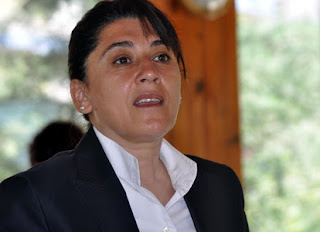
PHOTO from Radikal

Sunday's elections created what is perhaps the most representative parliament in the history of the Turkish Republic. Of the 87% of eligible Turkish voters who showed up to cast ballots, only 4.4% voted for parties were not ultimately elected to parliament. This is down from 13% in 2007 and 32% in 2002. This representation problem has been a function of small political parties being unable to meet the country's high 10% threshold required to enter parliament. (The Kurdish BDP is an exception to this rule since it has not run as a political party, but rather chosen to run candidates as independents. A difficult feat to pull off, the BDP won 36 MPs this parliamentary election cycle.)

However, though there are now few political parties in parliament, this does not mean Turkey is necessarily any less divided. In fact, each of the four political parties now represented have unique constituencies and platforms that do not necessarily square with each other or facilitate compromise. As the AKP vows to seek compromise and civil society input as it moves forward with re-drafting the country's 1982 constitution, which was drafted in the shadow of a dramatic coup in 1980, it is unclear just how successful it can and will be.

Assessing the BDP

Cengiz Candar argues in today's Radikal that what a " BDP opening" is needed, meaning that the AKP must accommodate the voices and politics of the Kurdish nationalist party. At the same time, Candar, who is joined by other liberal public intellectuals who support Kurdish political, civil, and cultural rights, argues that the BDP has not shown itself to be a positive player when it comes to adopting the conciliatory politics required to reach a solution to the age-old Kurdish problem.

As Henri Barkey elucidated at an event at the Carnegie Endowment today (podcast here), the BDP's victory is impressive in that it resulted not only from the support it receives in the southeast (and in Kurdish areas throughout the country), but also from its tremendous capacity to organize. Successfully unning independent candidates for parliament is no easy task, and basically required the party to apportion its support for specific candidates running at the provincial level and then organize voters to elect these candidates. For example, in Diyarbakir, where support for the BDP was high, BDP supporters were divided between the number of candidates the BDP thought it could successfully run. Such a strategy requires the BDP to perform a complicated electoral math in determining just how many candidates it can elect in the context of a complicated electoral system and successfully rally the vote behind these independent candidates.

Though the BDP's success should not be underestimated, it should also not be overplayed. As Candar explains, though the BDP has gotten better at electoral engineering, political support for the party has not necessarily increased. Further, it should not be forgotten that a significant number of Kurds voted for the AKP despite its heavy nationalist rhetoric (Candar estimates 42%). Had the AKP not run a nationalist campaign in an effort to run the MHP into the ground, the result might have been different. Candar also points attention to the factions the BDP has managed to bring together (for example, bringing leftists together with staunch Kurdish nationalists and pro-Kurdish conservatives like Altan Tan and Sereafettin Elci). According to Candar, though this coalition-building is taking place at the elite level, the BDP has not succeeded in doing so among voters.

Trouble Brewing

In the days after the election, the BDP used this mammoth victory to call for the release of PKK terrorist leader Abdullah Ocalan and direct negotiations with the PKK, actions sure to infuriate the vast majority of Turkish votes. In doing, the BDP is alienating itself from the larger electorate and adopting a divisive politics sure to further fuel the conflict.

At the same time, the AKP has paid little attention to the Kurdish problem, the existence of which the party denied during the campaign, and is instead focusing on moving onward with business as usual. The two positions combined create the conditions for a political crisis, which could come soon given that six of BDP's deputies are currently in jail and their eligibility to hold seats in parliament still up in the air.

Chief among these is Hatip Dicle, who was convicted in 2009 for disseminating PKK propaganda and whose candidacy was at the heart of the riots that enfolded at the end of April when the High Election Board (YSK) invalidated the candidacies of 11 BDP candidates (see April 21 post). On June 9, just three days before the elections, the Supreme Court of Appeals upheld Dicle's conviction. Though it was too late to remove his name from the ballot, the High Elections Board will decide whether he is able to serve in parliament.

The six BDP candidates currently jailed as part of the KCK operations (and who are awaiting trial) include Gulseren Yildirm, Ibrahim Ayhan, Selma Irmak, Faysal Sarayildiz, Kemal Aktas, and Dicle. Dicle's case is special since he is not only jailed and awaiting trial for alleged membership in the PKK (KCK), but has been convicted previously and been unable to attain the necessary paperwork required to allow him to enter parliament. The Constitution bars convicted persons from holding parliamentary office. (In addition to the six jailed BDP candidates, two CHP candidates and one MHP candidate, both recently elected, are also currently detained (for their role in Ergenekon).)

Meeting in Diyarbakir yesterday, the BDP called for the release of all six elected members and demanded the release of Ocalan. If the release of the six was not controversial enough, combining such a move with Ocalan's release is not politically savvy nor helpful for the peace process. Reaction in the Turkish press, nationalist and otherwise, has been harsh, and will likely only increase in intensity should a crisis with Dicle come to a head.

Will the AKP Seek Compromise?

Speculation is still high as to whether Prime Minister Erdogan will seek a presidential term in either 2012 or 2014 given the party's successful election result. While some observers argues the party's loss of seats and new need for compromise when it comes to amending the country's constitution renders null the possibility of a powerful Erdogan presidency, others conjecture the AKP will still be able to find the support it needs to change the constitution and empower Erdogan.

The prime minister has announced that he will not run for parliament again, and the AKP's current by-laws prevent him from being appointed to another term as prime minister. CSIS' Bulent Aliriza writes
The new constitution seems certain to usher in a presidential system, and it is clear that Erdogan intends to run for the presidency, either in 2012 or more likely in 2014. If he were to choose the latter date, he would then be in a position to implement his “Target 2023” election manifesto through the centennial of the Turkish Republic as president. However, the inability of the JDP to obtain 330 seats, which would have enabled Erdogan to get public approval for a new constitution in a referendum, presents an obstacle that needs to be overcome.
Apart from the question of Erdogan continuance as the leading force in Turkish politics, the more immediate question is whether and just how the AKP will seek compromise and consensus on the constitution, especially given the likelihood of conflict over the jailed opposition candidates who have just been elected from parliament.

Again, a key question here is whether and how the party will attempt to repair the bridges it has burnt with the large number of Kurdish voters to whom the party turned its back. Though the AKP failed to push the ultra-nationalist MHP beneath the 10% threshold, according to Barkey, any increase in the AKP's number of voters (above the 50% of the country who supported it in this election) will come from nationalist voters.

Getting these votes is dependent on how the party treats the Kurdish issue, and should it be intent to continue its nationalist rhetoric, the BDP opening for which Candar hopes is simply not going to come to fruition. At the same time, the AKP has expressed intent to negotiate with the CHP and the MHP, and there are those in the party who realize the necessity of dealing with the BDP, however unsavory and threatening its politics. At the party's parliamentary group meeting today, Erdogan re-affirmed his intent to move forward with the constitution and said he would personally supervise negotiations with the opposition and engagement with civil society.

Just how all of this will happen is yet to be seen, especially given that the next few weeks could prove difficult if the courts and the YSK prevent the release and entry of those elected candidates currently jailed. And, while Turkey might have a more representative parliament, a less divided country it is not.

Tuesday, June 14, 2011

A Pyrhhic Victory?

I recently wrote a short entry on the elections for Democracy Digest, a project of the National Endowment for Democracy. An excerpt:
Increasingly, Turkey is polarized between those who support the AKP and those who do not. The AKP’s critics include not only the secular elite, but also liberals, Kurds and other minority groups, and others who fear the intolerance with which the party deals with difference and dissent.

However, the new parliament presents fresh opportunities for compromise and reconciliation. All parties agree that Turkey should adopt a new constitution, and given the CHP’s progressive turn, the country now has a genuine opportunity to pass a liberal democratic constitution that will respect and affirm the rights of all citizens.

Nevertheless, and despite Prime Minister Erdogan’s acceptance speech yesterday in which he vowed to seek compromise on a new constitution, it is possible, even likely, that the AKP will promote its agenda with minimal compromise and consultation (as it has in the past). Such a unilateral approach increases the likelihood of the new constitution entrenching the illiberal practices evident in the AKP’s current exercise of power, including the targeting of journalists, libel suits, increased reliance on executive and administrative orders, enhanced cabinet powers at the expense of parliament, limited minority rights, and restrictions on freedom of association and civil society.

Turkish civil society is crucial to ensuring that Erdogan seeks compromise with the other three political parties that have entered parliament. In this context, civil society will prove just as key to saving Turkish democracy as it did during the optimistic years after the EU accepted Turkey’s application for membership in 1999 and major reforms started coming down the pipe. Support for strengthening political parties and institution building has been enormously successful, but further progress is unlikely without funding and empowering civil society to hold the government and political parties in check and goad them to respond to democratic demands.

A democratic regression in Turkey will not only mark the end of a regional success story but also set back Islamist/conservative democrats in other Muslim states who view the AKP as an exemplar. As recent survey research attests, 66% of Arabs view Turkey as a democratic model.

Turkish democracy is neither a mission accomplished nor a lost cause. Authoritarian trends can be reversed and the AKP government may yet return to the more liberal politics of its inception. However, this will take serious work and dedication from the government, opposition political parties, and civil society. These elections and upcoming plans to draft a new constitution provide at once a strong impetus for reform and a new starting point.
For the full entry, click here. The blog is a good way to monitor political development throughout the world.

Monday, June 13, 2011

A Country Divided

Cartoon from Hurriyet

Sounding the same refrain as last September's constitutional referendum, yesterday's election results reveal Turkey to be increasingly divided between those who support the ruling AKP government and those who do not.

Yesterday the AKP managed to increase its vote from the  46.58% it captured in 2007 parliamentary elections to 49.91%, though the party lost lost seats and its 3/5 majority in parliament (see yesterday's post).

Additionally, the AKP became the first party since the Democratic Party in the 1950s to win three consecutive parliamentary elections; however, unlike the Democratic Party, the AKP has become more popular each election, not less. Yet, while the results hint at the AKP's growing popularity, they also hint at a growing disconnect between the party's supporters and those who fear its burgeoning illiberal tendencies (see last Tuesday's post).

The Other Half

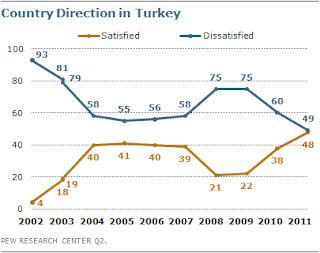
As echoed by the results of a recent Pew poll, Turkey is becoming an increasingly divided country. While those who support the AKP continue to enthusiastically return it to power, the other half (and it is literally half) of its population is deeply concerned with the direction in which the country is headed. The abyss between the two camps has grown in recent years, revealing a social phenomenon much more complicated than the narrative so often told in Western newspapers of a conflict between the ascendant Islamist middle class and the secular Kemalist elite.

Instead, what is happening in Turkey is that half the population solidly supports the AKP and its policies while the other half are becoming increasingly alienated from the party for a variety of reasons. This "other half" is not some unified Kemalist/secularist/nationalist opposition bloc, but rather represents a diverse array of different facets of Turkish society that have been left out of the AKP's increasingly hegemonic vision.

Of those opposed to the AKP, there are those concerned with the party's Turkish-Sunni chauvinism. These include not only members of a secular elite, but also Alevis (15 to 20 million people), Kurds (also 15 to 20 million people, though many Kurds are also Alevis), liberals (including Islamists), and leftists concerned about the AKP's neoliberal economic schemes. There are also plenty of observant Sunni Muslims who are nonetheless less pious than the AKP and/or increasingly concerned with the party's attempts to legislate its values. At the same time, there is a significant number of voters (~10%) for whom the AKP is not chauvinist enough. Most of these vote for the ultra-nationalist MHP.

The Next Steps

From Radikal
Starting with Refah in 1994, the AKP's antecedent, the AKP has gradually increased its votes since first elected office in 2002 with the one exception being the March 2009 local elections.

This is where the steps the AKP takes after the elections become crucial. Prime Minister Erdogan is determined to push through a new constitution that would institute a presidential system. Erdogan is widely thought to have designs on running for president should the changes come into being.

However, in a twist, though the AKP increased its share of the popular vote, it lost seats in parliament and is now short of the 3/5 majority it needs to unilaterally amend the constitution as it did last year. The loss of seats is a function of two factors,  namely a high 10% threshold and a complicated system of closed-list proportional representation: an increase in the number of independent deputies associated with the Kurdish nationalist BDP and the increased number of voters in big cities where the party tends to do less well.

As a result of the shortfall, the AKP to some degree be pressured to compromise with opposition political parties if a new constitution is going to emerge, an objective supported by all political parties entering parliament.

That said, and despite Prime Minister Erdogan's acceptance speech yesterday in which he vowed to seek consensus as his government moves forward with a new constitution, it is possible, even likely, that the AKP will use its power to push forward its agenda with minimal compromise and consultation (as it has in the past). However, the risk, of course, is the way that power is enacted  (targeting of journalists, libel suits, increased reliance on executive and administrative orders, more power to cabinet/less to parliament, limited minority rights, restrictions on association/NGO activity, etc.).

The most popular politician in the history of Turkish electoral politics, Erdogan has accomplished a tremendous electoral feat. It is more likely to encourage his appetite for power than to tame it. Power corrupts, and the more absolute the power, the more absolutely it corrupts.

Weep Not for the Opposition

And, where does the opposition stand -- and those who did not vote for the AKP? For one, it is unlikely the AKP will be able to further increase its vote. Given that the number of people unhappy with the direction in which Turkey is headed is the same number of people who did not vote for the AKP (see Pew Poll above), there is little headway the AKP can make in terms of winning additional votes -- basically, the party is maxed out.

All the same, the AKP's uncanny ability to turn nationalist then liberal -- only to do it all over again -- cannot be underestimated, and the party has a decent shot at maintaining its current numbers, especially if it decides to move again to the left so as to not be out-done by the CHP. However, I do believe the party's most recent bout of illiberalism, on full-display in its handling of the Ergenekon investigation, has burned many bridges, as did its extreme nationalist return in the past few months preceding the election.

There is little likelihood that bridges with more nationalist-inclined Kurds can be repaired given the ruling party's tenor this election cycle, especially given the failure of its Kurdish opening to deliver many concretes. Even less likely is that the party will win back the liberals and progressives who have been breaking ranks since 2005, many of whom have come to fear the party as a new authoritarian threat.

While the AKP might win some hardline nationalist votes from the MHP, it is unlikely to have much success here without losing a certain remainder of optimistic liberals who have continued to support the party for its economic successes and in spite of its illiberal tendencies.

The CHP

PHOTO from Radikal

Meanwhile, the CHP should regard its performance yesterday as a victory. "The new CHP," as the party has billed itself in the run up to the elections, managed to increase its vote share by 5% (a larger increase than the AKP) and gain 38 seats. Additionally, the CHP seems to have broadened its geographic reach, winning its party leader's home province of Tunceli while faring reasonably better in areas outside of its traditional strongholds. Support for the party might not be as deep in traditonally nationalist coastal enclaves (Antalya, Canakkale, and Izmir) as it once was, but the party has broadened its support beyond voters in these provinces while successfully moving toward establishing a different, much more liberal, pro-European electoral base.

Though no doubt disappointed, the CHP should realize it will take time for the Turkish public to trust it. A party in transition, the CHP had been up until a year ago an intolerant, oftentimes destructive force, providing people with little to no alternative but to vote for the AKP. There are likely plenty of Turkish voters who cast ballots for the AKP but are less than solid supporters; however, they do not trust the CHP either.

 Further, as Milliyet columnist Asli Aydintasbas (in Turkish) writes, the CHP lacks the organizational and fundraising capacity of the AKP and should give itself some time to catch up.

All the same, CHP leader Kemal Kilicdaroglu is likely to face extreme pressure from his party. There are already rumors that the party's old guard is plotting his demise and some papers are reporting the leader offered to step down.

Message to CHP: Patience is a virtue. After many years of not being progressive, it is simply going to take time and commitment to get people to trust in the party. If the party decides to once more change course, it is likely to do more harm than good to its long-term viability.

The BDP

The BDP is the clear winner in this election. Most pre-election polls expected the BDP to win between 25 and 30 seats, a significant increase over its present 20. However, the BDP's ability to capture 36 seats has taken many by surprise, though it should not. As mentioned above, the AKP's nationalist turn (see past post) has thoroughly alienated many Kurds. Though many of these voters were already alienated, hence the BDP's electoral success in local elections in March 2009, the most recent electoral cycle has driven many to a virtual point of no return. It will be difficult for the AKP to build consensus with the party given the bad feeling and that the BDP will feel more emboldened by this recent triumph.
The good news is that two of the party's more dovish figures, Ahmet Turk and Aysel Tugluk, who were expelled from parliament in December 2009, have returned, but so has Leyla Zana, a Kurdish militant hardliner who often advocates on behalf of the PKK. Just what the BDP will do in the coming months is uncertain, but one thing is for certain: hardline Kurdish nationalism, including militancy, got a boost this election year.

The MHP

While many thought the sex scandal would finish off what was already an ultra-nationalist party in decline, the MHP managed to comfortably pass the 10% threshold with relative ease. This might in part be due to rising unrest in the southeast and Kurdish nationalism, to which equally virulent Turkish nationalism is too frequently the response. No matter how hard the AKP tries to devour this ultra-nationalist core of voters, they still do not seem comfortable voting for Erdogan. Pro-state, nationalist idealists are just simply not going to budge on this one.

Sunday, June 12, 2011

Election Night . . .

From Radikal

Election results started to come out at six o'clock in the evening Turkey time, and it became evident early on that the AKP had a commanding lead of the popular vote. However, despite capturing a near 50% of voters, the largest percentage the party has captured since it first came to power in 2002, the party fell four seats shy of the 330 seats it needs in parliament (a 3/5 majority) to push through a constitution unilaterally. For an electoral map complete with official results, click here.


This means that for the first time in a long time the AKP will have to engage in political bargaining (see yesterday's post). Last year the AKP successfully pushed through a series of constitutional amendments using its previous 3/5 majority before successfully submitting the amendments to referendum. Meanwhile, the ultra-nationalist MHP managed to comfortably surpass the 10% threshold required for political parties to enter parliament, winning 13% of the popular vote. Though the party went from 69 to 54 seats, coming in above then 10% threshold made it difficult for the AKP to meet the 3/5 marker.

The AKP's chances at gaining a 3/5 majority were further damaged by the historical success of the Kurdish nationalist party, the BDP. The BDP managed to pick up a whopping 36 seats (up from 20), no doubt a result in part to growing disenchantment with -- and, in many cases, outright hostility toward -- the party in Turkey's mostly Kurdish southeast. Running as independents so as to escape the 10% threshold, the BDP captured 6% of the vote.

The AKP's nationalist turn, presumably an effort to win voters away from the MHP, had the predictable effect of alienating Kurdish voters. Ironically, as the only other political party competitive in the region, it also contributed greatly to its failure to win 3/5 of parliamenatary seats since the BDP fared so well. AKP's efforts to defeat the MHP were a gamble, losing Kurdish votes for ultra-nationalist votes (while at the same time empowering the BDP), and the party paid the price.

In addition to MHP votes, the party did pick up a significant number of votes from the SP (Felicity Party), a legacy of Erbakan's National Outlook movement, consolidating its control over the Islamist vote. It also picked up votes from the center-right Democrat Party, which also harkens back to an earlier era. I would venture to say these are the blocs that explain the party's ability to increase its share of the popular vote.

Meanwhile, the CHP, which took enormous risks this election cycle, performed under expectations. The CHP captured 26% of the popular vote to gain 38 seats (from 97 to 135), but some expected the party to poll over 30%. During the campaign, the CHP became by far the most progressive mainline party, taking positions more pro-European, pro-peace, and pro-liberal than the AKP (again, see yesterday's post). However, the party's controversial positions, especially on the Kurdish issue, may have alienated some in its formerly nationalist base -- votes that would have gone to the AKP or the MHP. However, nonetheless, CHP leader Kemal Kilicdaroglu and ""the new CHP" managed to gain almost 3.5 million new voters and pick up seats. Whether the CHP will continue to steer Kilicdaroglu's chart or be so frustrated with the results that it changes course once more remains to be seen.

In his acceptance speech, Prime Minister Erdogan vowed to build consensus on a new constitution and reiterated that he represented all Turkish citizens, not just those who voted for him. Prime Minister Erdogans aid the consensus would be built among political parties and civil society groups, all of which would be consulted during the process. However, the prime minister made the same promise last year and fell short.

All parties support drafting of a whole new document to replace the country's 1982 constitution drafted under military tutelage, but just what will happen in the coming months is very much up in the air. The AKP is far from weak, and could well gain the 3/5 majority it needs without too much maneuvering.


UPDATE I (6/13) -- For a truly wonderful electoral map complete with candidate names according to the provinces from which they were elected, click here. The AKP won more provinces along Turkey's more secular Western coast than it has in the past, but this should not be read as a significant setback for the CHP. Though the CHP no doubt lost votes in some of these Kemalist/nationalist strongholds, including majorities, it seems to have widened its support throughout the country, picking up votes in provinces where before it was not at all competitive.

Saturday, June 11, 2011

What Will Happen Tomorrow (And After)?

Reuters Photo from VOA Kurdish

I gave a radio interview this morning to Voice of America's Kurdish service in which I was asked what would be the impact of tomorrow's elections on the AKP-led government's plans to introduce a new constitution.  Though the interview mostly focused on the Kurdish issue, of particular interest was just how successful the AKP could be in bringing forward plans to introduce a new constitution.

If the AKP wins at least 330 seats in the parliament (it now has 336), it will be able to introduce constitutional amendments without the need for much consensus before taking them to referendum -- an approach the AKP took last year and with great success. If the party manages to surpass 367 votes, it will have a 2/3 super majority that will allow it to unilaterally overhaul the constitution without the need for referendum. While the latter is unlikely and the former in doubt, the larger issue is just how sincere the party is in its reiterations that it will seek consensus as it moves forward. At the moment, all four parties with a chance of entering parliament have pledged to adopt a new constitution.

Last year, the party showed little concern as it pushed amendments rapidly forward. Neither civil society nor opposition political parties were given much voice in the process and the result was a referendum that basically polarized the Turkish public. The Kurdish nationalist BDP boycotted the referendum while the CHP and the MHP campaigned hard against the amendments. Though the official result was 58%, the actual number of Turkish citizens who approved the changes was lower given that a large number of Kurds who did boycott.

If the referendum is taken as a measure of the support for the AKP, it can be said that roughly over one-half of Turkish citizens approve of the party and the direction in which it is taking the country. This matches more or less with what a recent Pew poll found. According to the poll, 48 percent of Turkish citizens are satisfied with the direction the country is taking; however, 49 percent responded they are dissatisfied. The satisfied voters, more or less, can be assumed to be likely to vote for the AKP, but of more interest are those who are not. How many of these voters are simply typical Turkish cynics and how many are disenchanted with the party? The rising number of potentially disenchanted is cause for concern (and that is more than an understatement).


One of the most pressing problems in Turkish politics today is the amount of polarization in Turkish political society. Some of this can be explained by the increasing illiberal attitudes and policies of the AKP (see Tuesday's post), which, of course, is made all the more problematic by the AKP's seeming lack of willingness to engage opposition parties and craft serious political compromises when it comes to making government policy. Without an entrenched rights-based liberal democracy, the lack of compromise becomes all the more disturbing. A unilaterally-drawn up constitution will only serve to further polarize the Turkish public while continuing to fail at any real resolution of the classic dilemma posed by democracy and difference.

However, should the AKP fall short of 330 seats tomorrow, the party will be more inclined to compromise. Just exactly what this process of compromise would look like and what parties it would include remains to be seen, but perhaps for the first time in a long time the AKP will be forced to work with other parties to carve out a political agenda.

At stake are Erdogan's ambitions to institute a presidential system that would facilitate his ascendancy to the presidency. If Erdogan wins comfortably tomorrow, he will be more confident in these efforts. Even should the AKP fall short of gaining 3/5 of the seats in parliament, an increase in the popular vote for the AKP will embolden the already emboldened leader to move forward in his quest.

Meanwhile, just as interestingly, the CHP, which has drastically changed its leadership and party platform, will discover whether its new position in Turkish politics will be rewarded. The CHP is expected to pick up seats and increase its vote either way, but will likely have a difficult time gaining the 30% of the vote for which the party is striving. The CHP, which has billed itself as "the new CHP,"  has taken enormous risks this election cycle, presenting itself as pro-Europe, pro-liberal, pro-peace, and importantly, anti-nationalist and anti-coup. With Kilicdaroglu's victory over the party stalwart and former party secretary-general Onder Sav last year, the party has turned 180-degrees in many of its policies, especially in regard to the Kurds and its former pro-military/pro-coup attitude. Defeating Sav, Kilicdaroglu remarked, "The empire of fear is over in the CHP. Now it is time to end the empire of fear in Turkey."

The MHP will also face a serious test tomorrow. A little less than a month ago, there was serious question as to whether the ultra-nationalist party would be able to surpass the 10% threshold required to enter parliament. However, polls conducted at the end of June put the party safely over the threshold. That said, just how well the party does tomorrow will have an impact on the number of seats allocated to the AKP and CHP. The AKP has been competing for its nationalist voter base while the CHP's recent positions, especially in regard to the Kurds, might have alienated some in its former nationalist base to vote for the MHP.

And, finally, not without its own test will be the Kurdish nationalist BDP. The BDP currently has 20 seats in parliament, just enough to form a parliamentary group and be represented. However, there is little doubt that the BDP will surpass this number and could pick up well over 30 seats. Though the BDP candidates are running as independents since there in no chance they could meet the 10 percent threshold, the rising force of the party in the southeast and in Western cities populated by a large number of Kurdish migrants will indubitably be one of the most important stories of this election cycle. As its main challenger, the AKP's increased nationalist rhetoric is likely to work in favor of the party.

We'll see what tomorrow brings.

Friday, June 10, 2011

Getting the Nationalist Vote . . .

EPA Photo from Al-Jazeera English

As the part of the AKP's continuing efforts to cater its election rhetoric to nationalist voters, Prime Minister Erdogan has declared that he would have executed jailed PKK leader Abdullah Ocalan had he been prime minister at the time. Erdogan accused the MHP of giving its support to a 2002 that abolished the death penalty, implying that problems with Ocalan would have been solved if the government at the time had properly sent him to the gallows.

The remarks came in response to unfounded allegations from the MHP that the AKP-led government was in negotiations with the PKK to arrange for Ocalan's release. At the moment, the AKP and the ultra-nationalist MHP are both competing to win nationalist votes. For more on this dynamic, click here.

While the AKP might succeed in luring votes away from MHP by taking a hardline position on the Kurdish issue, it does so at the cost of further alienating Kurdish voters in Turkey's mostly Kurdish southeast. Recently, the party has been behaving as if these voters simply do not matter and the result will indubitably be a historic increase in the number of votes the Kurdish nationalist party receives on Sunday.

More troubling is that the AKP's election rhetoric will seriously hamper its chances of repairing its relationship with nationalist Kurds with whom it will likely have to work with to some degree if it is going to pass a constitution that takes all views into account, as Erdogan has expressed is his intention. Given the party's nationalist turn, it will be very difficult to win Kurdish nationalist voters, even those who are not necessarily supportive of the PKK-affiliated BDP.

Meanwhile, an even bigger danger lurks that could further compounds AKP's Kurdish problem. Ocalan, through his lawyers, is threatening a drastic increase in PKK violence should the government not move to negotiate with the PKK by June 15. The specter of renewed PKK violence of the kind last summer will only serve to distract from the government's efforts to pass a constitution and further polarize Turks and Kurds.

Monday, June 6, 2011

Even MHP Recognizes the Kurdish Problem

PHOTO from Radikal

Even the ultra-nationalist MHP seems to recognize the Kurdish problem. In the party's first campaign rally in the mostly Kurdish city of Diyarbakir yesterday, MHP leader Devlet Bahceli went a step ahead of Erdogan in recognizing the persistence of the Kurdish problem (for story, in Turkish, click here).

In Diyarbakir last Wednesday, Prime Minister Erdogan declared the Kurdish problem "solved," seemingly closing the peace initiative his government announced in July 2009. In contrast, Bahceli said, "I know you have a problem, but the solution is not street protests." Bahceli, like Erdogan, called for more economic development in the region while arguing that amending the constitution to end prohibitions on education in mother tongue, a long-time and principal demand of many Kurds, will not "fill your stomach."

In the past, the MHP has taken the most hawkish position on the Kurdish issue. An ultra-nationalist Turkey party with historical roots to gangs that target leftists and nationalist Kurds, the party has little hope of being competitive in the region. At the same time, it is significant that even it felt the need to hold a campaign rally in Diyarbakir.

In his speech, Bahceli said Kurds are regarded as equal to Turks, stressing that they too are members of the Turkish "nation," a claim many more nationalist Kurds adamantly reject. While many Kurds are fine being Turkish citizens, the claim that they are Turks due to their bonds of citizenship with the Turkish state (a claim stipulated in Article 66 of the Turkish constitution) raises the ire of more than a small number.

The CHP has proposed amending the constitution to eliminate the controversial article so that Turkish citizenship will not longer beat an ethnic definition, a move which has been denounced by both the AKP and the MHP. It was the first mainline Turkish party in the history of the Turkish republic to do so.

Sunday, June 5, 2011

Come Again??

AA PHOTO from Hurriyet Daily News

Campaigning over the weekend, Prime Minister Erdogan said the recent op-ed in The Economist endorsing the CHP was the work of "international gangs" and linked the magazine's support of the CHP to the opposition party's policy supposedly more friendly policy toward Israel. In an interview with the TRGT news channel on Saturday evening, the prime minister said, "This international media, as they are supported by Israel, would not be happy with the continuation of the AKP government. . . . Of course, they have their hands on Turkey nowadays." Is it a Zionist conspiracy? Or, is it that the prime minister simply cannot endure criticism or dissenting opinions?

In all fairness, emotional outbursts are common in Turkish politics, especially less than two weeks away from an election. At the same time, if the prime minister is looking to counter criticisms that he is thin-skinned, authoritarian, and intolerant of dissent, such baseless and strongly accusatory remarks are not winning him or his party any points.

Fellow party cadres Foreign Minister Ahmet Davutoglu and EU Chief Negotiator Egeman Bagis have also chimed in. According to Davutoglu, The Economist "violated media ethics" in printing the op-ed. From Bagis's point of view, the op-ed is mere "rubbish" and must have been ordered by "dark powers" inside Turkey (see Radikal columnist Cuneyt Ozdemir (in Turkish)). Okay . . . so not the work on international gangs . . . Ergenekon?

For more in English, see this story from Hurriyet Daily News.

Friday, June 3, 2011

Falling Out of Love

Signalling that the Western media is falling out of love with the AKP, The Economist has endorsed the CHP ahead of the June 12 elections. In 2007, and in the midst of seriously high tensions with the Turkish military over the election of President Gul, the magazine endorsed Erdogan. Now it seems the magazine has turned an about-face. An excerpt:
That Turkish voters are poised to return Mr Erdogan to power in the general election on June 12th is thus not surprising. It is, however, worrying. Mr Erdogan is riding sufficiently high in the polls to get quite close to the two-thirds parliamentary majority that he craves because it would allow him unilaterally to rewrite the constitution. That would be bad for Turkey.

This judgment is not based on the canard that a theocracy is being built. Nine years ago Istanbul’s secular establishment fretted about AK’s Islamist roots—and some early squabbles over religious schools and allowing women to wear the Muslim headscarf at university were indeed troubling. But since then the pious Mr Erdogan and his party have been pragmatic. No matter what the army and too many Israelis (and Americans) whisper, there is scant evidence that AK is trying to turn a broadly tolerant Turkey into the next intolerant Iran.

The real worry about the AK party’s untrammelled rule concerns democracy, not religion. Ever since Mr Erdogan won his battles with the army and the judiciary, he has faced few checks or balances. That has freed him to indulge his natural intolerance of criticism and fed his autocratic instincts. Corruption seems to be on the rise. Press freedom is under attack: more journalists are in jail in Turkey than in China. And a worrying number of Mr Erdogan’s critics and enemies, including a hatful of former army officers, are under investigation, in some cases on overblown conspiracy charges.

On top of this, on the campaign trail Mr Erdogan has begun to take a more stridently nationalist tone: he and his party are no longer making serious overtures to the Kurds, Turkey’s biggest and most disgruntled minority. Mr Erdogan has hinted that if he wins a two-thirds majority next week, he will change the constitution to create a powerful French-style presidency, presumably to be occupied by himself. In a country that is already excessively centralised, that would be a mistake.

It would be better if a new AK government were to take a more broadly inclusive approach. Turkey’s constitution does indeed need a makeover, but it should be rewritten in consultation with other political parties and interest groups, and not as an AK project. The best way to make sure this happens would be to push up the vote for the main opposition party, the centre-left Republican People’s Party (CHP). Assuming that two smaller parties also get into the grand national assembly, that should be enough to deny AK its two-thirds majority.

As it happens, the newish CHP leader, Kemal Kilicdaroglu (nicknamed Gandhi for his ascetic ways), has been a huge improvement on his dinosaur of a predecessor, Deniz Baykal. He has weeded out much of the party’s old guard, shown himself intolerant of corruption and shifted the party away from its instinctive sympathy for the army’s role in politics. Even more remarkably, Mr Kilicdaroglu has been attracting more supporters than Mr Erdogan to election rallies in the mainly Kurdish south-east, where the CHP has long been weak, by talking more openly of giving all of Turkey’s 81 provinces greater autonomy (it probably helps that he is from the Alevi Muslim minority and that he may have Kurdish forebears).

The AK party is all but certain to form the next government. But we would recommend that Turks vote for the CHP. A stronger showing by Mr Kilicdaroglu’s party would both reduce the risks of unilateral changes that would make the constitution worse and give the opposition a fair chance of winning a future election. That would be by far the best guarantee of Turkey’s democracy.
The Economist has a Turkish-print edition and the endorsement matters. There are already items in the Turkish press that the prime minister is denouncing the magazine, a move that will likely earn him only more scorn. For the story that ran with the op-ed, click here.

In addition to The Economist, Erdogan has also caught the attention of the New York Times, which, while not endorsing the CHP, expresses many of the same concerns about the prime minister's ironclad rule. From the Times:
Turkey does need a new, more democratic constitution. But if the AKP gains 330 of the 550 seats, it will be able to push through a constitutional draft without support from the opposition and put it straight to a referendum. (If the AKP gained 367 seats, it could even to adopt the constitution in a parliamentary vote.) A “one-party” constitution would lead to further divisions in Turkey’s already-polarized political system. The opposition parties, together representing half of Turkey’s electorate, might well boycott a constitutional process dominated by the AKP.

Even among AKP supporters there might not be much debate: Erdogan has single-handedly struck 220 of the current 334 AKP MPs off the candidates’ list and replaced them with little-known loyalists. In a party that was once proud of its local roots, the top-down sweep has left many members cross.

Many observers suspect that Erdogan’s main objective in the new constitution is to move Turkey from a parliamentary to a presidential system along French lines. Already, the AKP has amended the current Constitution so that future presidents will no longer be elected by Parliament but by the people. The new constitution would presumably give the presidency bigger powers, commensurate with its popular mandate.

Most Turks expect that Erdogan himself will want to become president when Abdullah Gul’s term expires.

In Turkey’s already highly centralized system, a move toward a presidential system does not look like a good idea. It could lead either to rivalry and paralysis between a strengthened president and a traditionally powerful prime minister, both backed by a popular mandate. Or it could further erode checks and balances and reinforce autocratic tendencies.
For my own thoughts, along similar lines, see past posts on the AKP's simple majoritarian conception of democracy and burgeoning authoritarian tendencies. What Turkey is faced with should the AKP continue on its current trajectory is illiberal democracy, or perhaps better (worse?) put, electoral authoritarianism.

I laid much of this out in March 2009 when the AKP first introduced the major constitutional overhaul it pushed through in last September's referendum.

Thursday, June 2, 2011

Two Steps Forward, Three Steps Back (Maybe More)

PHOTO from Radikal

It seems the AKP took two big steps forward when it announced what was initially billed as a "Kurdish opening" in July 2009 (the initiative later went through many name changes), froze in place (following the nationalist uproar in October 2009 after the Habur affair), and then three steps back in recent months as the party campaigns for the June 12 elections. Though Prime Minister Erdogan had a chance to re-set his approach to the Kurdish conflict during an AKP campaign rally in Diyarbakir yesterday, the prime minister instead sounded the same notes he did in Van two weeks ago when he denied the existence of the Kurdish problem and then proceeded to blame the CHP for its creation.

In addition, as Hurriyet columnist Sedat Ergin points out, the prime minister burned all bridges with the pro-Kurdish, PKK-affiliated BDP, making it near impossible for him to work with the party in the future. Accusing the BDP of basically behaving like a terrorist organization, he said the strength of the BDP came from the PKK and then proceeded to link the CHP with the PKK. Instead of denouncing violence and pushing forward a democracy agenda as CHP leader Kemal Kilicdarolgu did when he spoke in Diyarbakir the day before, Erdogan relied on attacking opposition parties. The CHP and BDP are fascists, according to Erdogan, bent on stoking separatism and tearing the nation apart. As in Van, he wrongly pinned the existence of the Kurdish problem on the CHP's association with the Dersim rebellion in 1937-38, going so far back as to attack former Ismet Inonu, who was not even in charge at the time.

Perhaps most disturbingly, the prime minister relied on the religious card, accusing the BDP of promoting Zoroastrianism in the region (still, I want to know where this comes from) and waging a campaign against imams (see past post). For Erdogan, it seems the Kurdish problem is solved. Nowhere in his address was there even a mention of carrying on the Kurdish initiative, which did little in actualizing all the hopes it initially engendered. Instead, the focus was on economic development (more "Islamist bananas," as Milliyet columnist Ece Temelkuran articulated in 2007), an old theme the AKP sounded in 2008 and that most observers thought it had transcended during the Kurdish initiative (for a history of Erdogan's addresses in Diyarbakir and the prime minister's recent nationalist turn, see this past post).

As Milliyet columnist and leading Kurdish expert Fikret Bila (in Turkish) postulates, for Erdogan, the Kurdish problem is in the past. The demands for constitutional reform put forward by the BDP are irrelevant, and are only used by the "bad Kurds"  to stir up trouble. Never mind that the CHP has also put forward serious constitutional changes, including mother tongue education and removing the ethnic chauvinism that currently defines Turkey's constitutional understanding of citizenship.

"How can Muslims ever follow the BDP?" asks Erdogan. In the prime minister's world, at least at the moment and in the midst of competing for the nationalist vote with the ultra-nationalist MHP, the days of denial and assimilation are over. It is too bad that there are plenty of Kurds who do not feel this way, and too bad that until their demands are met by the state, Turkey's Kurdish conflict will rage on.

For a good play-by-play (or, step-back, step-back) accounting of the speech, see Hurriyet columnist Ahmet Hakan's column (in Turkish). For an English-language news account, click here for coverage from Hurriyet Daily News.

Wednesday, June 1, 2011

Everyone is a Turkish Citizen

PHOTO from Taraf

The CHP has declared its support to amend the constitution in favor of a non-ethnic understanding of Turkish citizenship. Under the country's current constitution (drafted under military tutelage) all citizens of Turkey are members of the Turkish nation (click here, in Turkish). Further, according to Article 66, every Turkish citizen is considered to be a Turk. This is the first time that any major Turkish political party in the entire history of the Turkish republic has offered such a non-ethnic understanding of citizenship.

The change is proposed as part of a wide series of concrete constitutional reforms the CHP has endeavored to put forward. The proposed reforms were drafted by CHP vice-president Suheyl Batum with a team of 35 academics. Though some have speculated that the CHP is too diverse a coalition to generate concrete proposals (Batum himself hales from the center-right), the constitutional proposals are more solid in substantive than the rhetoric coming out of the AKP.

The CHP has also expressed its support for education in mother tongue, which requires amending Article 42, which stipulates that no Turkish citizen can receive education in any mother tongue language other than Turkish. Article 42 specifically targets languages native to Anatolia, such as Kurdish, while allowing for education in English, French, and other foreign languages.

Kilicdaroglu addressing a campaign rally in Hakkari. PHOTO from Milliyet


Meanwhile, for the first time in nine years, the CHP held an election rally in Diyarbakir a day ahead of the rally AKP is expecting to hold tomorrow. Though turnout was somewhat disappointing for the party (only ~2,000 people showed up), it is clear the CHP is performing a series of firsts that could find itself winning voters in the southeast and currying favor with liberal reformers who have since become disenchanted by the AKP.

For an accounting and history, as well as some more context, of the proposals the CHP is putting forward on the Kurdish issue, see this post from a few weeks ago.

Prime Minister Erdogan will hold a rally in Diyarbakir today.

Tuesday, May 31, 2011

Mass Protest in Hopa

PHOTO from Radikal

An election rally for Prime Minister Erdgoan in the Black sea town of Hopa (Artvin) near the border with Georgia resulted in mass protests today. Though the town was relatively calm during Erdogan's speech, the situation intensified later as the prime minister's convoy was leaving Hopa. Protestors threw stones at the convoy, seriously injuring a bodyguard. Police used teargas to breakup the protestors and fired shots in the air, which led to the death of demonstrator Metin Lokumcu (he had a heart attack).

According to news reports, protests spread to Ankara later in the day at word of Lokumcu's death. When protestors attempted to try to leave a black wreath at the Prime Ministry, police intervened. Clashes broke out that involved more teargas, more water cannons, and more detentions (around 60).


UPDATE I (6/2) -- For an English-language account of the protests from Bianet, click here. Bianet reports 54 people were detained in Ankara, four of whom were formally arrested. Protests also broke out in Istanbul and Izmir.

Grey Wolf Attacks on BDP Politicians

Ultra-nationalist youth attacked two people distributing waivers for Labor, Democracy, and Freedom Block candidate Emrullah Bingul in Izmit, a town just outside Istanbul (and where I spent my first year in Turkey). The attackers were reported to be Grey Wolves, a fascist youth organization connected to the ultra-nationalist MHP. The attack took place at a mosque near the main municipal building where supporters of the BDP and the Labor Party (EMEP) were distributing campaign material.

The previous day, the convoy of candidate Levent Tuzel, a member of the same party block, was attacked in Istanbul, also reportedly by Grey Wolves.

The Grey Wolves have a nasty past. Linked to numerous attacks on leftists since the 1970s, including assassinations and wholesale massacres of Turks who deviate from their Turkish-Sunni chauvinist idealism, the youth groups are still around and attack vulnerable targets when tensions are high.

In the wake of a massive sex scandal, the MHP is still hovering at around 10% in public opinion polls, the threshold parties must meet in order to enter parliament. If the the MHP falls under this threshold, ultra-nationalism, a force in Turkey that has been on the decline in recent years (though there were huge outbursts in 2007) will no longer be represented in parliament. However, there is legitimate fear that the party, which has renounced violence, might become more reactionary should this come to fruition.

For a bit more about the ultra-nationalist right, see this early post from 2008. An excerpt:
Although the early [MHP] was not particularly successful in electoral politics, it gained notoriety when it founded its youth organization, the Hearths of the Ideal (Ülkü Ocakları). Members of the group began to call themselves the "Grey Wolves" ("Bozkurtlar") and the group soon took on a paramilitary dimension when it opened camps to train members to engage in violent acts against the Turkish left. The enemy of the time was not Islamist, but communist, and the Grey Wolves became an increasing threat to those who it saw as opposed to their Sunni Muslim-Turkish identity. By the late 1970s, political violence against the left was rife and reveals itself most violently in the slaughter of Alevis that took place in Kahramanmaraş in December 1978 when well over 100 Alevis were murdered in a pogrom organized by the Grey Wolves. The Grey Wolves had two reasons to hate the Alevis: first, they practice a heterodox form of Shi'a Islam that was at odds with their Sunni bigotry, and second, the Alevis were generally aligned with the left. It is also likely that the group was responsible for the May Day violence of 1977 in which 39 people lost their lives when unknown gunmen opened fire on leftist protesters and operated with the cooperation of some sectors of the Turkish Armed Forces as part of the theorized "deep state" (see Jan. 25 post).

Violent acts were also engaged in on the part of the extreme left, but did not compare to the prolific heinousness of the Grey Wolves. Indeed, the violence of both groups attributed to the political instability that the military coup of 1980 claimed as justification for their political intervention. After the military seized control in September of that year, it closed down all political parties, began work on a new constitution, and arrested and tortured several people it claimed to be trouble-makers. Those arrested included Türkeş and members of the Grey Wolves, but the principal aim of the military was to end what it saw as an emerging threat coming from the radical Turkish left (a view it had in common with the Grey Wolves). As in Iran in the 1970s, several leftists were detained for indefinite periods of time in political prisons and subjected to tortured. Interestingly, there is evidence that implicates United States-CIA involvement in the coup and that puts these events in the Cold War context in which they occurred.

It is interesting to think of how exogenous the events at Akdeniz seems in the stalemate of the current political climate. The factors for this stalemate are twofold: first, the moderation of the radical right to a degree that it is now able to represent itself in the form of an establishment party; second, the demise of the Turkish left to such a degree that its policies now seem more in line with the far right than with its own history (see Feb. 12 post).

To explain the first factor, it is necessary to understand the development of MHP in the post-coup years. In many ways, the 1980 coup tamed it and with its reconstitution in 1983, MHP began to move past its involvement in paramilitary activities and at the same time seek a greater role in electoral politics. With the death of Türkeş in 1997, Bahçeli further moderated the party's positions while also seeking to expand its base by appealing to pious Muslim voters with strong natioanlist leanings. The party became declared its opposition to the türban ban at universities and argued that türban-wearing women should be able to work in government. In 1999, the party won 18 percent of the vote thanks to this more religious platform and promises to execute Abdullah Öcalan.

Some have attributed the rise of MHP as symptomatic of an increase in nationalist feeling in recent years, but others have pointed to the party's success as rooted in the turbulent political situation in which Turkey found itself when the old center-right parties weakened in the closing years of the 1990s. Worthy of examination is Bülent Aras and Gökcen Bacık's 2000 article, "The Rise of the Nationalist Action Party and Turkish Politics" in Nationalism and Ethnic Politics (Vol. 6:2, pp. 48-64), in which the authors argue the latter.
Given that MHP's meeting the 10% threshold is the big question for the upcoming June 12 elections, I thought it might be useful to link back to this so readers can get more of a sense of the party's origins and just where it stands in the Turkish political landscape.

Thursday, May 26, 2011

Bomb Explodes in Etiler

DHA PHOTO from Milliyet

A bomb exploded in Etiler, an up-scale neighborhood in Istanbul, this morning has injured eight people.

According to news reports, the blog was mounted on a bicycle and might have targeted police given that there is a police training school nearby. It is not clear at this time who or what organization is behind the bomb.

The bomb was the first in a long time to target citizens. The normal PKK has typically avoided hitting citizen targets, though the Kurdistan Freedom Falcons (TAK), a radical and much more violent PKK-offshoot, has been known to target civilians with regularity. Various leftist groups have also been associated with such attacks.

An Opportunity for Citizen Journalism

Erkan Saka, whose English-language blog I feature in the blogroll ("Turkey in the Media") to the right, is leading a group of Bilgi University students in a social media project aimed to collect information garnered by citizen journalists monitoring the June 12 elections. From Hurriyet Daily News:
The website, http://secim2011.crowdmap.com, is a Turkish version of the Ushahidi website which uses the concept of crowdsourcing via multiple channels, including SMS, email, Twitter and the Internet, to provide citizens with a platform to upload their own instant media independently of mainstream networks.

“Our website allows the public to reach [campaign] reports in the easiest way,” media and communications student Metin Özer recently told the Hürriyet Daily News Economic Review.

Regarding recent protests in Taksim Square against plans to increase filters against the Internet, Erkan Saka, an academic at the university's Media and Communication Systems Department, told the Daily News that because no political parties were front and center during the demonstrations, it suggested that citizens were now experiencing a period of real activism and that such anti-censorship movements provided an example of mass collaboration.

“Turkish websites have become a refuge where hate speech or censorship is often protested [as evidenced by the] thousands who gathered in Taksim Square [earlier in May to demand a free Internet],” Saka said, adding that the group had launched the project not simply due to the protest but also because the website could be useful in promoting more productive uses of information technology.

Emphasizing the importance of the website, Özer said the project was a mission to support local journalism. The mainstream media collects its news from the wires, but it takes too long to format the information and post it for the public, he added.

“[The] purpose was to develop a collective mind through social media,” Saka said.
Saka has been active in the mass protests that have taken place throughout Turkey in reaction to Turkey's plans to introduce an Internet filtering and profile system set to launch Aug. 22. The protests in the Taksim Square and other places throughout the country evince the mass protest the government's plans have sparked.

However, what is needed in addition to the "real activism" of which Saka speaks is organization. The CHP has taken an active role in protesting the government's plan as well, and while there are a limited number of NGOs working on Internet freedom issues, in particular Bilgi University professor Yaman Akdeniz's Cyber-Rights.org and Bianet, which is challenging Turkey's already restrictive Internet law at the European Court of Human Rights, what is lacking are well-funded, well-organized civil society groups that are able to viably connect the protestors with the state.

Friday, May 20, 2011

The Prime Minister's Curious Obsession with Inonu

Commemorations of the Dersim rebellion were held in the city (now known as Tunceli) on Wednesday. The Tunceli Cultural Association and Dersim Associations Federation organized the demonstrations. DHA PHOTO from Hurriyet Daily News

In an election rally in the southeastern city of Van, Prime Minister Erdogan once again took the opportunity to assail the CHP for its role in the massacre of thousands of Alevi Kurds in the fall of 1937/spring of 1938. Curiously, Erdogan focused his scorn on then-CHP leader Ismet Inonu, who was not president at the time (an error repeated here in Today's Zaman (also repeated in Zaman) -- in fact, Inonu, after a political fallout with Ataturk, resigned in fall 1937). Obviously the CHP, the oldest party in Turkey and the party of Ataturk, has undergone numerous transformations since 1938.

This Wednesday marked the annual commemoration of the Dersim massacre, an oft-overlooked event in Turkish history that has received increasing attention in the Turkish media in recent years as Turks begin to discover and constructively discuss the darker side of the republic's formative years.

The attempt by Erdogan to associate the CHP with Dersim is not the first. He made the same remarks last August while campaigning for Kurdish votes for the September referendum (see here, in Turkish).

Just as significant to the prime minister's remarks in Van was the religious tone of his speech, calling on Turks and Kurds to unite as Muslims and accusing the pro-Kurdish BDP of creating dangerous divisions. Particularly disturbing, and completely fallacious, the prime minister, speaking in Siirt, another southeastern town, accused the BDP of fostering Zoroastrianism. I would like to know more about the roots of this accusation (is there some Turkish/Kurdish cultural significance? where did this come from?), and so if anyone has any information, please send it onward.

In March, BDP leader Selahattin Demirtas warned Kurds from speaking openly at mosques, hinting that imams appointed by the Turkish Directorate of Religious Affairs, or Diyanet, might be spies for the state (a dangerous intimation given that the PKK was killing imams in the dirty war in the 1990s). Also curiously, the BDP, which is well-known for its neo-Marxist, secular views (not Zoroastrianism!!), has made efforts this election cycle to compete with the AKP for religious votes. From Hurriyet Daily News:
Erdoğan said the course in solving the Kurdish issue has been changed since 2002, as they have ceased to ignore the existence of the problem. Outlining five documents issued by İnönü in the late 1940s that prohibited the use of Kurdish and ordered the confiscation of books written in the language. “Dear residents of Van! When you were suffering this pain here in Van, we were suffering the same pains in Istanbul. This period of denial has lasted until we came to power.”

The police and gendarmerie have taken extraordinary security measures in the city in order to prevent a potential dispute between the ruling and pro-Kurdish party fans. However tight security measures in the eastern province of Van ahead of Prime Minister Recep Tayyip Erdoğan’s election rally Friday did not dissuade protesters from taking to the streets for a mass prayer.

Despite a crackdown resembling the days when the region was under a state of emergency, some 5,000 members and supporters of the pro-Kurdish Peace and Democracy Party, or BDP, gathered outside to hold their midday prayers at a park instead of in a mosque.

Imams in Turkey are selected and assigned by the state. The BDP has charged the government with using religion as a political tool.

Hundreds of police officers silently joined in the act of civil disobedience, held just hours before Erdoğan was set to arrive. The thousands of people who showed up for the prayer dispersed silently, without a trace of slogans or banners.

“They used to say the religion of Kurds is Zerdust, not Islam. Who said that? The man in İmralı and those who follow him,” Erdoğan said Thursday at a campaign event in Siirt, referring to the imprisoned leader of the outlawed Kurdistan Workers’ Party, or PKK.

“What do they do now? They say, ‘You cannot pray behind the state’s imam; gather elsewhere.’ The Friday prayer is about being together. They try such things to break our togetherness,” the prime minister said.
Time will tell if the AKP will have any success maintaining its strong base of more religiously-inclined voters in the southeast. Kurds are indeed more conservative, especially outside the major cities, and the AKP fared well in 2007 parliamentary elections, capturing as much as half the vote even in the Kurdish nationalist stronghold of Diyarbakir. However, those victories were diminished in March 2009 local elections, and the BDP's new efforts to woo these voters from the AKP and shed its perceived strict secularist credentials could allow the Kurdish nationalist party to make serious inroads this time around.

As to Dersim, CHP leader Kemal Kilicdaroglu, engaged in similar electioneering efforts, has asked for a state-led commission of inquiry into what happened. Kilicdarolgu is himself Alevi, and his comments follow a remarked turn for the CHP. Last year, after denouncing fellow CHP party member Onur Oymen for insulting remarks Oymen made justifying the Dersim massacres, Kilicdaroglu was forced to back-down. However, Baykal's resignation as party leader and Kilicdarolgu's recent ascendancy to the party's top leadership position (in particular, his defeat of former Secretary-General Onder Sav, who was close to Baykal), have drastically changed CHP's role in the political scene.

Thursday, May 19, 2011

Caught on Tape...Sex Scandal Hits the MHP

As violence boils over in the southeast, the MHP, Turkey's third largest party, finds itself in the midst of a major sex scandal. For over a week, a mysterious website has been threatening to release sex tapes unless MHP leader Devlet Bahceli resigns. The MHP had until yesterday to meet the demands or have the website release the names of the party members who were caught on film.As promised, the website released names and tapes. Among the MHP members "caught" are three deputies, as well as the party's secretary-general.

In addition to video that has been released (nothing too explicit), there is audiotape. The tape is probably more damning than the video, featuring MHP politicians saying particularly dirty things to prostitutes. The tapes are getting wide play in the Turkish press.

Crazy things tend to happen in elections, but in Turkey the level of "craziness" is particularly high. Just one year ago former CHP leader Deniz Baykal was forced to resign his long-held top position in the chief opposition party following the release of a sex tape documenting what Baykal likely now considers a rather unfortunate affair with a female deputy within his party. The tape was released a few months before last year's constitutional referendum. Like the CHP scandal, the forces behind this new wave of videotapes is not known.

The MHP is accusing the ruling AKP of being behind the tapes. The footage was apparently taken in a house the party used for illicit liaisons with women who were most likely prostitutes. The house seems to have been under surveillance for a long period of time.

The MHP is hovering just above 10% in public opinion polls -- the same percentage the party needs to capture to be able to enter parliament.  The AKP has the most to gain should the MHP fall under the 10% mark since it would be rewarded the majority of the seats the MHP does not pick up according to Turkey's rather unhealthy D'Hondt system of proportional representation. For more on how this works, click here. At stake for the AKP is the ability to unilaterally put through a new constitution. The party needs 330 seats (3/5 of the parliament's 550 seats) to craft amendments to submit to popular referendum (as was the case with the recent constitutional changes passed Sept. 12) and 367 seats to push through amendments without the referendum requirement(2/3 of the 550 seats).

Last year, the ultra-nationalist MHP staked its political future on opposing the AKP's referendum and grand-standing on the Kurdish issue. Despite the government's failed "Kurdish opening" and the wave of PKK terrorist violence that was raging at the time, the MHP failed to get many of its voters out. Now that the AKP seems to have taken a more nationalist turn, Prime Minister Erdogan recently declaring "one nation, one language, one flag," the MHP is having difficulties winning over its usual constituency. The sex tape scandal will further injure its chances of remaining a major player in Turkish politics.

Wednesday, May 18, 2011

Is AKP Nationalism a Mistake?

In recent weeks, the AKP has taken an increasingly nationalist tone. As AKP puts its effort into winning votes from the constituency of the ultra-nationalist MHP, it risks not only a massive electoral loss in Turkey's Kurdish southeast but stoking Kurdish counter-nationalist sentiments. The violence, which should be read as a backlash against the AKP, is already at a level the ruling party has yet to see and risks getting worse.

Milliyet columnist Semih Idiz argues that the AKP is playing with fire. As large scale protests continue throughout the southeast in response to allegations that the Turkish military, which is in theory now under the command of the AKP civilian government, abandoned the bodies of 12 PKK militants, the prime minister continues to play the nationalist card.

Since the failed Kurdish opening, Erdogan has taken the position that there are "good Kurds" and "bad Kurds," and that it is the latter who are at the heart of the unrest. At the same time, he has seemingly drawn back from previous government initiatives to provide the Kurds with more cultural rights and is instead focusing on "eliminating" the "bad Kurds," which many in the region see the AKP as doing by way of the KCK operations, which began after the AKP suffered electoral losses in the 2009 local elections.

Pandering to nationalist sentiment makes sense from one angle. In recent public opinion polls, the MHP is hovering at the 10% threshold required for political parties to enter parliament and the party will likely fare even worse given the sex scandal in which it is now deeply entangled. If the AKP can shut the MHP out parliament, it will be that much closer to the super majority required to enact a new constitution unilaterally and without going to referendum.

While some AKP apologists have made claims that the military action not to return the bodies to their families (a claim that is still confusing and largely unsubstantiated) is the result of a deep state conspiracy aimed at undermining the AKP before elections (a frequently convenient, oft-used excuse), the AKP is doing little to step back from its nationalist posturing. From Idiz:
How Erdoğan can stand up, in the face of what is actually happening, and claim that “Turkey’s Kurdish problem is over” is a mystery. He appears to be telling us that all the protests we see by the Kurds, the position that the BDP is taking in this respect, and the intense public debate about this issue represent something other than the Kurdish problem.

Even the highly respect columnist Hasan Cemal, who is known for supporting the AKP and also for his outspoken stance on issues like the Kurdish issue, is admitting that Erdoğan’s playing of the nationalist card to undermine the MHP has crossed a line. Erdoğan is relying on the fact that the MHP’s nationalist strongholds all voted “yes” for the AKP’s package of constitutional amendments in last September’s referendum.

That happened despite the fact that MHP leader Devlet Bahçeli argued against the constitutional changes by maintaining that Erdoğan was betraying the country and actively dividing it with his Kurdish initiative. Under normal circumstances, this allegation should have made MHP supporters vote against the constitutional amendments. But it did not, thus encouraging Erdoğan to switch from a position of empathy with the Kurds to pandering to the nationalists.

. . . .

There are also those, Cemal being one of them, who argue that if the Turkish army is under the orders of the elected government, as the AKP claims it is when it serves its interests to do so, then Erdoğan should step in and prevent the military from engaging in operations that merely make a bad situation worse. In the meantime there are regional developments that stand to aggravate the issue further.

Ankara has of course normalized ties with the Kurds of northern Iraq, and as belated as this was, it is nevertheless a good development contributing to regional stability. Developments in Syria, however, have energized the Kurdish movement in that country and it is not clear how this situation will affect Turkey’s Kurdish problem.

The bottom line here is that there appears to be little political wisdom in Erdoğan’s current approach to the problem, which in fact smacks of political opportunism aimed at the nationalist vote, rather than a consideration of the welfare of the whole of Turkey. But what he is achieving in doing this is stoking up Kurdish nationalism and contributing to a further division of the country.
While the party won over many Kurdish skeptics in 2005 when Erdogan delivered a landmark speech painting Turkey as a multi-ethnic, multi-religious country, a speech that eschewed nationalism and began to move understanding "Turkishness" as something other than an ethnic or even national identity, those votes are mostly gone. Given the crisis in Syria and that the AKP is likely to lose a huge number of Kurdish voters in the southeast, what is happening in the southeast right now is particularly dangerous.

The June elections will be a showdown between the AKP and the PKK-affiliated BDP, and at the moment, neither side is taking a nonviolent, accommodationist position. Unless something changes, just what will come of this cannot possibly be good.

Sunday, May 15, 2011

A Bloody Weekend, A Riotous Week

PHOTO from Radikal

Predominantly Kurdish cities throughout the southeast are in an uproar this week after clashes with PKK fighters attempting cross the border from northern Iraq resulted in the death of 12 militants. PKK news sources claim five Turkish soldiers were killed in retaliation. Major fighting has been taking place on the border since the Turkish military launched a large-scale operations on Thursday.

According to news reports, three of the bodies were not collected by the Turkish Armed Forces and returned to their families, as is usually the practice. In an effort to retrieve the bodies, a group of approximately people marched from Sirnak province over the Iraqi border, where they got into a confrontation with the Turkish military. The conflict was defused by local officials, after which the military retrieved the bodies to in the end return them to relatives.

Just one month before elections, Kurdish AKP deputy Galip Ensarioglu accused the powers-that-be of using the clashes as a means to stoke ultra-nationalist sentiment and keep the MHP above the 10% threshold. The AKP is attempting to win voters from MHP's usual constituency in an effort to have the part fall below the threshold, the occurrence of which would help secure an AKP super-majority.


UPDATE I (5/17) -- Bianet reports that 47 people were detained on Sunday night in Hakkari (like Sirnak, also on the border with Iraq) after protests there. There were also wide-scale protests in Diyarbakir and Istanbul. In Istanbul, 1,000 people assembled outside Galatasary Lisesi on Istiklal. Bianet also reports that Turkish military officers today fired upon a high school in Cizre, a town in Sirnak, after students began to protest and shout pro-PKK slogans.

Radikal reports that Sirnak governor Vahdettin Ozkan requested Gen. Mustafa Bakici to collect the bodies, but that the general refused on the grounds that the people should "experience the power of the state." There are also allegations that the Turkish military insensitively called BDP offices and told them to come pick up the bodies of the militants. None of this has been confirmed. BDP deputy Gulten Kisanak conveys her narrative of what happened here. It all seems like an incredibly confusing incident with plenty of politics on both sides.

Prime Minister Erdogan is set to hold an election rally in Siirt on Thursday.