Showing posts with label BDP. Show all posts

Friday, February 10, 2012

Weakening Minority Rights in Parliament

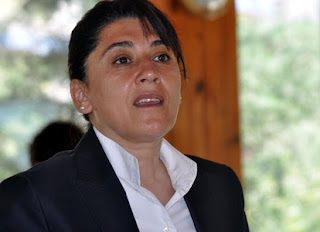
PHOTO from Hurriyet Daily News

At a time when Turkey is gearing up to craft a new constitution, its parliament is currently drafting changes to its rules that would significantly shorten the period of debate, extend sessions into the weekend if necessary, and limit proposals to draft laws.

The ruling AKP is claiming the rules are intended to streamline debate and increase parliamentary efficiency while opposition parties are claiming the new regulations are intended to silence opposition voices (for specific changes, click here). The debate reached a climax yesterday when the CHP, the largest opposition party, stormed the rostrum after Speaker Cemil Cicek closed debate after a five hour standoff wherein CHP and BDP lawmakers shouted slogans against the speaker, forcing Cicek to call numerous recesses.

The eventual result was a fistfight after Cicek closed the session. Fistfights are not altogether uncommon in the parliament, and in 2001, a similar debate over rules left one parliamentarian dead of a heart attack after a fight broke out. Cicek has been trying for the past week to reach a compromise between the AKP and opposition parties, though his efforts have clearly failed.

All three opposition parties are united against the rules changes, and claim the AKP is attempting to fix the rules ahead of the constitutional draft being submitted to the general assembly in order to easily force the document out of parliament and submit it to referendum, as the party did the 2010 amendment package. Though the AKP is three votes shy of the 330 votes (3/5 majority) it needs to pass the new constitution in parliament and take it to referendum (as it did in 2010), the opposition fears that the AKP could well cobble together this majority rather than engage all parties in a more consensual process.

Clearly such an endeavor would hurt the legitimacy of a new constitution and certainly contradict the ruling party's stated objective of achieving the widest degree of consensus possible -- but, here again, the operative word is "possible," and efforts to build consensus will depend on just how the AKP interprets this mission, and how committed it will remain to it. A party operating with a solid 3/5 majority since its entrance to parliament in 2002, consensus-building has not exactly been the party's forté, nor has it, in all fairness, to any Turkish political party. For more on this point, see E. Fuat Keyman and Meltem Muftuler-Bac's recent article in the January issue of the Journal of Democracy.

The appropriateness of fist-fighting aside, the move to change the rules has led opposition parties to boycott the constitutional reconciliattion commission charged with framing a new civilian constitution, and has, in general, detracted from the commission's task-at-hand. The commission is comprised of  12 members (three from every party) and is designed to garner consensus among political parties and civil society.

At this phase of the re-drafting process, the commission is currently seeking proposals from politicians and civil society groups, which up until recently, could be viewed publicly on this website parliament setup in October. Yet at the beginning of February the commission decided to hide the substance of proposals being submitted in order to protect the names of individuals and groups submitting them since some were quite controversial. At the moment, only the names of individuals and groups submitting proposals are left on the site. For more, see this front-page article from the Jan. 27 edition of Milliyet.

Tuesday, January 24, 2012

Accommodating "Real Existing" Kurdish Nationalism

I have recently published an article in this January's issue of the Journal of Democracy on Kurds in Turkey. The article argues that while progress has been made in recent years to recognize Kurdish ethnicity as a reality and advance cultural rights and economic development, the Turkish state has yet to come to terms with the national dimension of the problem. The article also includes a critical discussion of the positions taken by Kurdish nationalists and the government, as well as the role liberalism will play in any resolution of the conflict if it is to be settled within current boundaries.

Unfortunately one needs a subscription to Project MUSE in order to access the article, but here is the abstract.
Turkish state policy toward the Kurds, the Republic of Turkey's largest ethnic minority, has evolved from denial and mandatory assimilation to cultural recognition to acknowledgement of the Kurds' contested status as a political problem demanding political solutions. The election of 36 Kurdish-nationalist lawmakers, most of whom now sit in parliament as representatives of the Peace and Democracy Party (BDP), bolsters the salience of Kurdish nationalism and the need to accommodate it through normal politics rather than attempt to suppress it through violence. How state authorities and politicians handle the Kurdish question will continue to say much about both the success of Turkey's efforts at democratic consolidation and, more generally, the potential for democracy to manage problems involving self-conscious and mobilized national minorities dwelling within the borders of strong and highly centralized nation-states.
Many thanks to Umit Firat whose insights helped inform this article, and whose work to find solutions to transform the conflict I greatly admire. And many thanks to executive editor Phil Costopolous for his incisive editing and to managing editor Brent Kallmer for providing the abstract.

I would also like to point your attention to the three other articles in the larger cluster of articles of which mine is but a part, including Meltem Muftuler-Bac and E. Fuat Keyman's overview of AKP rule in an era of "dominant party politics," Ersel Aydinli's commentary on the current state of civil-military relations, and Berna Turam's incisive essay on civil liberties in an era in which religious and secular Turks are learning to live together. The overarching theme of Turam's article and my own is the need to settle democracy and difference, a topic I touch upon often in this blog and elsewhere.

Monday, January 16, 2012

KCK Operations Continue As Negotiations Remain Halted

PHOTO from Radikal

Continued operations against the Union of Communities in Kurdistan (KCK), the political/civil society wing of the KCK established between 2005 and 2006, have resulted in the detention of 37 Kurdish nationalist activists, many from the Peace and Democracy Party (BDP).

The raids took place on Friday, and involved searches of 123 locations, including the BDP-controlled municipal building in Diyarbakir, BDP headquarters in Istanbul, and the Diyarbakir offices of the Confederation of Trade Unions and Public Employees (KESK), as well as the Kurdish language-cultural organization Kurdi-Der, the Education and Science Workers' Union (Egitem-Sen), the Human Righs Association (IHD), as well as various other non-governmental organizations accused of being linked to the KCK. Provincial and district offices of the BDP across several provinces were also raided, in addition to, most controversially, parliamentarian Leyla Zana's Ankara home (for more on Zana, click here). For an account of the raids in English from Bianet, click here.

The BDP maintains a largely subservient relationship with the PKK, and in the past year, many of its members, with cresendoing fervor, have expressed support for the terrorist organization, including crediting the armed struggle for the progress that has been made in recent years on the minority/cultural rights front. Yet the party remains the only viable legal representative of the Kurdish nationalist movement. The KCK's establishment and activity since its founding has greatly blurred the boundaries between the BDP and the PKK, further confounding its relationship to the PKK and the independence of its members.

For their part, BDP politicians argue the government is determined to push them out of politics, and that the KCK operations are the principal means for doing this. Kurdish members of the AKP are somewhat divided on the issue of the operations. For example, AKP parliamentarian Galip Ensarioglu told Rudaw that while the operations against the KCK are sometimes inaccurate, members of the KCK should understand that "they will have to pay the consequences." Other Kurdish AKP parliamentarians -- for example, Zafer Ozdemir from Batman -- offer stronger support.

Ensarioglu, like other Kurdish parliamentarians from the AKP who tread a thin line, attempt to create distance between the ongoing operations and the government, arguing that the KCK operations are carried out by sometimes overzealous prosecutors and not the AKP. That said, it is highly unlikely that the operations would continue without the AKP-led government's consent, and indeed, government officials have openly spoken out on their status. Soon after Friday's operations, Deputy Prime Minister Bekir Bozdag said the operations will continue.

. . . .

PKK head Murat Karayilan confirmed from Kandil that he was in negotiations with the Turkish government for five years, and that for two to three years, the negotiations were direct. Karayilan has gone onto elaborate that the return of refugees from Makhmour and Kandil were the result of negotiations between Prime Minister Erdogan and imprisoned PKK leader Abdullah Ocalan, and came at the proposal of Ocalan.

On Oct. 18, 2009, two groups consisting of eight guerrillas and 26 refugees returned through the Habur border crossing between Turkey and Iraq to be met by Kurdish nationalist politicians and waves of cheering nationalist Kurds shouting pro-PKK slogans. The appetite of the Turkish public for the Kurdish opening the government had announced the previous summer was soon lost amidst displays of what looked to be victory celebrations that were broadcast for days across Turkish television.

Negotiations soon after ceased, and reports indicate that they have not picked up sense. Tapes leaked of negotiations in Oslo were released this past August, and were not denied by the AKP government. Despite the revelations that both sides of the conflict were at one point holding negotiations, there is no indication from the various centers of power within the PKK nor the AKP government that they will pick up again anytime soon.

For another PKK account of the negotiations, click here for Muzaffer Ayata's interview with Rudaw. When negotiations stopped, PKK violence escalated, and in the past year, has included violence perpetrated against civilians, including bombings in civilian areas and the abduction of school teachers sent to serve in the southeast.

Wednesday, January 11, 2012

More Trouble with Leyla Zana

BDP parliamentarian and nationalist hardliner Leyla Zana has once more incited a firestorm of criticism. In a speech delivered in Frankfurt, Zana said arms were the Kurds' "insurance policy," and that the progress the Kurds have accomplished thus far is due to the PKK's armed struggle.

This could not be further from the truth. Reform passed in recent years on the Kurdish question has occurred when PKK violence has been at a low, the result of a commitment to liberalism and political rights that has allowed Kurdish activists and politicians to more freely participate in politics, albeit with continued serious restrictions. Any progress on the Kurdish front owes itself to liberalism and the EU accession process more than to violence, which has only stalled reform and led to the old political deadlock. The state is now attempting to assert itself against a Kurdish nationalist politics that thanks to the KCK has become inextricably entangled with violence. For my past post on Zana, click here.

Prime Minister Erdogan responded today by telling Zana that she should "go to the mountain," meaning she should give up parliamentary politics and join the PKK. While this was indubitably not the most productive thing to say, it is more evidence that the prime minister is "fed up," and that it is all the less likely to engage the BDP now than before.

Erdogan also responded to comments made by BDP leader Selahattin Demirtas in response to remarks made by Chief of General Staff Necdet Ozel in an interview with Milliyet in which Ozel said he has qualms with labeling PKK members "terrorists." Demirtas had responded that Ozel did not carry as much importance as a "colonel" and that he did not care what the military chief had to say. Erdogan declared that the PKK Demirtas serves would not allow the BDP leader to shepherd 100 sheep.

PHOTO from Habertürk

The prime minister also drew attention to BDP politicians who had placed PKK regalia on the coffins of some of the 35 people who were killed in the air strikes at Uludere, accusing them of politicizing the tragedy. A parliamentary sub-commission has been established to investigate the strike at Uludere while the government still has yet to issue an official apology or admit mistakes made by MIT or the Turkish Armed Forces. Habertürk reports that the Interior Ministry has stripped a local gendarme deputy commander of his post. The Sirnak governor's office is carrying out its own investigation in conjunction with the Interior Ministry.

In other news related to Uludere, Habertürk columnist Ece Temelkuran, a prominent and controversial Turkish journalist, has been fired for apparently taking too critical a line on the tragedy. In recent columns, Temelkuran had referred to the air strikes as a "massacre." The Wall Street Journal's Ayla  Albayrak gives Temelkuran's firing attention in the international press.

Thursday, January 5, 2012

Ozel Regrets "Terrorist" Label

PHOTO from Milliyet

Milliyet's Fikret Bila has run an interview with Chief of General Staff Necdet Ozel in which the head of the Turkish Armed Forces says he would not like to call PKK fighters "terrorists" since they, too, are citizens of Turkey.

According to Ozel, many PKK fighters have been deceived, a fact which the top general laments at the same time he gives casualty figures of how many terrorists have been killed in the past six months. Turkish forces in Turkey's near 18-year conflict with the PKK. That number is at 165, according to Ozel, while 112 have surrendered and another 50 have been captured.

Ozel's intimation that PKK fighters should not be labeled as "terrorists" has infuriated many Turks, and nationalist-minded bloggers are clamoring to criticize Ozel as ineffective, and many not simply vis-á-vis the Kurdish question, but in regard to the treatment of army generals who have been arrested in the ongoing Ergenekon investigations.

In the interview, Ozel also dismissed reports that the PKK has adopted a truce, arguing that the opposite is in fact true and that PKK operations have continued throughout the winter. He also said unequivocally that the Turkish Armed Forces were in no way involved in the negotiations between MIT and the PKK that seem to have ended at the end of 2009 or beginning of 2010. Ozel further states that he is against recognizing Kurdish as an official language or integrating it into school education and using it to administer public services.

The general goes on to state that the United States has provided assistance from northern Iraq, though the Kurdistan Regional Government (KRG) has done little to assist with the situation. Iraqi officials have told Ankara that there is little they can do (see an account of TRT's interview, in Turkish, with Iraq Vice President Tariq Hashimi on Oct. 30). Meanwhile Iraqi President Jalal al-Talabani and KRG president Massoud Barzani, much to the likely frustration of Turkish officials, continue to dialogue with the BDP, urging the party, albeit without much visible success, toward peace.

Wednesday, January 4, 2012

Puppets of the PKK!, Says Erdogan

PHOTO from Hurriyet

Prime Minister Erdogan addressed AKP's parliamentary group meeting yesterday, telling BDP parliamentarians that "they could not even use the restroom without being attached to their master's strings." Erdogan was likely incensed by charges that BDP deputy Hasip Kaplan incited the beating of Naif Yavuz and strong statements in recent days by BDP leader Selahattin Demirtas.

Though AKP officials have long charged that the BDP is closely affiliated to the PKK, Erdogan's strong language evinces the intense animosity between not only the BDP and his party, but also the Turkish public. There are news reports that the KCK operations have revealed links that speeches of BDP parliamentarians are drafted by or with the input of PKK leadership, and that BDP addresses are often coordinated with terrorist attacks. Though the government is short on hard evidence, accusations of the BDP taking its orders from Kandil are likely to heighten tensions with the BDP in the coming weeks. Demirtas, for his part, compared the nationalist resistance movement to that of the Palestinians and told supporters in Diyarbakir that Kurds would "fight like Palestinians."

Erdogan's demonstrable anger is no doubt related to his utter frustration with the BDP. The AKP has been trying to broker a peace agreement since 2005. The biggest blow to these efforts came in October 2009 when a return of PKK militants returned at the Habur border crossing to be greeted by Lurdish nationalist politicians and Kurdish nationalist crowds flashing victory signs. The AKP had designed the affair to be a solemn proceeding to mark the inception of a larger peace process, but was instead met with Kurdish nationalist fanfare and an enraged Turkish public irate over what it perceived as victory celebrations for terrorists. Soon after, the AKP's "democratic opening" rapidly began to crumble and the party distanced itself from Kurdish nationalist politicians.

The failed attempt also seemed to disrupt ongoing secret negotiations the AKP and MIT, Turkey's intelligency agency, had been holding with Ocalan and PKK representatives from Europe and Kandil. Tape recordings of negotiations held in Norway between unidentified representatives of MIT and the PKK were released this past August, and in a landmark moment and to Erdogan's credit, the prime minister defender MIT and its director Hakan Fidan, as well as the potential value of the talks at the time. Yet the prime minister has said that talks have since stopped, and there is no evidence otherwise to contradict that whatever negotiations were occuring between 2005 and 2009 have begun anew.

Further, relations with imprisoned PKK leader Abdullah Ocalan, jailed in isolation on a small island called Imrali just outside of Istanbul, have also soured. Ocalan had sounded a calming note in early July, calling BDP politicians to end their boycott of parliament and calling a peace council to be formed. Yet, after these declarations in early July, the PKK launched a major attack in Diyarbakir that killed 13 soldiers. The attack coincided with the Democratic Society Congress (DTK)'s declaration of autonomy, though DTK leaders denied any connection. Erdogan quickly seemed to lose confidence in Ocalan -- either because he could not control the PKK, which in fact has multiple command centers often at odds with each other, the most important of which is Murat Karayilan's command over the organization from Kandil, or because the exiled leader betrayed him. The fact that the attack occurred right before the Ocalan's call to extend a July 15 ceasefire, and that public statements of and intelligence on PKK leadership in Kandil seemed to reveal the PKK had a different intention, lends evidence to the former. At the end of July, Erdogan declared Ocalan powerless, and shortly after cut off the exiled PKK leader's access to his attorneys, through whom the PKK leader would issue announcements to Kandil, the BDP, and the hardline Kurdish nationalist masses who support him. Talks with the BDP to re-enter parliament also collapsed.

The situation only intensified in the months ahead, though the BDP did decide to end its boycott of parliament just days before it reconvened at the beginning of October. Yet, again, soon after this decision the PKK killed 24 soldiers in Cukurca (Hakkari), the fourth most deadly attack in the history of Turkey's conflict with the PKK. The October 19 attack sparked public outcry throughout the country. In response, Erdogan increased pressure on Iraq to drive the PKK from Kandil and operations against the KCK intensified. On October 30, police detained 48 alleged KCK operatives, including controversial publisher Ragip Zarakolu and Busra Ersanli, an academic at Marmara University who was a member of the commission established to work on the constitution. KCK operations continued throughout November and December, and on December 20, over 50 individuals, mostly journalists, were detained in what police said was an operation targeting the press wing of the KCK.


With Habur, the DTK declaration, and Hakkari hardly water under the bridge, the increasing militancy of the BDP's rhetoric has curried the party little favor and driven Erdogan and members of his party to nationalist excesses of their own. Erdogan and other officials' impatience and outright anger toward the BDP, which were fully manifest in yesterday's parliamentary group meeting, have led to conjecture that the party could be closed. Yet doing so would come at tremendous political cost for the AKP. The closure of the BDP's predecessor, DTP, in December 2009, led to a wave of international criticism and significantly hampered the political process.

Whether the AKP likes it or not, the BDP is the only legal representative of Kurdish nationalism and Kurdish nationalists' only conduit into the Turkish political system. If the BDP were to be shut down, the alienation of Kurdish nationalists from the political process alredy exacerbated by the KCK operations would be near complete. Therefore, though many opinion leaders are pointing to the example of Batasuna's closure in Spain, which shared a comparable relationship to ETA before its closure in 2002, it should also be noted that Batasuna enjoyed much less political support and that the Basque nationalist political landscape was and is far more plural than the Kurdish nationalist scene in Turkey.

For these reasons, it is unlikely that the BDP will be closed; however, at the same time, it is also highly likely that the AKP will be conciliatory, especially when the militant rhetoric is escalating in intensity. The best indicator for this is the government's continued dedication to its coordinated, rapid response security measures, despite the incident in Uludere, and that Erdogan, though expressing great regret in the days following the strike, has since continued to defend the Turkish Armed Forces and intelligence agencies. It seems the state is intent to express its authority over elements of the Kurdish nationalist movement after months during which the movement used a combination of politics and terrorism in its own efforts to assert power.

. . . .

Erdogan also had strong words for Taraf, which has run stories in the past few days alleging that last week's air strike in Uludere that killed 35 innocent civilians resulted from intelligence collected by the MIT, as well as the CHP and its leader Kemal Kilicdaroglu, who has called for a parliamentary investigation of what happened.


UPDATE I (1/5) --  President Gul and Chief of General Staff Necdet Ozel met yesterday about what occurred at Uludere. Interestingly, Hakan Fidan, head of MIT, also attended the meeting. MIT is at the center of the schedule as allegations emerge that the attack resulted from faulty intelligence provided by the organization.

Thursday, December 29, 2011

Reform, Not Militancy

At a rally in Yuksekova (Hakkari), BDP leader Selahattin Demirtas again declared that Kurds want autonomy, and again, voiced implied support for violent struggle. According to Demirtas, Kurds will continue to wage resistance and fight against government pressure. The comments were made in response to government preparation's to reform laws that have increasingly been used to target nationalist Kurds who express opinions contrary to that of the government.

The government announced earlier this week that it has prepared a package of laws aimed to address the Kurdish question, including limited rights to freedom of expression and protest, as well as the possibility of an amnesty for "repentant terrorists." Though the reforms are far from a wholesale solution to current problems and come at a time when the government continues to target Kurdish nationalist politicians and journalists, as well as some Turks and Kurds whose ideas on the Kurdish question run contrary to that of the government, they are a step, however small,  in the right direction. The AKP has proposed provisions to a current law restricting speech that "incites hatred," as well as an amendment to a law that allows individuals charged with making symbols of terrorism to be sentenced to 10 years in prison and a stop to prosecutions of Kurdish nationalist activists who use "Sayin" (a term of respect) to address PKK leader Abdullah Ocalan.

On Dec. 22, just one week before the reform plan was announced, Deputy Prime Minister Bulent Arinc declared that denying the identity of the Kurdish people was tantamount to denying their existence to people. He promised constitutional and other legal reforms that would protect Kurdish identity, and it seems the AKP may be intent on delivering.

Arinc's statement and the AKP's reform plans comes on the back of the detentions of 51 assumed Kurdish nationalist activists, mostly journalists, who are alleged PKK associates. The detentions seek to repress journalists offering support (or, what is conceived by the government to be support) of ideas shared by the PKK. The journalists are accused of working in cahoots or being members of the press arm of the KCK, the political organization setup by the PKK to penetrate Kurdish civil society and political life. Yet, as with other KCK sweeps, in many cases the evidence against the alleged PKK associates is slipshod and/or condemns journalists for writing reports that might be considered to support the organization. The problems with this approach are numerous, and reflect flaws in the government's larger approach to prosecute and imprison (for very long periods of time) political actors who have not actually engaged in terrorist offenses.

That said, Demirtas' remarks echo the militancy of BDP rhetoric in recent months and will contribute little to a solution. Turkish politicians and civil society are already in the midst of a serious debate as to whether "poems, songs, and art" can be considered terrorist acts as put forward by Interior Minister Idris Naim Sahin (see Ahmet Hakan in Hurriyet). Arinc offers a potentially alternative take, and though it is still unclear in what direction the AKP will go, the BDP is making no progress on the issue by adopting a rhetoric of militancy rather than reform.

Rather than following a hardline in doubt shaped by Kandil and perhaps Imrali, Demirtas would be better to follow in the steps of fellow BDP member Serafettin Elci, who welcomed Arinc's remarks as a step forward and asked the government to produce concrete measures. The government did, showing that Elci and moderates within the BDP could be more powerful than the hardliners if given a chance.

Wednesday, December 28, 2011

The Trouble with Leyla Zana

I stopped posting on this blog just over six months ago to focus on other projects with a post-election consideration of the BDP in the aftermath of last June's elections. Much to the chagrin of some of its followers and fellow Turkey observers, this post featured a photograph of Leyla Zana, a leading Kurdish activist representing the hardline segment of the "legal Kurdish nationalist movement" who had just been elected to parliament. It seems in some ways appropriate to pick up where I left off then, and this after six months of stirring political developments in the Turkish government's relationship with the BDP, the PKK, and the KCK, the political organization founded by the terrorist PKK between 2005 and 2006 and that has increasingly complicated the Kurdish political landscape, further blurring the boundaries between the BDP and the PKK.

In a recent interview with the Danish website Rudaw, which is supported by forces friendly to KRG president Massound Barzani, Zana declared that Kurds were no longer demanding simple autonomy, but rights to self-determination (for coverage in Hurriyet, click here). The troubles with Zana's claim are many, and not least is that "autonomy" is an instrument to actualizing rights a nation possesses to self-determination. In the interview, Zana says that a referendum ought to be held to let Kurds decide whether they want a federal system, an autonomy, or secession from Turkey. While many Kurds do understand themselves as belonging to a distinct nation, understood here as a unit exerting a demand to determine its own political future based on a common sense of belonging to a group, Zana is quite wrong to declare that somehow a territorially-based autonomy agreement or something else of the sort somehow falls short of recognizing Turkish Kurds' right to self-determination, which might be accommodated through any variety of scenarios.

First, I would like to say that there is nothing in my mind wrong with Kurdish nationalist politicians and activists articulating a right to self-determination and putting forward various political agendas to that affect. Though the Turkish state is far from ready to seriously discuss any such scenario and the AKP-led government unlikely to recognize a Kurdish right to self-determination and embrace a normal politics through which that right might be accommodate through minority rights-based policy solutions, Kurdish nationalism is a reality that will eventually have to be addressed. At the same time, Zana's understanding of how a right to self-determination might be asserted and thereby accommodated reveals a larger immaturity on the part of the Kurdish nationalist movement, and when accompanied by a significant number of Kurdish nationalists' unwillingness/inability to denounce violence, is greatly problematic and likely to lead simply to more violence. Here, it is also important to note that likely more than half of the Kurds in Turkey do not necessarily share such nationalist aspirations, and of those, far fewer, likely far less than 10 percent, support secession from Turkey. Kurdish Turks are more likely to look to Turkish cities in the West, in which about half of Turkey's Kurdish population now lives, than to cities in the north of Iraq. Kurds are tied to Turkey through politics, economy, culture, and family relations.

Further, the trouble with Leyla Zana is her dismissal of individual rights-based solutions to solve the conflict. While she acknowledges the government is attempting to solve the Kurdish question through providing for individual rights for Kurds (honestly, something that is still quite lacking), she dismisses these efforts as hopeless, declaring that Kurds "are not individuals but a nation." Just as assertive varieties of Turkish nationalism threaten individual rights and liberties, so does the predominant understanding of Kurdish nationalism that exists in most Kurdish nationalist circles. Ironically, Turks (including Turkish Kurds) have moved to embrace liberalism, as revealed by the rapid face of liberal reforms passed since Turkey began its EU accession process in 1999. Though the struggle for individual liberties is ongoing in Turkey and has suffered serious setbacks in recent years, from Zana's comments, one might conclude that liberalism (and with it, liberal nationalism) has a lot further to go in the predominantly Kurdish southeast than it does in the rest of Turkey.

In the past six months, the BDP's rhetoric has become increasingly militant and separatist, and to such a degree that it is difficult to recognize the party in comparison to the Democratic Society Party (DTP) that preceded it, and which was shut down in December 2009. The DTP, though far from liberal nationalist, was more reform-driven, more open to compromise, and in many ways, up against much greater odds than the current DTP. When the DTP was in power, the opposition CHP was dominated by assertive Turkish nationalists, and the AKP, though in some ways more accommodating than it is now after two summers of violent terrorist attacks and a failed liberalization initiative, much less able to fully tackle the problem. Now that the government has made significant headway in achieving civilian dominance over the army, a reasonable, responsible Kurdish nationalist party could in many ways accomplish a great deal, albeit with considerable resistance and back-peddling. Though the AKP government might in many ways be blamed for Kurdish nationalists' drift toward militarism and alienation, this in no way alleviates the BDP from responsibility, nor can the Turkish government be blamed for being reluctant to fairly deal with a political party that continues to endorse the utility of violence and align (perhaps even coordinate) itself with terrorist activity that has in recent months targeted civilians.

A solution to Turkey's Kurdish question is possible, but not without liberalism.

Wednesday, June 15, 2011

Rough Waters Ahead?

PHOTO from Radikal

Sunday's elections created what is perhaps the most representative parliament in the history of the Turkish Republic. Of the 87% of eligible Turkish voters who showed up to cast ballots, only 4.4% voted for parties were not ultimately elected to parliament. This is down from 13% in 2007 and 32% in 2002. This representation problem has been a function of small political parties being unable to meet the country's high 10% threshold required to enter parliament. (The Kurdish BDP is an exception to this rule since it has not run as a political party, but rather chosen to run candidates as independents. A difficult feat to pull off, the BDP won 36 MPs this parliamentary election cycle.)

However, though there are now few political parties in parliament, this does not mean Turkey is necessarily any less divided. In fact, each of the four political parties now represented have unique constituencies and platforms that do not necessarily square with each other or facilitate compromise. As the AKP vows to seek compromise and civil society input as it moves forward with re-drafting the country's 1982 constitution, which was drafted in the shadow of a dramatic coup in 1980, it is unclear just how successful it can and will be.

Assessing the BDP

Cengiz Candar argues in today's Radikal that what a " BDP opening" is needed, meaning that the AKP must accommodate the voices and politics of the Kurdish nationalist party. At the same time, Candar, who is joined by other liberal public intellectuals who support Kurdish political, civil, and cultural rights, argues that the BDP has not shown itself to be a positive player when it comes to adopting the conciliatory politics required to reach a solution to the age-old Kurdish problem.

As Henri Barkey elucidated at an event at the Carnegie Endowment today (podcast here), the BDP's victory is impressive in that it resulted not only from the support it receives in the southeast (and in Kurdish areas throughout the country), but also from its tremendous capacity to organize. Successfully unning independent candidates for parliament is no easy task, and basically required the party to apportion its support for specific candidates running at the provincial level and then organize voters to elect these candidates. For example, in Diyarbakir, where support for the BDP was high, BDP supporters were divided between the number of candidates the BDP thought it could successfully run. Such a strategy requires the BDP to perform a complicated electoral math in determining just how many candidates it can elect in the context of a complicated electoral system and successfully rally the vote behind these independent candidates.

Though the BDP's success should not be underestimated, it should also not be overplayed. As Candar explains, though the BDP has gotten better at electoral engineering, political support for the party has not necessarily increased. Further, it should not be forgotten that a significant number of Kurds voted for the AKP despite its heavy nationalist rhetoric (Candar estimates 42%). Had the AKP not run a nationalist campaign in an effort to run the MHP into the ground, the result might have been different. Candar also points attention to the factions the BDP has managed to bring together (for example, bringing leftists together with staunch Kurdish nationalists and pro-Kurdish conservatives like Altan Tan and Sereafettin Elci). According to Candar, though this coalition-building is taking place at the elite level, the BDP has not succeeded in doing so among voters.

Trouble Brewing

In the days after the election, the BDP used this mammoth victory to call for the release of PKK terrorist leader Abdullah Ocalan and direct negotiations with the PKK, actions sure to infuriate the vast majority of Turkish votes. In doing, the BDP is alienating itself from the larger electorate and adopting a divisive politics sure to further fuel the conflict.

At the same time, the AKP has paid little attention to the Kurdish problem, the existence of which the party denied during the campaign, and is instead focusing on moving onward with business as usual. The two positions combined create the conditions for a political crisis, which could come soon given that six of BDP's deputies are currently in jail and their eligibility to hold seats in parliament still up in the air.

Chief among these is Hatip Dicle, who was convicted in 2009 for disseminating PKK propaganda and whose candidacy was at the heart of the riots that enfolded at the end of April when the High Election Board (YSK) invalidated the candidacies of 11 BDP candidates (see April 21 post). On June 9, just three days before the elections, the Supreme Court of Appeals upheld Dicle's conviction. Though it was too late to remove his name from the ballot, the High Elections Board will decide whether he is able to serve in parliament.

The six BDP candidates currently jailed as part of the KCK operations (and who are awaiting trial) include Gulseren Yildirm, Ibrahim Ayhan, Selma Irmak, Faysal Sarayildiz, Kemal Aktas, and Dicle. Dicle's case is special since he is not only jailed and awaiting trial for alleged membership in the PKK (KCK), but has been convicted previously and been unable to attain the necessary paperwork required to allow him to enter parliament. The Constitution bars convicted persons from holding parliamentary office. (In addition to the six jailed BDP candidates, two CHP candidates and one MHP candidate, both recently elected, are also currently detained (for their role in Ergenekon).)

Meeting in Diyarbakir yesterday, the BDP called for the release of all six elected members and demanded the release of Ocalan. If the release of the six was not controversial enough, combining such a move with Ocalan's release is not politically savvy nor helpful for the peace process. Reaction in the Turkish press, nationalist and otherwise, has been harsh, and will likely only increase in intensity should a crisis with Dicle come to a head.

Will the AKP Seek Compromise?

Speculation is still high as to whether Prime Minister Erdogan will seek a presidential term in either 2012 or 2014 given the party's successful election result. While some observers argues the party's loss of seats and new need for compromise when it comes to amending the country's constitution renders null the possibility of a powerful Erdogan presidency, others conjecture the AKP will still be able to find the support it needs to change the constitution and empower Erdogan.

The prime minister has announced that he will not run for parliament again, and the AKP's current by-laws prevent him from being appointed to another term as prime minister. CSIS' Bulent Aliriza writes
The new constitution seems certain to usher in a presidential system, and it is clear that Erdogan intends to run for the presidency, either in 2012 or more likely in 2014. If he were to choose the latter date, he would then be in a position to implement his “Target 2023” election manifesto through the centennial of the Turkish Republic as president. However, the inability of the JDP to obtain 330 seats, which would have enabled Erdogan to get public approval for a new constitution in a referendum, presents an obstacle that needs to be overcome.
Apart from the question of Erdogan continuance as the leading force in Turkish politics, the more immediate question is whether and just how the AKP will seek compromise and consensus on the constitution, especially given the likelihood of conflict over the jailed opposition candidates who have just been elected from parliament.

Again, a key question here is whether and how the party will attempt to repair the bridges it has burnt with the large number of Kurdish voters to whom the party turned its back. Though the AKP failed to push the ultra-nationalist MHP beneath the 10% threshold, according to Barkey, any increase in the AKP's number of voters (above the 50% of the country who supported it in this election) will come from nationalist voters.

Getting these votes is dependent on how the party treats the Kurdish issue, and should it be intent to continue its nationalist rhetoric, the BDP opening for which Candar hopes is simply not going to come to fruition. At the same time, the AKP has expressed intent to negotiate with the CHP and the MHP, and there are those in the party who realize the necessity of dealing with the BDP, however unsavory and threatening its politics. At the party's parliamentary group meeting today, Erdogan re-affirmed his intent to move forward with the constitution and said he would personally supervise negotiations with the opposition and engagement with civil society.

Just how all of this will happen is yet to be seen, especially given that the next few weeks could prove difficult if the courts and the YSK prevent the release and entry of those elected candidates currently jailed. And, while Turkey might have a more representative parliament, a less divided country it is not.

Tuesday, June 14, 2011

A Pyrhhic Victory?

I recently wrote a short entry on the elections for Democracy Digest, a project of the National Endowment for Democracy. An excerpt:
Increasingly, Turkey is polarized between those who support the AKP and those who do not. The AKP’s critics include not only the secular elite, but also liberals, Kurds and other minority groups, and others who fear the intolerance with which the party deals with difference and dissent.

However, the new parliament presents fresh opportunities for compromise and reconciliation. All parties agree that Turkey should adopt a new constitution, and given the CHP’s progressive turn, the country now has a genuine opportunity to pass a liberal democratic constitution that will respect and affirm the rights of all citizens.

Nevertheless, and despite Prime Minister Erdogan’s acceptance speech yesterday in which he vowed to seek compromise on a new constitution, it is possible, even likely, that the AKP will promote its agenda with minimal compromise and consultation (as it has in the past). Such a unilateral approach increases the likelihood of the new constitution entrenching the illiberal practices evident in the AKP’s current exercise of power, including the targeting of journalists, libel suits, increased reliance on executive and administrative orders, enhanced cabinet powers at the expense of parliament, limited minority rights, and restrictions on freedom of association and civil society.

Turkish civil society is crucial to ensuring that Erdogan seeks compromise with the other three political parties that have entered parliament. In this context, civil society will prove just as key to saving Turkish democracy as it did during the optimistic years after the EU accepted Turkey’s application for membership in 1999 and major reforms started coming down the pipe. Support for strengthening political parties and institution building has been enormously successful, but further progress is unlikely without funding and empowering civil society to hold the government and political parties in check and goad them to respond to democratic demands.

A democratic regression in Turkey will not only mark the end of a regional success story but also set back Islamist/conservative democrats in other Muslim states who view the AKP as an exemplar. As recent survey research attests, 66% of Arabs view Turkey as a democratic model.

Turkish democracy is neither a mission accomplished nor a lost cause. Authoritarian trends can be reversed and the AKP government may yet return to the more liberal politics of its inception. However, this will take serious work and dedication from the government, opposition political parties, and civil society. These elections and upcoming plans to draft a new constitution provide at once a strong impetus for reform and a new starting point.
For the full entry, click here. The blog is a good way to monitor political development throughout the world.

Monday, June 13, 2011

A Country Divided

Cartoon from Hurriyet

Sounding the same refrain as last September's constitutional referendum, yesterday's election results reveal Turkey to be increasingly divided between those who support the ruling AKP government and those who do not.

Yesterday the AKP managed to increase its vote from the  46.58% it captured in 2007 parliamentary elections to 49.91%, though the party lost lost seats and its 3/5 majority in parliament (see yesterday's post).

Additionally, the AKP became the first party since the Democratic Party in the 1950s to win three consecutive parliamentary elections; however, unlike the Democratic Party, the AKP has become more popular each election, not less. Yet, while the results hint at the AKP's growing popularity, they also hint at a growing disconnect between the party's supporters and those who fear its burgeoning illiberal tendencies (see last Tuesday's post).

The Other Half

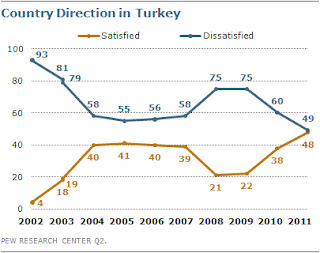
As echoed by the results of a recent Pew poll, Turkey is becoming an increasingly divided country. While those who support the AKP continue to enthusiastically return it to power, the other half (and it is literally half) of its population is deeply concerned with the direction in which the country is headed. The abyss between the two camps has grown in recent years, revealing a social phenomenon much more complicated than the narrative so often told in Western newspapers of a conflict between the ascendant Islamist middle class and the secular Kemalist elite.

Instead, what is happening in Turkey is that half the population solidly supports the AKP and its policies while the other half are becoming increasingly alienated from the party for a variety of reasons. This "other half" is not some unified Kemalist/secularist/nationalist opposition bloc, but rather represents a diverse array of different facets of Turkish society that have been left out of the AKP's increasingly hegemonic vision.

Of those opposed to the AKP, there are those concerned with the party's Turkish-Sunni chauvinism. These include not only members of a secular elite, but also Alevis (15 to 20 million people), Kurds (also 15 to 20 million people, though many Kurds are also Alevis), liberals (including Islamists), and leftists concerned about the AKP's neoliberal economic schemes. There are also plenty of observant Sunni Muslims who are nonetheless less pious than the AKP and/or increasingly concerned with the party's attempts to legislate its values. At the same time, there is a significant number of voters (~10%) for whom the AKP is not chauvinist enough. Most of these vote for the ultra-nationalist MHP.

The Next Steps

From Radikal
Starting with Refah in 1994, the AKP's antecedent, the AKP has gradually increased its votes since first elected office in 2002 with the one exception being the March 2009 local elections.

This is where the steps the AKP takes after the elections become crucial. Prime Minister Erdogan is determined to push through a new constitution that would institute a presidential system. Erdogan is widely thought to have designs on running for president should the changes come into being.

However, in a twist, though the AKP increased its share of the popular vote, it lost seats in parliament and is now short of the 3/5 majority it needs to unilaterally amend the constitution as it did last year. The loss of seats is a function of two factors,  namely a high 10% threshold and a complicated system of closed-list proportional representation: an increase in the number of independent deputies associated with the Kurdish nationalist BDP and the increased number of voters in big cities where the party tends to do less well.

As a result of the shortfall, the AKP to some degree be pressured to compromise with opposition political parties if a new constitution is going to emerge, an objective supported by all political parties entering parliament.

That said, and despite Prime Minister Erdogan's acceptance speech yesterday in which he vowed to seek consensus as his government moves forward with a new constitution, it is possible, even likely, that the AKP will use its power to push forward its agenda with minimal compromise and consultation (as it has in the past). However, the risk, of course, is the way that power is enacted  (targeting of journalists, libel suits, increased reliance on executive and administrative orders, more power to cabinet/less to parliament, limited minority rights, restrictions on association/NGO activity, etc.).

The most popular politician in the history of Turkish electoral politics, Erdogan has accomplished a tremendous electoral feat. It is more likely to encourage his appetite for power than to tame it. Power corrupts, and the more absolute the power, the more absolutely it corrupts.

Weep Not for the Opposition

And, where does the opposition stand -- and those who did not vote for the AKP? For one, it is unlikely the AKP will be able to further increase its vote. Given that the number of people unhappy with the direction in which Turkey is headed is the same number of people who did not vote for the AKP (see Pew Poll above), there is little headway the AKP can make in terms of winning additional votes -- basically, the party is maxed out.

All the same, the AKP's uncanny ability to turn nationalist then liberal -- only to do it all over again -- cannot be underestimated, and the party has a decent shot at maintaining its current numbers, especially if it decides to move again to the left so as to not be out-done by the CHP. However, I do believe the party's most recent bout of illiberalism, on full-display in its handling of the Ergenekon investigation, has burned many bridges, as did its extreme nationalist return in the past few months preceding the election.

There is little likelihood that bridges with more nationalist-inclined Kurds can be repaired given the ruling party's tenor this election cycle, especially given the failure of its Kurdish opening to deliver many concretes. Even less likely is that the party will win back the liberals and progressives who have been breaking ranks since 2005, many of whom have come to fear the party as a new authoritarian threat.

While the AKP might win some hardline nationalist votes from the MHP, it is unlikely to have much success here without losing a certain remainder of optimistic liberals who have continued to support the party for its economic successes and in spite of its illiberal tendencies.

The CHP

PHOTO from Radikal

Meanwhile, the CHP should regard its performance yesterday as a victory. "The new CHP," as the party has billed itself in the run up to the elections, managed to increase its vote share by 5% (a larger increase than the AKP) and gain 38 seats. Additionally, the CHP seems to have broadened its geographic reach, winning its party leader's home province of Tunceli while faring reasonably better in areas outside of its traditional strongholds. Support for the party might not be as deep in traditonally nationalist coastal enclaves (Antalya, Canakkale, and Izmir) as it once was, but the party has broadened its support beyond voters in these provinces while successfully moving toward establishing a different, much more liberal, pro-European electoral base.

Though no doubt disappointed, the CHP should realize it will take time for the Turkish public to trust it. A party in transition, the CHP had been up until a year ago an intolerant, oftentimes destructive force, providing people with little to no alternative but to vote for the AKP. There are likely plenty of Turkish voters who cast ballots for the AKP but are less than solid supporters; however, they do not trust the CHP either.

 Further, as Milliyet columnist Asli Aydintasbas (in Turkish) writes, the CHP lacks the organizational and fundraising capacity of the AKP and should give itself some time to catch up.

All the same, CHP leader Kemal Kilicdaroglu is likely to face extreme pressure from his party. There are already rumors that the party's old guard is plotting his demise and some papers are reporting the leader offered to step down.

Message to CHP: Patience is a virtue. After many years of not being progressive, it is simply going to take time and commitment to get people to trust in the party. If the party decides to once more change course, it is likely to do more harm than good to its long-term viability.

The BDP

The BDP is the clear winner in this election. Most pre-election polls expected the BDP to win between 25 and 30 seats, a significant increase over its present 20. However, the BDP's ability to capture 36 seats has taken many by surprise, though it should not. As mentioned above, the AKP's nationalist turn (see past post) has thoroughly alienated many Kurds. Though many of these voters were already alienated, hence the BDP's electoral success in local elections in March 2009, the most recent electoral cycle has driven many to a virtual point of no return. It will be difficult for the AKP to build consensus with the party given the bad feeling and that the BDP will feel more emboldened by this recent triumph.
The good news is that two of the party's more dovish figures, Ahmet Turk and Aysel Tugluk, who were expelled from parliament in December 2009, have returned, but so has Leyla Zana, a Kurdish militant hardliner who often advocates on behalf of the PKK. Just what the BDP will do in the coming months is uncertain, but one thing is for certain: hardline Kurdish nationalism, including militancy, got a boost this election year.

The MHP

While many thought the sex scandal would finish off what was already an ultra-nationalist party in decline, the MHP managed to comfortably pass the 10% threshold with relative ease. This might in part be due to rising unrest in the southeast and Kurdish nationalism, to which equally virulent Turkish nationalism is too frequently the response. No matter how hard the AKP tries to devour this ultra-nationalist core of voters, they still do not seem comfortable voting for Erdogan. Pro-state, nationalist idealists are just simply not going to budge on this one.

Sunday, June 12, 2011

Election Night . . .

From Radikal

Election results started to come out at six o'clock in the evening Turkey time, and it became evident early on that the AKP had a commanding lead of the popular vote. However, despite capturing a near 50% of voters, the largest percentage the party has captured since it first came to power in 2002, the party fell four seats shy of the 330 seats it needs in parliament (a 3/5 majority) to push through a constitution unilaterally. For an electoral map complete with official results, click here.


This means that for the first time in a long time the AKP will have to engage in political bargaining (see yesterday's post). Last year the AKP successfully pushed through a series of constitutional amendments using its previous 3/5 majority before successfully submitting the amendments to referendum. Meanwhile, the ultra-nationalist MHP managed to comfortably surpass the 10% threshold required for political parties to enter parliament, winning 13% of the popular vote. Though the party went from 69 to 54 seats, coming in above then 10% threshold made it difficult for the AKP to meet the 3/5 marker.

The AKP's chances at gaining a 3/5 majority were further damaged by the historical success of the Kurdish nationalist party, the BDP. The BDP managed to pick up a whopping 36 seats (up from 20), no doubt a result in part to growing disenchantment with -- and, in many cases, outright hostility toward -- the party in Turkey's mostly Kurdish southeast. Running as independents so as to escape the 10% threshold, the BDP captured 6% of the vote.

The AKP's nationalist turn, presumably an effort to win voters away from the MHP, had the predictable effect of alienating Kurdish voters. Ironically, as the only other political party competitive in the region, it also contributed greatly to its failure to win 3/5 of parliamenatary seats since the BDP fared so well. AKP's efforts to defeat the MHP were a gamble, losing Kurdish votes for ultra-nationalist votes (while at the same time empowering the BDP), and the party paid the price.

In addition to MHP votes, the party did pick up a significant number of votes from the SP (Felicity Party), a legacy of Erbakan's National Outlook movement, consolidating its control over the Islamist vote. It also picked up votes from the center-right Democrat Party, which also harkens back to an earlier era. I would venture to say these are the blocs that explain the party's ability to increase its share of the popular vote.

Meanwhile, the CHP, which took enormous risks this election cycle, performed under expectations. The CHP captured 26% of the popular vote to gain 38 seats (from 97 to 135), but some expected the party to poll over 30%. During the campaign, the CHP became by far the most progressive mainline party, taking positions more pro-European, pro-peace, and pro-liberal than the AKP (again, see yesterday's post). However, the party's controversial positions, especially on the Kurdish issue, may have alienated some in its formerly nationalist base -- votes that would have gone to the AKP or the MHP. However, nonetheless, CHP leader Kemal Kilicdaroglu and ""the new CHP" managed to gain almost 3.5 million new voters and pick up seats. Whether the CHP will continue to steer Kilicdaroglu's chart or be so frustrated with the results that it changes course once more remains to be seen.

In his acceptance speech, Prime Minister Erdogan vowed to build consensus on a new constitution and reiterated that he represented all Turkish citizens, not just those who voted for him. Prime Minister Erdogans aid the consensus would be built among political parties and civil society groups, all of which would be consulted during the process. However, the prime minister made the same promise last year and fell short.

All parties support drafting of a whole new document to replace the country's 1982 constitution drafted under military tutelage, but just what will happen in the coming months is very much up in the air. The AKP is far from weak, and could well gain the 3/5 majority it needs without too much maneuvering.


UPDATE I (6/13) -- For a truly wonderful electoral map complete with candidate names according to the provinces from which they were elected, click here. The AKP won more provinces along Turkey's more secular Western coast than it has in the past, but this should not be read as a significant setback for the CHP. Though the CHP no doubt lost votes in some of these Kemalist/nationalist strongholds, including majorities, it seems to have widened its support throughout the country, picking up votes in provinces where before it was not at all competitive.

Saturday, June 11, 2011

What Will Happen Tomorrow (And After)?

Reuters Photo from VOA Kurdish

I gave a radio interview this morning to Voice of America's Kurdish service in which I was asked what would be the impact of tomorrow's elections on the AKP-led government's plans to introduce a new constitution.  Though the interview mostly focused on the Kurdish issue, of particular interest was just how successful the AKP could be in bringing forward plans to introduce a new constitution.

If the AKP wins at least 330 seats in the parliament (it now has 336), it will be able to introduce constitutional amendments without the need for much consensus before taking them to referendum -- an approach the AKP took last year and with great success. If the party manages to surpass 367 votes, it will have a 2/3 super majority that will allow it to unilaterally overhaul the constitution without the need for referendum. While the latter is unlikely and the former in doubt, the larger issue is just how sincere the party is in its reiterations that it will seek consensus as it moves forward. At the moment, all four parties with a chance of entering parliament have pledged to adopt a new constitution.

Last year, the party showed little concern as it pushed amendments rapidly forward. Neither civil society nor opposition political parties were given much voice in the process and the result was a referendum that basically polarized the Turkish public. The Kurdish nationalist BDP boycotted the referendum while the CHP and the MHP campaigned hard against the amendments. Though the official result was 58%, the actual number of Turkish citizens who approved the changes was lower given that a large number of Kurds who did boycott.

If the referendum is taken as a measure of the support for the AKP, it can be said that roughly over one-half of Turkish citizens approve of the party and the direction in which it is taking the country. This matches more or less with what a recent Pew poll found. According to the poll, 48 percent of Turkish citizens are satisfied with the direction the country is taking; however, 49 percent responded they are dissatisfied. The satisfied voters, more or less, can be assumed to be likely to vote for the AKP, but of more interest are those who are not. How many of these voters are simply typical Turkish cynics and how many are disenchanted with the party? The rising number of potentially disenchanted is cause for concern (and that is more than an understatement).


One of the most pressing problems in Turkish politics today is the amount of polarization in Turkish political society. Some of this can be explained by the increasing illiberal attitudes and policies of the AKP (see Tuesday's post), which, of course, is made all the more problematic by the AKP's seeming lack of willingness to engage opposition parties and craft serious political compromises when it comes to making government policy. Without an entrenched rights-based liberal democracy, the lack of compromise becomes all the more disturbing. A unilaterally-drawn up constitution will only serve to further polarize the Turkish public while continuing to fail at any real resolution of the classic dilemma posed by democracy and difference.

However, should the AKP fall short of 330 seats tomorrow, the party will be more inclined to compromise. Just exactly what this process of compromise would look like and what parties it would include remains to be seen, but perhaps for the first time in a long time the AKP will be forced to work with other parties to carve out a political agenda.

At stake are Erdogan's ambitions to institute a presidential system that would facilitate his ascendancy to the presidency. If Erdogan wins comfortably tomorrow, he will be more confident in these efforts. Even should the AKP fall short of gaining 3/5 of the seats in parliament, an increase in the popular vote for the AKP will embolden the already emboldened leader to move forward in his quest.

Meanwhile, just as interestingly, the CHP, which has drastically changed its leadership and party platform, will discover whether its new position in Turkish politics will be rewarded. The CHP is expected to pick up seats and increase its vote either way, but will likely have a difficult time gaining the 30% of the vote for which the party is striving. The CHP, which has billed itself as "the new CHP,"  has taken enormous risks this election cycle, presenting itself as pro-Europe, pro-liberal, pro-peace, and importantly, anti-nationalist and anti-coup. With Kilicdaroglu's victory over the party stalwart and former party secretary-general Onder Sav last year, the party has turned 180-degrees in many of its policies, especially in regard to the Kurds and its former pro-military/pro-coup attitude. Defeating Sav, Kilicdaroglu remarked, "The empire of fear is over in the CHP. Now it is time to end the empire of fear in Turkey."

The MHP will also face a serious test tomorrow. A little less than a month ago, there was serious question as to whether the ultra-nationalist party would be able to surpass the 10% threshold required to enter parliament. However, polls conducted at the end of June put the party safely over the threshold. That said, just how well the party does tomorrow will have an impact on the number of seats allocated to the AKP and CHP. The AKP has been competing for its nationalist voter base while the CHP's recent positions, especially in regard to the Kurds, might have alienated some in its former nationalist base to vote for the MHP.

And, finally, not without its own test will be the Kurdish nationalist BDP. The BDP currently has 20 seats in parliament, just enough to form a parliamentary group and be represented. However, there is little doubt that the BDP will surpass this number and could pick up well over 30 seats. Though the BDP candidates are running as independents since there in no chance they could meet the 10 percent threshold, the rising force of the party in the southeast and in Western cities populated by a large number of Kurdish migrants will indubitably be one of the most important stories of this election cycle. As its main challenger, the AKP's increased nationalist rhetoric is likely to work in favor of the party.

We'll see what tomorrow brings.

Monday, May 16, 2011

Detentions and Arrests Spike in the Southeast

Newroz demonstrations in Diyarbakir / PHOTO from Efe

The number of detentions and arrests in Turkey's mostly Kurdish southeast has drastically increased in the past month. The spike follows the BDP's "democratic solutions" campaign launched in March, as well as the mass unrest two weeks ago following the Election Board's attempt to bar some candidates from the pro-Kurdish BDP party from running in parliamentary elections. The number of people detained and arrested in conjunction with the government's ongoign operations against the KCK is also part of the equation. From Bianet:
A total of 2506 people were taken into police custody in Turkey between 24 March and 11 May 2011. Operations that resulted in the arrest of more than 400 people were carried out between the Newroz celebrations (end of March) and 1 May demonstrations.

According to the Dicle News Agency (DİHA), an estimated 2506 people were taken into police custody for political reasons in the course of police operations that started after the Newroz festivals and peaked with the veto decision of the Supreme Election Board (YSK) on 18 April. Hundreds of people were arrested. Only within the past five days, 155 people were taken into custody and 53 people were arrested.

According to data compiled by DİHA from the news the agency obtained, more than 2000 people were taken into custody between 24 March and 29 April, a period of six weeks. On 29 April, the last day of this wave of operations, at least 66 people were taken into custody in seven different cities.

According to figures announced by the Human Rights Association (İHD), 831 people, 189 of whom were children, were taken into police custody after the veto decision of the YSK between 19 and 29 April. The YSK had decided to bar twelve independent candidates from the general elections, a decision that was partly reversed later on. During the same period of time, two people were killed by the police and 308 people were injured during demonstrations.

* At least 177 people were taken into police custody in the scope of operations carried out between 29 April and 5 May.

* On Friday 6 May, 163 people were taken into police custody in Kurdish provinces and Hatay/Dörtyol, Bodrum and Adana, 19 of whom were arrested. On 7 May, another 24 arrests and an additional eleven people were registered.

* This rate increased further between 7 and 11 May. Throughout five days, 155 people were taken into custody and 53 were arrested. On 9 May, seven university students were arrested, among them one DİHA reporter. On 10 May, 34 people were taken into police custody, three of them are alleged members of the 'Group Comment' organization.

* Police operations were conducted in Hakkari, Mardin, Şırnak, Diyarbakır, Siirt, Van, Urfa, Söke, Erzurum and Malatya between 7 and 11 May.
Detentions and arrests are different in Turkey. Polce have the right to detain suspects for up to 24 hours, and a judge may extend this time to 48 hours, excluding the time it takes to transport detainees from different facilities. During this time, a detainee is entitled to the right to an attorney.

However, under the Anti-Terrorism Law, in cases where a suspect is thought to be linked to a terrorist organization no such right is afforded. In the southeast, this is the case in the vast majority of detentions. In most of these cases, detainees are not allowed to see an attorney until after the detention period is over, allowing police to freely interrogate people without an attorney "getting in the way." According to human rights groups, it is during this time that torture and other forms of ill-treatment is most likely to occur.

According to Serkan Akbas, a lawyer with the Diyarbakir Bar Association,  most detentions and arrests are based on photographs of people attending this or that event or meeting with people thought to be associated with the KCK or PKK. This has long been the case, though I assume the situation has gotten only worse. A mere photograph and a vendetta can land a person in serious trouble.

Detentions also routinely follow demonstrations and clashes with police, such as have been occurring in relation to the "peace tents" the BDP has setup in relation to the "democratic solutions" campaign.

Those arrested during protests can face more jail time than actual militants who decide to surrender. Under a limited amnesty law, militants receive a maximum of six year and three months in prison. Meanwhile, protestors can face between seven and 15 years in prison. For more on this, see Human Right Watch's November report on protesting as a criminal offense.

Further, arrests, even if based on the shoddiest of evidence, can land one in prison for months. According to the Minister of Justice, the average length of time between arrest and a trial verdict was 580 days. The problem of prolonged periods of arrest is indubitably a violation of the right to an expedient trial guaranteed under the European Convention of Human Rights. In the wake of the Ergenekon and Sledgehammer investigations, yhe practice has been criticized by the Turkish Bar Associations' Union. Bilgi Univeristy law professor Idil Elveris writes about the issue here.

Sunday, May 15, 2011

A Bloody Weekend, A Riotous Week

PHOTO from Radikal

Predominantly Kurdish cities throughout the southeast are in an uproar this week after clashes with PKK fighters attempting cross the border from northern Iraq resulted in the death of 12 militants. PKK news sources claim five Turkish soldiers were killed in retaliation. Major fighting has been taking place on the border since the Turkish military launched a large-scale operations on Thursday.

According to news reports, three of the bodies were not collected by the Turkish Armed Forces and returned to their families, as is usually the practice. In an effort to retrieve the bodies, a group of approximately people marched from Sirnak province over the Iraqi border, where they got into a confrontation with the Turkish military. The conflict was defused by local officials, after which the military retrieved the bodies to in the end return them to relatives.

Just one month before elections, Kurdish AKP deputy Galip Ensarioglu accused the powers-that-be of using the clashes as a means to stoke ultra-nationalist sentiment and keep the MHP above the 10% threshold. The AKP is attempting to win voters from MHP's usual constituency in an effort to have the part fall below the threshold, the occurrence of which would help secure an AKP super-majority.


UPDATE I (5/17) -- Bianet reports that 47 people were detained on Sunday night in Hakkari (like Sirnak, also on the border with Iraq) after protests there. There were also wide-scale protests in Diyarbakir and Istanbul. In Istanbul, 1,000 people assembled outside Galatasary Lisesi on Istiklal. Bianet also reports that Turkish military officers today fired upon a high school in Cizre, a town in Sirnak, after students began to protest and shout pro-PKK slogans.

Radikal reports that Sirnak governor Vahdettin Ozkan requested Gen. Mustafa Bakici to collect the bodies, but that the general refused on the grounds that the people should "experience the power of the state." There are also allegations that the Turkish military insensitively called BDP offices and told them to come pick up the bodies of the militants. None of this has been confirmed. BDP deputy Gulten Kisanak conveys her narrative of what happened here. It all seems like an incredibly confusing incident with plenty of politics on both sides.

Prime Minister Erdogan is set to hold an election rally in Siirt on Thursday.

Monday, April 25, 2011

Kurdish Nationalism is Not Going Away

The backs of young men shouting slogans in support of Ocalan and the PKK at a festival organized by the Diyarbakir municipality. PHOTO by Ragan Updegraff

In the wake of the spate of violence sparked last week after the Elections Board (YSK) decided to bar 12 BDP candidates from running in June's parliamentary elections (the board decided on Thursday to reverse the decision), this Monday, as last, threatens more unrest as police acted to detain prominent BDP politicians.
Police detained 35 people Monday in the southeastern province of Hakkari, including the deputy mayor and other local officials, in connection with ongoing investigations into the Kurdish Communities Union, or KCK.

The operations, reportedly carried out by police with special authority at city-center locations and at the “Democratic Solution Tent” set up by the pro-Kurdish Peace and Democracy Party, or BDP, drew strong criticism from the party.

“This policy of the government is aimed at emptying out our party and [demoralizing] all those who love peace and democracy. This is psychological warfare,” said Mehmet Salih Yıldız, an independent candidate for Parliament supported by the BDP.

The 35 people who were detained in the operations include Hakkari Deputy Mayor Nurullah Çiftçi, Vice Mayor Hatice Demir, provincial council head Ferzınde Yılmaz, BDP provincial chairman Orhan Koparan, BDP central district chairman Kenan Kaya, the area “muhtar” (headman) and members of the provincial council and the municipality.

The suspects will be transferred to court after being questioned by the Hakkari police, the Anatolia news agency reported.
The recent operations in Hakkari are sinfificant in that they include top officials in the BDP-governed municipality, which is one of the most fervent BDP strongholds in the country. Since local elections in March 2009 in which the BDP captured large majorities in several southeastern provinces, the party has worked hard to govern these municipalities as relatively sovereign from Ankara. The party has focused on providing municipal services and using the municipality in novel ways to further its political agenda, including organizing political fora, such as the "democratic solution" tent in Hakkari, that challenge the AKP's approach to dealing with the problem.

And what is that approach? For many Kurds, more important than the "Kurdish opening" is what they see as the ruling party's attempts to suppress Kurdish political organization that challenges the AKP agenda. Though the "Kurdish opening," which was soon changed to a "democratic opening" and then to a project to promote "national unity and brotherhood," promised to offer solutions to long-existing problems, particularly in the area of cultural and minority rights, the opening gained little momentum and was largely dead by October. (For a history of the opening up to May of last year, click here.) After a very violent summer, there is little hope for the opening in the region and the AKP is facing record lows in terms of its popularity in provinces like Hakkari and Sirnak.

Monday's detentions will only further stoke nationalist sentiments and resentment against the AKP among Kurds already inclined to support the BDP. Combined with the complete and utter mess that defines the trials of alleged "KCK members" currently ongoing in Diyarbakir and Van, relations between Turks and Kurds will get worse before they get better. The BDP stands to gain votes as a result of the increased tensions, and in my analysis, the AKP is misguided if it thinks it can seriously "remove" (a nasty word) the Kurdish political actors it deems more unsavory.

Some leading AKP figures have attempted in the past year to distinguish between "bad Kurds" and "good Kurds," the main criterion for the separation between the two being the latter's support of the government. If the AKP thinks this a waiting game, that these players, attitudes, and demands will just go away with enough repression, it is sorely mistaken. As former Turkish security officials and long-time observers of the Kurdish question can testify, such an approach has been taken before, it has failed before, and it will fail again.

Hence, we have former Turkish officials like retired MIT deputy director Cevat Ones calling for  a serious reconsideration of the problem, a re-working of Turkish nationalism and the constitutional foundations of the Turkish state that accommodates the self-determination demands of nationalist-minded Kurds. Ones's words seem to be falling on deaf ears, but the problem is not going away. (See Nese Duzel's column in Taraf (in Turkish) for more on Ones.)

Thursday, April 21, 2011

Mass Protects Continue in Response to YSK Decision

President Gul called today for Turkey's Supreme Election Board (YSK) to solve problems surrounding the candidacy of 12 BDP members the BDP put forward earlier this month. The YSK barred these candidates from running on Monday, sparking protests across the country that are still ongoing and have resulted in at least one death. The YSK, under tremendous pressure, is set to meet tomorrow to review its decision.

On Monday, the YSK set a deadline of Wednesday for the candidates to submit proper documentation that they had resolved outstanding issues related to prior convictions. The YSK lifted the barring of some BDP candidates, including Sebahat Tuncel, Gültan Kışanak, Leyla Zana, Ertuğrul Kürkçü and Hatip Dicle, after candidates submitted proper documentation.

The YSK is backing down on its decision and most surely looking for an exit strategy despite earlier declarations it would stand by its decision. That said, some candidates have yet to be reinstated and so the issue is still up in the air as to whether the BDP will actually go through with its threat to boycott the June elections.

The YSK decision has also raised discussed of the 10% threshold currently in place for Turkish parties to represent parliament. If the BDP candidates had been running a full-fledged party members rather than independent candidates, they would not have been subject to the YSK's scrutiny.

More as it happens . . .


UPDATE I (4/22) -- The YSK has reversed its decision (from Radikal, in Turkish).

UPDATE II (4/24) -- Aengus Collins reflects on the YSK debacle and "the rules of the game." An excerpt:
As soon as the YSK barred the Kurdish candidates, the game was lost. There were better and worse ways of trying to recover the situation, but none that would prevent a bright light being shone on serious problems. Had the YSK dug its heels in and insisted that the rules gave it no choice but to exclude the candidates from June’s election, Turkey’s outrageous infringements of the political rights of its Kurdish voters and politicians would have been advertised more glaringly than is usually the case.

Far preferable, then, for the YSK to have reversed its decision relatively swiftly? Well, yes, up to a point. The decision’s reversal is to be welcomed. But look at what it says about the robustness of the system that underpins Turkey’s electoral mechanics. On Monday, the rules were interpreted to mean that these individuals had forfeited the right to stand for election. This was the conclusion of a state body the decisions of which are not subject to appeal. And yet on Thursday the same body performed a neat little pirouette to arrive at more or less the opposite of its position on Monday.

What does this tell us about the integrity of the rules? It tells us that what matters in Turkey is not the formal construction of the rules, but the spirit in which they’re interpreted and implemented at any given time. This is not a phenomenon peculiar to Turkey, and it is not a phenomenon that necessarily yields negative results. But at a time when Turkey is considering a wholesale revision of its constitution and when the gap between lofty democratic rhetoric and grubby coalface politics is wider than ever, it warrants some attention.