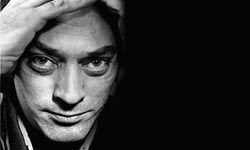
PHOTO from Hurriyet
Paul Auster and Prime Minister Erdogan stirred a controversy after Auster gave an interview to Hurriyet in late January in which the Jewish-American author said he would not visit Turkey due to the number of imprisoned writers. Prime Minister Erdogan fired back at his party's parliamentary group meeting a few days later, calling Auster "ignorant" and hypocritical for visiting Israel, which the author visited in 2010. The spar between the two men only ratcheted up when Auster issued a response in the New York Times in which the prominent author reiterated his concerns about press freedom in Turkey. CHP opposition leader Kemal Kilicdaroglu soon jumped into the fray, inviting Auster to come to Turkey at his invitation, after which another back-and-forth ensued in which Erdogan said Kilicdaroglu and Auster should "go for a picnic together" atop a hill in Israel overlooking Gaza.
Just why these remarks triggered such a firestorm is something of a mystery to outsiders of Turkey (I have had four people ask me this in the past two days), but it has a lot to do with the sensitivity of the prime minister and the political opportunism involved on all sides. After all, this is politics. If Erdogan had simply let the author's comments go by the wayside when first they were issued, this would be a non-story. Yet Erdogan decided to attack Auster, not only contradicting his claim writers were being imprisoned in Turkey for expressing their views (according to Erdogan's public statements, these writes are "terrorists," people who plotted to overthrow the government or who supported the PKK), but linked Auster to the Palestinian-Israeli conflict, a move sure to win him popular support among the party's base.
As far as I can tell, Auster has been largely ambivalent on the issue of Israel's occupation of the Palestinian territories, but at the same time, Erdogan's ad hominem attack on Auster is more deflection than reasoned response, and in turn, Kilicdaroglu's backing of Auster an attempt to put raise the profile of the continued attacks on press freedom in Turkey, and of course, win political points in so doing. To me, what is significant here is that Auster's comments, whose Jewish ancestry and shakiness on the issue of occupation make for an easy target, were so singled out by prime minister. Erdogan's remarks, while not necessarily anti-Semitic, show the familiar lack of control for which the prime minister has often been criticized by friends and enemies alike.
Most interesting here is how Erdogan and others in the AKP, as well as AKP-friendly public opinion leaders, were quick to label Auster as either a victim or perpetrator of a massive smear campaign designed to discredit the party. Sabah columnist Nazli Ilacak portrays Auster as seriously misinformed, but places the blame on an organized psychological campaign being carried out against the AKP-led government. Is the misinformation that made its way to Auster the product of Ergenekon? Is this the kind of black-ops for which former General Chief of Staff Ilker Basbug is currently imprisoned?
According to AKP Vice President Bulent Gedikli, the answer is yes. In a statement made yesterday, Gedikli said, "Paul Auster is part of the plot." "What plot?" I might ask, but many in the AKP, including a number of their supporters, would dismiss me as a fool -- and do so quite sincerely.
The narrative of many in and supportive of the AKP is defined by victimage, of shadowy forces conspiring to keep them at the bottom ranks of society and far removed from political power even when every indication of the Turkey that exists after nearly ten years of AKP rule is that the reality could be further from the truth.
Unfortunately, this narrative is largely a by-product of real policies in over 80 years of Turkish history that were designed to do just this -- most significant among them, at least in terms of the historical memory of those currently in power, the Feb. 28 process that brought down the elected Refah party government in 1997 and the policies to follow that were designed to, though not so successfully, to keep political Islam in its place and guard against the rise of a pious majority. The narrative is one of oppression, and democracy, for many, therefore understood solely in terms of allowing for the majority, long downtrodden, to finally take the reigns of power. For those who imagine plots at every corner and shadowy networks bent on destruction, democracy is about liberation, but it is not necessarily liberal.
What the recent Auster imbroglio reveals is that these myths are not gone from historical memory, and despite ten years of dominant party politics, will likely not be gone anytime soon. Also revealed is that playing on these anxieties, especially if the opponent is as easy a target as Auster, can garner a good bit of political capital. At the end of the day, Erdogan likely emerged stronger and the victim mentality ever more entrenched while few will remember who Paul Auster is in a few months time.
Showing posts with label Political Culture. Show all posts
Tuesday, February 7, 2012
Thursday, March 25, 2010
Professor Jenny White on Nationalism and Islam
Professor Jenny White recently gave an interview to the new blog Changing Turkey in a Changing World in which she discusses the existing literature on Turkish politics and history, including on the question of nationalism and Islam. She also discusses her most recent book in the Kamil Pasha series, The Winter Thief, which was just released.
Sunday, March 21, 2010
Paranoid Politics and Seismic Risks
Istanbul-based freelance journalist Claire Berlinski has a particularly cutting and perspicacious piece on Turkey that ran in The Wall Street Journal about a week ago. The piece struck me when I read it then, and I think it useful to post if only to share Berlinski's portrait of a country that is difficult to easily paint and abundant in contradictions, mysteries, and potentials for obfuscation. Incisive and polemical in the many points of argument and analysis she presents, Berlinksi draws particular focus on what she considers to be Turkey's paranoid style of politics.
Almost everyone in Turkey subscribes to one of two conspiracy narratives about this party or its antagonists. In the first, the AKP is a party of religious deception that seeks to bring all elements of the government under its control. Its hidden goal is the eradication of the secular state, the wrenching of Turkey from the West, and, ultimately, the imposition of Islamic law. In this narrative, the specter of the sect leader Fethullah Gülen, who has undefined ties to the party and has taken exile in Utah, arouses particular dread. His critics fear he is the Turkish Ayatollah Khomenei; they say that his acolytes have seeped into the organs of the Turkish body politic, where they lie poised, like a zombie army, to be awakened by his signal.In the piece, Berlinksi also assesses Turkey's large informal economy, which Berlinksi assesses has "been exaggerated by statistical legerdemain," as well as what she seems to in part symbolically put "among the most serious of Turkey's problems" -- "the grave seismic risk to Istanbul," which according to Berlinski, is effectively "ignored in the constant din of mutual accusations." Berlinski concludes:
The second version holds that the AKP is exactly what it purports to be: a modern and democratic party with which the West can and should do business. Mr. Gülen's followers say the real conspirators are instead members of the so-called Deep State—what they call a demented, multitentacled secret alliance of high-level figures in the military, the intelligence services, the judiciary and organized crime.
Neither theory has irrefragable proof behind it. Both are worryingly plausible and supported by some evidence. But most significantly, one or the other story is believed by virtually everyone here. It is the paranoid style of Turkish politics itself that should alarm the West. Turkey's underlying disease is not so much Islamism or a military gone rogue, but corruption and authoritarianism over which a veneer of voter participation has been painted.
The system does not look too undemocratic on paper. Turkish political parties are structured, in principle, around district and provincial organizations. There is universal suffrage, but a party must receive 10% of the vote to be represented in Parliament. Party members elect district delegates, district presidents and board members. Yet Turkish prime ministers have near-dictatorial powers over their political parties and are not embarrassed to use them.
Protesters against the rash of coups d'etat in downtown Istanbul in February.
.It is theparty members, not voters, who pick the party leader. Members of Parliament enjoy unlimited political immunity, as do the bureaucrats they appoint. The resulting license to steal money and votes is accepted with alacrity and used with impunity. Corruption and influence peddling are the inevitable consequence. Business leaders are afraid to object for fear of being shut out.
Conspiracies flourish when citizens fear punishment for open political expression, when power is seen as illegitimate, and when people have no access to healthy channels of influence. They give rise inevitably to counterconspiracies that fuel the paranoia and enmity, a self-reinforcing cycle. Throughout Turkey is the pervasive feeling that no one beyond family can be trusted.
The common charge that the AKP is progressively weakening the judiciary and the military is objectively correct, as is the claim that this concentrates an unhealthy amount of power in the hands of the executive branch. Yet the prime minister and his intimates insist that their actions are defensive. "For 40 years, they have kept files on us. Now, it is our turn to keep files on them," AKP deputy Avni Doğan has said.
Their enemies voice the same worldview. "When you look at Turkey today, it is as if the country has ... fallen under foreign occupation," the leader of the opposition CHP party Deniz Baykal has said.
Paranoia is inevitably also grandiose. When the House Committee on Foreign Affairs passed up the recent resolution to describe the massacre of Armenians in the First World War era as a genocide, Suat Kiniklioglu, the spokesman of the Foreign Affairs Committee of the Turkish Parliament, explained Turkey's outrage thus: "I think the Americans would feel that same if we were to pass a resolution in our parliament talking about the treatment of [native] Indians in this country."
Mr. Kiniklioglu speaks fluent English; he has spent years in the West. Yet he is blind to the most obvious of facts about American culture: No one in America would give a damn.
The failure to prepare for this predictable event is a betrayal of trust, like so many the Turkish people have suffered. Each deepens the paranoia. Each citizen believes that to survive, he must lie and conspire. Everyone assumes everyone else is lying and conspiring against him because he himself is lying and conspiring.
Turkish Ambassador Namik Tan recently said that the West "must understand that in this region, two plus two doesn't always equal four. Sometimes it equals six, sometimes 10. You cannot hope to understand this region unless you grasp this."
Psychiatrists are typically advised to attempt to form a "working alliance" with the paranoid patient, avoid becoming the object of projection, and provide a model of non-paranoid behavior. This is also sound advice in diplomacy.
But paranoia is known to be a particularly intractable disorder. Those who experience it do not trust those trying to help them. The West should keep this, too, in mind, for the paranoid spiral here could easily do what spirals are known to do: spin out of control.
Thursday, January 28, 2010
Postmodernity and the Arc of Turkish Identity
Ferhat Kentel, Professor at Istanbul Sehir University / PHOTO from the Balkans ProjectThe Balkans Project recently featured a fascinating interview with Ferhat Kentel, a sociologist at Istanbul Sehir University. Working on the construction of Turkish national identity, Kentel is examining one of the most controversial and heuristic themes in Turkish politics -- in many ways, a theme that defines, and most certainly pervades, every aspect of political discourse, be it Turkey's efforts to come to terms with its minorities (Muslim and non-Muslim), its attempts to reconcile Islam and the Turkish naton-state, its ongoing EU accession process, its confrontration with ultra-nationalist elements like Ergenekon, its international relations, etc. I have provided excerpts in this post, though I most definitely recommend reading though the whole interview.
This new situation is not just about the disappearance of the old Turkish national identity. Someone can feel that he or she is Kurdish, another Turkish, another Moslem, and these all together. All are negotiating identities. Turkishness is a negotiation as well. It becomes a crisis situation for the integration and unity of this society. I am working on this polarization between the early national construction and the new emerging complex identities and trying to find if there is a possibility of a new language, another way of speaking about this society.Kentel goes onto discuss the origins of Turkish national identity, and the haven Muslims in the Balkans found here in the face of Christian racism and European nationalism following the collapse of the Ottoman Empire. As Kentel notes, these Turks are the most keen to identify themselves as Kemalists, and eager to embrace Turkey as a newfound home, largely left their old identities behind for something new and modern. In the epigram of his epilogue to Postwar: A History of Europe Since 1945, Tony Judt quotes Ernest Renan:
I’m not just focusing on identity, but also people’s relationship with everyday life. Everyday life is the humus that lies beneath these identities. These different identities emerge from everyday life.
What does it mean to be a Turk today? The most prominent aspect of this established modern identity is a defensive one. When it emerged at the end of the Ottoman Empire, Turkishness was new. It was promoted in the name of a modernizing subject, in the name of enlightenment. It was connected to the creation of a new modern nation-state, to Ataturk, to Kemalism, to secularism, to the flag. To be Turkish was to be something modern. But today, it is more and more defensive. It refers to an older time. For that reason, it is more and more aggressive against the new voices.
Forgetting, I would even go so far to say historical error, is a crucial factor in the creation of a nation; thus the progress of historical studies is often a danger for national identity . . . The essence of a nation is that all individuals have many things in common, and also that they have forgotten many things.Turks, like other European nations, have forgotten many things. At the same time, what awaited those immigrants was a refuge from the discrimination, suffering, and war they had known in the past; in Turkey, they found a new home. Kentel's analysis of ultranationalists is different: not having immigrated from the Balkans, they were often left outside of the Kemalist project. According to Kentel, ultranationalists generally look to the Caucasus and Asia for their roots, often pointing to Central Anatolia as the origin of Turkish identity. Yet, I have met plenty of people who share both perspectives, often the products of mixed marriages between Balkan and Anatolian Turks, merely all the more proving Kentel's argument of the negotiation, multiplicity, and inherent complexity underlying Turkish national identity.
Kentel also explores the lack of understanding between Turks and Turkish minority groups, who are all too routinely bifurcated from one another in the literature into the oversimplified categories of "majority" and "minority." One need only to look at Hrant Dink to see how reality is far more complicated. Dink, proud of his Armenian heritage, never rejected his "Turkishness," but rather understood it differenty; sadly, it was this "different" understanding that led to his murder by people who adopted a defensive understanding of what it meant to be Turkish, and in turn, conspired to kill Dink. Similar kinds of negotiation and multiplicity also hold true for Kurds, Alevis, Greeks, Circassians, Laz, Roma, all of these groups and the diverse individuals in them approaching what it means to be Turkish differently. Many of the identities overlap, and few break down into the nice, neat categories in which they are often placed. Yet, for those Turks who did leave so much of their history behind, the issue of settling these multiple identities and the insistence that they be recognized is difficult. Kentel explains:
These Balkan-origin Turks are also the most reticent on the Kurdish issue. It seems to be a psychological dimension: These Turks left behind their traditional sense of belonging, so they cannot accept another people claiming their original identity. “We gave up ours,” they say, “why can’t you give up yours?” I hear this even from the Uyghur-origin people who came to Turkey during the last decades. “We were oppressed by the Chinese state,” they say. “We came to Turkey and this state protected us. We cannot betray this state. How can you Kurds do what you are doing?” Of course, the Kurds were not migrants to this country. Nor were the Armenians. They are autochthonous peoples of the Anatolian territories.Holding the traditional/pre-modern construction of Turkish national identity in opposition to the modern, Atatürkist understanding, Kentel highlights the conflicts and convergences between the two. Though Kentel does dwell too much on Ottomanism in his analysis, I think it too is probably worth examining in the mix, conflicting and converging with the other two in all sorts of ways relevant to political identity. And when religion is added into the mix, identity becomes all the more complicated, pushing and pulling with all of these other elements in what I have described elsewhere in this blog as a kaleidoscopic fashion, shifting and turning to suit the situation at hand or whatever the mood of the moment may be. Identity not being something intractable and constant, but rather adaptable and changing, Turks may well be all the richer for the multi-dimensional complexity of their specific identity(ies) despite the difficulties in its negotiation.
And, yet, though Turks have long negotiated these identities, and too often with a good bit of phobic defensiveness, the increased travel and business between countries (which Kentel assesses as weakening the defensive posture of Turkish nationalism -- see my post, "Article 301: An Imperialist Discourse," on the Sevres syndrome), the rise of political Islam, and European discourses about a postnational, multicultural Europe have all drastically pushed that negotiation into a new realm. I perhaps too optimistically evaluate the role of Europe, but the former two have certainly had a tremendous impact on just what observers of Turkish politics are seeing. Yet, as Kentel describes, this "opening" is not unqualified.
There are two contradictory tendencies, each one feeding and reinforcing the other. As we open up, the fear inside becomes more intense. Imagine all the people living under this ideology that says that we are alone, that we are superior, but that everyone fears us. What do you with the burden of this ideology? The opening of frontiers – in the world at large and in our minds – radicalizes the Turkish defensive identity. We are now living in the middle of this clash.As Barrington Moore described the transition to democracy as wrought with discord and violence, so perhaps is the journey to new, more open, more complex cultural identities. Much has been made of the rise of ultranatonalism in Turkey in recent years, the street protests and ethnic clashes that have erupted on the streets of Turkey's cities with an unwielding, defensive sort of hatred (see Ece Temelkuran n the Guardian, 2007); yet, is this perhaps a sign that things are getting better, that Turkey is moving forward in some sort of cultural transition of which we have yet to see the arc?
What I mean by a new Turkish identity is not just a global, liberal, or cosmopolitan identity. It is more complex. Part of this new identity is the overcoming of the ruptures of Kemalism. Kemalism required a rupture with the Ottoman era that defined it as an ancien regime. It involved a rupture around borders. It created a Turkishness on this territory with Arabs, Kurds, and others, but this required a rupture with the Arabs of Arabia, the Kurds of other countries and so on. Today it is not necessary for a nation-state to isolate itself this way. Our task is to reconstruct the bridges with all those populations and histories with which we have ruptured.
This new identity is looking for new words, new definitions.
Provocatively, Kentel lays out a possible journey, eschewing cosmpolitianism, liberalism, and racist traditionalism for something far more intriguing -- and perhaps, liberating.
So we can make a three-fold distinction. The first is cosmopolitanism or the loss of specific Turkishness. The second is the concentration, redefinition, and reshaping of Turkishness in a more racist way. And the third is an open-ended alternative: we don’t know where we are going but there is another way. This third situation, the creation of new meanings, is the revolutionary tendency.Examining the construction of Turkish identity as affected by a series of historical ruptures, Kentel goes onto explore how Islam is bringing to light the ruptures of Kemalism.
This new identity, if we summarize, is made also by linking to the past. It doesn’t involve returning to the past but, rather, struggling against the ruptures of history, against the categorizations of old/new, rational/irrational and so on, and against all the modernist constructions created by these categories.
Right now society is caught midway between Islam and modernity. Or, rather, there is no distinction between Islam and modernity as it was defined by modernist approaches. When you listen to some Islamic actors who focus on the authenticity of the Islamic message, they say that the majority of Muslims are lost now, that they have become almost like Protestants, that they only think about symbols of wealth, that they have lost the original message of the religion. But other, modernist voices inside the Islamic universe say that, no, the religion is not frozen in the 7th century, that Moslems as individuals must adapt to the new situation. This is a more liberal, maybe “Protestant” Islam, more individualized. They don’t forget that they are Moslem. They are still good believers. “I am essentially a businessman,” this kind of believer will say. “But five times a day I pray and then it is finished. My practice of Moslemhood doesn’t take more than one hour a day.” There is no difference with people who do gymnastics for one hour a day or do Indian meditation. This person’s identity is that of a businessman first.Just what that model will be or laboratory yield remains to be seen, but it truly is incredible, not to mention intellectually humbling, to be the midst of it.
So, they are not just Moslems, but they have a class position too. The Moslem businessmen’s union and the labor union of Moslem workers do not necessarily share the same communitarian Moslemhood. They are in conflict. The bourgeois Moslems say, “We are all Moslems, so accept your salary.” But the workers say, “No, we are not all Moslem brothers. You are rich and we are poor!”
There was a declaration recently launched by three Moslem women. “We are not free yet,” they said, referring to the liberalization of headscarves for a couple months before the constitutional court forbad them again. During this period, they said, “We will not be free until the Armenians, the Kurds, the Alevis are free too. We will not be free until the rights of shipyard workers are recognized.” They are very Moslem. They wear headscarves. They dream of living in an Islamic society in which Islam is recognized totally. But in their minds there are other possibilities for how to live with others. If someone doesn’t want to wear a headscarf, she is free to do so. This is something new. This is not the traditional Islam or the Islam of Kemalism. This third version has links with the new Turkish identity, which in turn has links to the past. They are important actors for this new Turkishness. Their Turkishness is not defensive. It is not racial. They are Turkish because they live in Turkey.
Turkey can be perceived as a model or a laboratory for the whole world.
Thursday, January 14, 2010
Multiplicity and Elif Shafak

A little less than a month ago I attended a talk Elif Shafak gave in which she alluded to the potential for holding multiple identities. For those who are not familiar with Shafak's work, Andrew Finkel has presented a fairly solid glimpse of someone whose refusal to be easily categorized makes any endeavor to profile Herculean. Though Shafak spoke in Turkish, which I am still very much at the incipient stages of coming to grasp, I was able, most surprisingly, to at least catch the broad outlines of her talk. Shafak's English, in which she also publishes, is like embarking on a long journey in which her use of language leads the way. It is not so much that her plots are secondary, but that they are at one with her language, making the latter not just a vehicle for telling her story, but in many ways the very story itself. Describing English as more mathematical than Turkish, I can only imagine what Shafak must be like in her mother tongue. That said, a critical pillar of her speech, and her work in general, is her conviction that identity should be characterized by a certain multiplicity and adaptive capacity. As Finkel quotes Shafak,
"You have to move beyond categories of good and bad. People are multi-layered and you can’t judge them by blocks and association.”Yet, as Shafak laments, categorization is strongly rooted in Turkish society, a phenomenon in which she seems to hope to complicate in both her literature and her politics.
Additionally, Shafak's talk gave me reason to look back at a study exploring political idenity among Turkish youth, some of the results of which were released this past September. The study, carried out by NYU professor of applied psychology Selcuk Sirin, found political identity for Turkish youth is not so singular, settled, or intractable -- all phenomena which Shafak would be likely to celebrate. Qantara's Jan Felix Engelhardt interviewed Sirin in September. For more on the study, including some of Sirin's results, as well as a bit of analysis, see Jenny White's Sept. 15 post.
For a penetrating article by Shafak on Ask, her most recent book, and writing in multiple languages, see this March article from Zaman (in Turkish). One of Shafak's most prominent crusades is to heighten the vocabulary employed by Turkish youth -- no doubt perhaps useful in describing poitical attitudes that, at least according to Sirin's study, are becoming increasingly complex.
Monday, December 22, 2008
A Smoker and an At Times "Ordinary" Man: Heaven Forfend!
From TDZ:
Journalist-documentary maker Can Dündar gave testimony at the Ankara Prosecutor’s Office on Saturday after criminal complaints were filed against his latest documentary film, which recounts the lesser-known sides of the life of Mustafa Kemal Atatürk, the founder of the Turkish Republic.For more on Dundar's film, click here.
“Mustafa,” which hit the theaters on Oct. 29, Republic Day, was the latest effort by Dündar, who has written and directed several documentaries on the life of Atatürk over the past 15 years, starting with his 1993 television documentary “Sarı Zeybek.”
This latest film brought with it heated debate in all segments of society over whether it depicts Atatürk’s character and private life correctly.
Criminal complaints against Dündar were filed by three individuals.
On Nov. 10, the anniversary of Atatürk’s death, Ahmet Ercan, founder of the Anti-Smoking Association, and Orhan Kural, honorary president of the Fighting against Smoking Foundation, filed a criminal complaint against “Mustafa,” in which Atatürk is frequently shown smoking.
The complaint reads: “The content of the film and its interpretation of its topics damage the republic and Atatürk. Damaging such values can lead to the breakup of Turkey and to the loss of national pride. On top of that, the father of the Turks has been shown smoking and drinking heavily. His esteem has been lowered. A person who was a good example for Turkish youth has been killed spiritually. The biggest cigarette advertisement in Turkish history has been made using Atatürk.”
Ercan and Kural submitted the petition to the Şişli Prosecutor’s Office to be sent to the Ankara Chief Prosecutor’s Office. They claimed that Dündar’s film violates the law on “preventing damage from tobacco products and their control.”
Another criminal complaint against Dündar was filed by lawyer Gülnihal Soydan, who claimed a lawsuit should be filed against not only Dündar but the entire cast and the sponsors of the documentary.
Soydan claimed that the documentary depicted Atatürk as an ordinary man by referring to him as “Mustafa” and constituted a crime under a law regarding crimes committed against Atatürk.
Thursday, December 11, 2008
Women in Politics and the Türban Bugaboo
Turkey was one of the first countries to allow women to hold elected office, but out of 8,794 men who have been elected to Parliament since 1935, the year in which Turkish women first took office, only 236 women have been elected. While it is true that women now hold a near 10 percent of seats in the Turkish Grand National Assembly (though many are in DTP), only a mere 2.32 percent hold local office. Even more shockingly, only .56% of all elected mayors are women. Out of those women who are elected to Parliament, many are so beholden to the males in their respective parties that they rarely speak out on their own accord. In the cabinet, there is only one woman, Nimet Çubukçu, and she is charged with women's issues. Many of these women are dependent on a tightly-controlled political party system that systemically preserves patriarchy as well as it does the elitism and nepotism long characteristic of Turkish party politics. Women are few and far between, especially women taking progressive political positions, and as if they did not face enough challenges, over sixty percent are barred from entering the public sphere as a result of their headscarves.According to a recent report from AKDER, preoccupation with the türban issue has not only taken the focus off improving the status of women in politics, but systematically denied a majority of Turkish women rights to political participation. As a result of the headscarf bugaboo, women have also been deprived of rights to education, employment, and economic and social security. Women who wear the headscarf are further subjected to abuse from society-at-large, in addition to the pain that comes with knowing one is not able to fulfill their potential.
Forbidding women to exercise their basic rights or barring their entrance to public places unless they take off their headscarves is clearly a form of violence. According to CEDAW, "gender based violence is violence that is directed against a woman because she is a woman or that affects women disproportionately."[65] Then again “being denied access to existing rights” is a form of violence against women. In addition, we must accept discrimination on the grounds of clothes worn on the basis of religious conviction as violence.As TDZ's Roberta Davenport gleans from the report, “If the authorities had spent one-tenth of that energy and time bringing solutions to the long list of real women’s problems, the status of women in Turkey would be much better today -- problems such as the fact that only one-quarter of women are employed and have poor access to health insurance or a pension, that more than 5 million women are illiterate, that although one in three Turkish women have been exposed to violence, that there are only 38 shelters for women in a country with 81 provinces and a population of 72 million.”
Women sometimes took their headscarf off just because they were “persuaded” by an employee or because they were threatened or injured physically. Sometimes they were insulted by staff or thrown out of a place and threatened with prosecution. Being turned off university campuses is a very common experience. YÖK (the Higher Education Council in Turkey , the central state body which regulates the whole of university education, including private universities, and has a reputation for applying restrictive and repressive policies) has published circulars to ensure that veiled women are not admitted into university staff’s residential quarters.[66] Women have been ejected from exam rooms because university staff did not approve of their wigs[67] and when a woman went to take her driving test, she was told “showing your hair will not damage your virtue and honour”[68] and frogmarched to the door by police.
Headscarfed women receive treatment very much like that received by black people in an apartheid society, unable to enter white people’s churches, restaurants bus stations and barred from higher education a situation which can cause real psychological trauma.[69]
Physical attack harms physical integrity, but an emotional and psychological attack damages emotional and psychological integrity. As psychiatrists might put it, the attack on the headscarf ban is an attack on personal identity for women who view the headscarf as part of their identity. The anger and frustration that headscarfed women feel at the cutting short of their future plans, the feelings of internal conflict, the strong feelings of having their path blocked when they refuse to take their headscarf off, and the feelings of guilt if they do take it off all amount to a highly destructive experience. [70]
Because wearing a headscarf is a woman’s conscious act and her own decision, the psychological damage is heightened even more. If the “uncovered head” which is being imposed in the interests of modernity were merely a matter of clothing, if the condition for entering education was to dress in green from head to foot, every woman who wanted to continue their education might have put up with such a rule even if it were against their individual preference. But the fact that the headscarf is worn for religious reasons makes the dilemma much sharper for women. The headscarf ban puts women in the position of submission to government authority, the school or the employer, choosing between wearing the headscarf or exercising her rights.
Removing a woman’s right to choose her own clothes under such circumstances is a profound external interference. Forcing a woman to either uncover her head or give up her rights is psychological violence, in the same way that forcing a woman to cover her head is psychological violence.
This is a current and ongoing violation because the ban remains in place and subjects women to constant negative feelings and thoughts. When women who choose to wear the headscarf for their own important reasons are confronted with coercive interference from the state, and not wanting to take the headscarf off are forced to do so, they suffer severe internal conflict at having to act contrary to their own choices and determinations.
The research entitled “Covered Reality of Turkey” has determined that women who had to take their headscarf off were indeed badly affected. The research found that 70.8% of women who removed their headscarf believe it damaged their personalities, and 63.2% felt insulted.[71] Consequently many women chose to stay away from education rather than take off their headscarf. But this in turn left those women feeling empty because they were not permitted to fulfill their potential.
In a recent survey by the World Economic Forum, its annual Global Gender Gap Report, Turkey ranked 123rd of 130 countries analyzed --a dismal result for a country in which men and women are legally equal, and more so, a society hugely supportive and proud of its inclusion of women in the public sphere.
To rectify women's subjugation in politics, some have advocated using gender quotas to bolster the participation of women in politics. Women's groups take different positions on the use of quotas, but many, like AKDER, have supported quotas as a means of positive discrimination by which to promote the equal participation of women in politics. Prime Minister Erdoğan opposes quotas, saying that they would make women dependent on the benevolence of men. However, as others have argued, it is hard to see how this is not already the case. AKDER was particularly perturbed last month after its campaign for gender quotas won the endorsement of TÜSIAD only to be criticized by Erdoğan. For many women's rights activists, the prime minister generated further doubt of his support for women in politics when he stated in March -- and on International Women's Day -- that every Turkish woman should give birth to at least three children.
PHOTO of Emine Bozkurt, European Parliament Rapporteur on Women's Rights in TurkeyNo political party has been particularly supportive of women's rights, and when women do reach political office, they either take a back seat or are used as political pawns. As Itir Bağdadi, lecturer at İzmir University of Economics, alluded to at a panel I was able to attend at this year's Middle East Studies Association (MESA) conference, women in the public sphere often behave as if they have to prove their masculinity -- often eschewing their interests as women, and perhaps going so far as to even compensate for their perceived femininity. The example Bağdadi brought up was former prime minister Tansu Çiller, who despite being rather centrist before landing in the position of prime minister, soon became a national security hawk. Çiller was Turkey's first female prime minister, and one of the first female leaders of governmet anywhere in the world. However, in Turkey, she is largely remembered as fomenting the war in the Kurdish southeast. The war deeply damaged Turkey's reputation around the world, failed to quell the PKK, and involved military/deep state tactics that systematically killed, injured, and displaced large swaths of Turkish Kurds, many of whom are still displaced today. Previous to rising to power as prime minister, Turgut Özal had been president, and his conciliatory stance on the Kurdish problem placed Turkey in the unique position of negotiating a solution -- a prospect with which Çiller was in favor when she said she favored a "Basque solution" to the problem (Zürcher). However, faced with pressure from Kemalist hardliners and what was likely a perceived exigency to prove herself "tough" on national security issues, Çiller led Turkey into a vicious political cycle from which it would not extricate itself until 1999. According to most of the women with whom I have talked, women are still very much reluctant to embrace their identities as women in the public sphere, and either resign themselves to work in a specific policy portfolio of "women's issues," or so respond to the double bind in which they are caught by abnegating their femininity.
Regardless of their weakened positions in party politics, women have become key public players. Women's groups are a critical sector of Turkey's inchoate civil society, and their strength is exemplified by the reforms these groups have helped secure. For example, in 2004, women's organizing resulted in the creation of a more progressive Turkish Penal Code. The voices of women were also harnessed in 2007 in opposition to the Turkish government's abortive attempt to change the constitution so as to characterize women as a vulnerable group in need of special protection.
Recently drawing attention to the dearth of women in politics, Emine Bozkurt, European Parliament Rapporteur on Women's Rights in Turkey, described the problem as systemic, eschewing arguments of culture and chalking women's discrimination in politics up to the political system. Bozkurt's arguments give further argument to quotas, but as AKDER acknowledges, should gender quotas become a reality, they do little for the estimated 62 percent of women denied the right to hold political office. From AKDER:
The United States Supreme Court Justice Louis Brandeis, in a judgment in 1927 stated that “Men feared witches and burnt women.” While problems of women’s rights, modernization, human rights, and democracy are being discussed throughout the rest of the world in the 21st century, Turkey , for the last ten years, has been preoccupied with whether women with headscarves have the right to enter higher education institutions. The talk is of progress and the contemporary world, but what is actually happening is that women who wear the headscarf are being excluded from society, and while the arguments about the headscarf/türban drag on, no serious steps are being taken about women’s existing and all-too-real problems.For more on Turkey's preoccupation with the headscarf debate and the crippling position in which it leaves women, see Feb. 19 post. If CHP is serious about its recent change of heart, it will do all it can to immediately rectify what its politics of division has done to impoverish Turkish women.
Monday, December 8, 2008
"Why I Love Turkey's Smoking, Drinking Founding Father"

From Aslı Aydintasbas in Forbes:
It felt like treason, and it probably was.For full article, click here.
I was betraying my country in that dark seedy room, afraid someone would recognize me in the very act of selling out the republic. Ah, the republic that emerged from the ashes of a bankrupt empire, as we were reminded every day in school, with amazing human sacrifice and collective determination to create a fresh new order.
That would be the Republic of Turkey, my homeland. And I was about to betray it by attending the noon showing of a controversial film about the life of its founding father, Mustafa Kemal Ataturk.
Mustafa opened in theaters on Oct. 29--the 85th anniversary of, well, the republic--to the delight of an eager crowd. A general-turned-statesman, Ataturk not only led an epic war of independence against the invading Western powers in 1919, but also transformed a declining Ottoman Empire to a modern republic by abolishing the sultanate, the caliphate and establishing a secular democratic system. His radical reforms--ranging from adopting the Latin script to equality for women--revolutionized Turkish society and anchored the young nation to the west.
Saturday, December 6, 2008
Intellectuals, Party Politics, and Hopes for the Future
Mümtaz'er Türköne examines intellectuals' relationship to politics, specifically the CHP. While holding intellectuals to task for adopting the same elitism as CHP members, Türköne acknowledges many to have supported AKP because of the party's pro-democracy and pro-EU agenda. Türköne is responding to a column by Oral Çalışlar in the leftist Radikal in which Çalışlar laments the emerging pro-establishment --meaning more nationalist/statist -- position of AKP, a development which has come to concern many progressive intellectual reformers as of late.
As CHP moves further to the right in its efforts to reach out to religious Turks, many of whom live outside the country's urban centers or are recent immigrants to the cities, AKP seems to be more accepting of CHP's pro-military/nationalist positions (and, before this, overly-concerned with its socially conservative base). Where does this leave pro-democracy intellectuals, who Türköne identifies with the left, and who have before supported AKP as a result of its liberal democratic credentials? At the moment, Turkey has no center-left party (see Erik Zürcher's recent critique of Turkish politics). While AKP can be aptly, though perhaps not adequately, explained as a center-right party (the party is economically and socially conservative), CHP is traditionally regarded as the establishment bastion of the Turkish left. However, CHP is more staunchly nationalist than it is pro-labor, more concerned with preserving Kemalist understandings of secularism --and, frequently, even ethnic solidarity -- than it is with promoting economic and social rights. Neither party is willing to aggressively address the issue of rights for ethnic and religious minorities, gender inequities, or draconian restrictions on the freedom of expression. Türköne intimates that intellectuals would be best represented by a third party, but in the end concludes that in the absence of a party, AKP is still the best hope. From Türköne:
An AKP stalwart, Türköne's conclusion is far from surprising, but interesting is his resignation at the structure of political parties. Türköne discounts the important role played by emerging Turkish civil society groups operating at the grassroots, and seems to suggest political parties to be the only driving force in democratic politics, in Turkey or otherwise. Attacking Çalışlar's position on political parties, Türköne argues that their predominance in Turkish politics has more to do with political culture than it does with the Political Parties Law. While this may indeed be the case, an issue addressed in my post two days ago about youth participation in politics, it does not mean that Turkish political leaders should not promote a more participatory polity.
Political culture is not static, and in Turkey, seems to be on the verge of recovery. Türköne's argument that intellectuals are best served by AKP may indeed be the case when it comes to the ballot box, but it is their engagement with the party outside of the dictatorial normal politics of inner-party decision making in which lie the best prospects for Turkish democracy. The development of a vibrant and diverse civil society is precisely what is needed in Turkey because the political party system is so impoverished, and one of the reasons for this poverty is the exact same party-centric view Türköne perpetuates. As Turkish citizens from a variety of religious and ethnic backgrounds, social classes, and political groups come to participate more in politics, Turkish political parties will in turn become more diverse, and consequently, more sophisticated in their understanding and approach to politics -- regardless of whether these citizens cover their heads, speak Kurdish, or practice heterodox forms of Islam. Increased participation in and organization of Turkish civil society should translate to increased demands for better representation, and demands for better representation are the only hope that a more democratic party politics might one day come to pass.
As CHP moves further to the right in its efforts to reach out to religious Turks, many of whom live outside the country's urban centers or are recent immigrants to the cities, AKP seems to be more accepting of CHP's pro-military/nationalist positions (and, before this, overly-concerned with its socially conservative base). Where does this leave pro-democracy intellectuals, who Türköne identifies with the left, and who have before supported AKP as a result of its liberal democratic credentials? At the moment, Turkey has no center-left party (see Erik Zürcher's recent critique of Turkish politics). While AKP can be aptly, though perhaps not adequately, explained as a center-right party (the party is economically and socially conservative), CHP is traditionally regarded as the establishment bastion of the Turkish left. However, CHP is more staunchly nationalist than it is pro-labor, more concerned with preserving Kemalist understandings of secularism --and, frequently, even ethnic solidarity -- than it is with promoting economic and social rights. Neither party is willing to aggressively address the issue of rights for ethnic and religious minorities, gender inequities, or draconian restrictions on the freedom of expression. Türköne intimates that intellectuals would be best represented by a third party, but in the end concludes that in the absence of a party, AKP is still the best hope. From Türköne:
Because of the elitist tradition on which it has relied, the CHP has failed to appeal to all of society and has not overcome its image as a bureaucratic party destined to always act as an opposition party. This was a problem of not only the CHP, but also intellectuals, who, like the CHP, are the products of the elitist tradition. However, intellectuals have a greater dilemma than the CHP. This is because intellectuals are accepted as intellectuals to the extent that they appeal to society. Unlike the CHP, they have to do things beyond this elitist tradition in order to advocate freedom, democracy and the rule of law. This accounts for why intellectuals cannot join the CHP, but at the same time, have problematic relations with conservative and traditional circles.For full article, click here.
As the CHP reviews its elitist past, intellectuals are discussing their problems with the Justice and Development Party (AK Party). Having supported the AK Party against the militarist and bureaucratic political guardianship, intellectuals are now questioning this support.
In Turkey, being an intellectual makes you automatically leftist. As the term "left" or "leftist" are preferred concepts in Turkey, these intellectuals tend to define themselves as "democrats." Although this designation is used for a different reason, it means "liberal" as it does in the US Democratic Party. The designation of "democrat" is used out of habit or for convenience for these intellectuals, most of whom are former Marxists. Oral Çalışlar, a Radikal columnist, says the number of these intellectuals is "40 or 50 at most," but this is not a small number either. As an intellectual acts as a translator for the feelings and tendencies of the masses who cannot express them, this figure is rather high. To dispel any doubt, we may also provide some names. This is a long list including Ahmet Altan, who ruthlessly shoulders the entire burden alone, the Altan brothers, Eser Karakaş, Şahin Alpay and Cengiz Çandar.
. . . .
First, we need to question the frequently voiced theses that "The AK Party is not democratic" and "Everyone seeks democracy for only their own community." How can one suggest that a political party -- not only the AK Party, but also the CHP and the Nationalist Movement Party (MHP) -- do not support democracy, which is their raison d'être? How can intellectuals, who are supposed to defend freedom against all sorts of power, yield to democracy, i.e., the rule of the people? Isn't there a problem with the description "a democratic intellectual who says the AK Party is not democratic"?
Our political system, which we call a representative democracy, is run through political parties. When you take political parties out of the system, there remains nothing that we can call democracy. Democracy is what makes parties exist. Parties are what make democracy exist. The description "a party that is not democratic," which Çalışlar is comfortable using, is not quite accurate. If he refers to "intra-party democracy," it is an altogether different topic. The political system that is up and running inside political parties is a product not of the Political Parties Law, but of the political culture of the nation.
An AKP stalwart, Türköne's conclusion is far from surprising, but interesting is his resignation at the structure of political parties. Türköne discounts the important role played by emerging Turkish civil society groups operating at the grassroots, and seems to suggest political parties to be the only driving force in democratic politics, in Turkey or otherwise. Attacking Çalışlar's position on political parties, Türköne argues that their predominance in Turkish politics has more to do with political culture than it does with the Political Parties Law. While this may indeed be the case, an issue addressed in my post two days ago about youth participation in politics, it does not mean that Turkish political leaders should not promote a more participatory polity.
Political culture is not static, and in Turkey, seems to be on the verge of recovery. Türköne's argument that intellectuals are best served by AKP may indeed be the case when it comes to the ballot box, but it is their engagement with the party outside of the dictatorial normal politics of inner-party decision making in which lie the best prospects for Turkish democracy. The development of a vibrant and diverse civil society is precisely what is needed in Turkey because the political party system is so impoverished, and one of the reasons for this poverty is the exact same party-centric view Türköne perpetuates. As Turkish citizens from a variety of religious and ethnic backgrounds, social classes, and political groups come to participate more in politics, Turkish political parties will in turn become more diverse, and consequently, more sophisticated in their understanding and approach to politics -- regardless of whether these citizens cover their heads, speak Kurdish, or practice heterodox forms of Islam. Increased participation in and organization of Turkish civil society should translate to increased demands for better representation, and demands for better representation are the only hope that a more democratic party politics might one day come to pass.
Thursday, August 7, 2008
History as Ideology
In recent months, I have been struck by how little many Turks know about Ottoman history. Most of the Turks with whom I am in contact tend to hale from more "Kemalist" families and are the products of an educational system that tends to place republican history over Ottoman history. For those who might not be aware of the difference, republican history can be said to start with the Turkish war for independence from those European empires who desired to see Anatolia divided as spoils in the aftermath of World War I. Of course, the most critical figure in republican history is Atatürk, who as founder of the republic, built the nation-state that was to become the Republic of Turkey. While learning republican history is no doubt critical to the education of future Turkish citizens, Ottoman history is largely undermined in the Turkish educational system. This is not to say that young Turks do not learn about the Ottoman Empire or that educators should spend more time on the Ottoman history than that of the Turkish republic. However, it is to say that there is a deficit in the teaching of Ottoman history and this shortcoming is no doubt partly motivated by ideology.
It is in this context that Abdullah Gül's appointment of Professor Ali Birinci to head the Turkish Historical Association (TTK) is controversial. Unlike his predecessor, Professor Yusuf Halacoğlu, Birinci is not a staunch Kemalist of the old variety, but rather is known for his critical opinions. Most polemical is his working friendship and support of colleague Atilla Yayla, who was recently found guilty of insulting Atatürk when he criticized Kemalism and intimated that it was backward to have so many pictures of Atatürk on display.
When Atatürk founded the Turkish Republic out of the ruins of the Ottoman Empire, he was left largely with Anatolia, the traditional Turkish heartland a large swath of which had been traditionally ignored by the Ottomans. However, before Atatürk, when the Ottomans were ruling from Topkapı, and later Dolmabahçe, most sultans spent their time looking toward the Balkans. The lands to the west, to which some Turks still refer as Rumeli ("Land of the Romans"), were the center of Ottoman focus--the pride of the Ottoman Empire outside İstanbul, largely regarded as the jewel in the center. However, as the "Sick Man of Europe" entered decline in the nineteenth-century, these treasured lands were largely dwindled by Ottoman failures at the hands of the fast-emerging European empires of the nineteenth-century. By the time World War I came and the Ottomans made the catastrophic choice of allying with Germany, the Ottomans realized they were fighting for survival. Already faced with the ideological challenge of the Young Turks, of whom Atatürk was a member, the conclusion of World War I called for a new ideology by which to unite Anatolia. As the Turkish heartland of the vanquished Ottoman Empire, Atatürk imposed the European ideology of the nation-state and built a country among the largely Turkish-speaking peoples which would soon be asked to rise to their new position of citizens of the young republic.
As a Young Turk, Atatürk had decried Ottoman failures to keep pace with European technological developments as the result of the Ottoman's outdated politics. Since its founding, the main source of identity in the Ottoman Empire had been that of religion. While the Ottomans established zones of religious freedom and tolerance within their imperial rule, these zones were predicated on religious identity. Called millet, the Ottomans granted legal recognition to a variety of religious communities, including Greek Christians, Armenian Christians, and Jews. Although millet is translated in modern Turkish as "nation," under the Ottomans the idea was quite different. The Muslim majority did not belong to a millet, but as Ottoman historian Norman Itkowitz elucidates, existed as the community of the Prophet, the umma as described by Islamic political theory. While members of the umma were regarded as Muslims, they were not necessarily regarded as Ottomans. As Itzkowitz further explains, Ottoman identity was something to be attained through climbing the stratified ranks of the landowner class. Thus, citizenship and identity in the Ottoman Empire can hardly be said to be pluralistic, as some Turks nostalgic of Ottoman history have told me, and modern political terms simply do not make sense when describing Ottoman realities. In marked contrast, Atatürk--and the Young Turks who came to power in the oft-ignored coup of 1913--sought to replace Ottoman notions of political identity and citizenship with conceptions that had been developed in Europe and that were quite outside Ottoman or Islamic experiences. While there is a dearth of research about the continuities between Young Turk/CUP ideology and Kemalism, it can be said simply that the state Atatürk built was quite radical insomuch as it forced a modern nation-state model on a society to which the idea of ethnic nationalism was quite foreign. The social engineering in which Atatürk engaged to make this possible is that extant in the Turkish educational system today, and it is also a reason why education is perhaps the most critical battleground to be drawn between the Kemalists of the "secular" old guard and the emergent political Islamists. Atatürk's abhorrence for the Ottoman-style of governance is reason for why so many Turks who are my age have little knowledge about Ottoman history.
In contrast, if I have questions or want to talk about Ottoman history, there are a few individuals to whom I know I can turn and it is little coincidence that many of these people are more sympathetic to political Islam and AKP. I must also say that some of the friends I have met here who are well-versed in Ottoman history are not necessarily sympathetic to political Islam or AKP, but at the same time, would not call themselves "Kemalists" or adopt the Manicheanism typical of leaders like Deniz Baykal. While they might dislike the "green capitalism" of AKP and Islamic leaders like Fethullah Gülen, find the radicalism of the Nur movement and older Islamic leaders like Erbakan off-putting, and be flatly opposed to any kind of Islamic governance, they are usually interested in Islam's religious values and are quite comfortable with using Islam as a source for political guidance. For many of those Turks who are proponents of AKP and a greater role for Islam in politics, many do indeed turn to examples of Ottoman greatness for examples of how an Islamic society can achieve parallel success. Despite that many of their analogies are sometimes more than a bit overdrawn, many Turks are coming to be interested in Ottoman history both for its own sake and for the exemplary value knowledge of Ottoman governance might have in generating arguments that challenge the status quo.
Gareth Jenkins discusses this dynamic and to what historian Andrew Mango has referred as the new "Ottoman nostalgia" in his recent article in the Eurasia Daily Monitor:
It is in this context that Abdullah Gül's appointment of Professor Ali Birinci to head the Turkish Historical Association (TTK) is controversial. Unlike his predecessor, Professor Yusuf Halacoğlu, Birinci is not a staunch Kemalist of the old variety, but rather is known for his critical opinions. Most polemical is his working friendship and support of colleague Atilla Yayla, who was recently found guilty of insulting Atatürk when he criticized Kemalism and intimated that it was backward to have so many pictures of Atatürk on display.
When Atatürk founded the Turkish Republic out of the ruins of the Ottoman Empire, he was left largely with Anatolia, the traditional Turkish heartland a large swath of which had been traditionally ignored by the Ottomans. However, before Atatürk, when the Ottomans were ruling from Topkapı, and later Dolmabahçe, most sultans spent their time looking toward the Balkans. The lands to the west, to which some Turks still refer as Rumeli ("Land of the Romans"), were the center of Ottoman focus--the pride of the Ottoman Empire outside İstanbul, largely regarded as the jewel in the center. However, as the "Sick Man of Europe" entered decline in the nineteenth-century, these treasured lands were largely dwindled by Ottoman failures at the hands of the fast-emerging European empires of the nineteenth-century. By the time World War I came and the Ottomans made the catastrophic choice of allying with Germany, the Ottomans realized they were fighting for survival. Already faced with the ideological challenge of the Young Turks, of whom Atatürk was a member, the conclusion of World War I called for a new ideology by which to unite Anatolia. As the Turkish heartland of the vanquished Ottoman Empire, Atatürk imposed the European ideology of the nation-state and built a country among the largely Turkish-speaking peoples which would soon be asked to rise to their new position of citizens of the young republic.
As a Young Turk, Atatürk had decried Ottoman failures to keep pace with European technological developments as the result of the Ottoman's outdated politics. Since its founding, the main source of identity in the Ottoman Empire had been that of religion. While the Ottomans established zones of religious freedom and tolerance within their imperial rule, these zones were predicated on religious identity. Called millet, the Ottomans granted legal recognition to a variety of religious communities, including Greek Christians, Armenian Christians, and Jews. Although millet is translated in modern Turkish as "nation," under the Ottomans the idea was quite different. The Muslim majority did not belong to a millet, but as Ottoman historian Norman Itkowitz elucidates, existed as the community of the Prophet, the umma as described by Islamic political theory. While members of the umma were regarded as Muslims, they were not necessarily regarded as Ottomans. As Itzkowitz further explains, Ottoman identity was something to be attained through climbing the stratified ranks of the landowner class. Thus, citizenship and identity in the Ottoman Empire can hardly be said to be pluralistic, as some Turks nostalgic of Ottoman history have told me, and modern political terms simply do not make sense when describing Ottoman realities. In marked contrast, Atatürk--and the Young Turks who came to power in the oft-ignored coup of 1913--sought to replace Ottoman notions of political identity and citizenship with conceptions that had been developed in Europe and that were quite outside Ottoman or Islamic experiences. While there is a dearth of research about the continuities between Young Turk/CUP ideology and Kemalism, it can be said simply that the state Atatürk built was quite radical insomuch as it forced a modern nation-state model on a society to which the idea of ethnic nationalism was quite foreign. The social engineering in which Atatürk engaged to make this possible is that extant in the Turkish educational system today, and it is also a reason why education is perhaps the most critical battleground to be drawn between the Kemalists of the "secular" old guard and the emergent political Islamists. Atatürk's abhorrence for the Ottoman-style of governance is reason for why so many Turks who are my age have little knowledge about Ottoman history.
In contrast, if I have questions or want to talk about Ottoman history, there are a few individuals to whom I know I can turn and it is little coincidence that many of these people are more sympathetic to political Islam and AKP. I must also say that some of the friends I have met here who are well-versed in Ottoman history are not necessarily sympathetic to political Islam or AKP, but at the same time, would not call themselves "Kemalists" or adopt the Manicheanism typical of leaders like Deniz Baykal. While they might dislike the "green capitalism" of AKP and Islamic leaders like Fethullah Gülen, find the radicalism of the Nur movement and older Islamic leaders like Erbakan off-putting, and be flatly opposed to any kind of Islamic governance, they are usually interested in Islam's religious values and are quite comfortable with using Islam as a source for political guidance. For many of those Turks who are proponents of AKP and a greater role for Islam in politics, many do indeed turn to examples of Ottoman greatness for examples of how an Islamic society can achieve parallel success. Despite that many of their analogies are sometimes more than a bit overdrawn, many Turks are coming to be interested in Ottoman history both for its own sake and for the exemplary value knowledge of Ottoman governance might have in generating arguments that challenge the status quo.
Gareth Jenkins discusses this dynamic and to what historian Andrew Mango has referred as the new "Ottoman nostalgia" in his recent article in the Eurasia Daily Monitor:
In recent years, the long-running struggle between the government of the moderate Islamist Justice and Development Party (AKP) and Turkey’s secular establishment has tended only to attract international attention when there has been a major public confrontation, such as the AKP’s ultimately successful attempt to appoint Gul to the presidency in 2007 and, more recently, the closure case against the AKP itself (see EDM, July 31).For one of the most recent examples of this "Ottoman nostalgia," see Sabancı University's creation of grants for the study of Ottoman heritage.
Such major confrontations are important indicators of a continuing shift in power in Turkey. In the long-run, however, the more decisive struggle is probably occurring on the margins of the political process, as the AKP gradually entrenches both its supporters and its ideology in the state apparatus, by means such as the appointment of its supporters to key positions in the bureaucracy.
The TTK was established by Mustafa Kemal Ataturk (1881-1938), who founded the modern Turkish Republic in 1923 from the rump of the Ottoman Empire following the latter’s defeat in World War I. Ataturk sought to create a Turkish nation state. At the time, outside the empire’s tiny educated elite, there was little sense, or even awareness, of a “national identity.” Under the Ottomans, the primary determinant of identity had been religion, which for the majority of the population meant Islam. Ataturk associated the Ottoman Empire with obscurantism and regarded Islam as one of the most important reasons for its failure to match the pace of technological and intellectual development in the West. The TTK’s main purpose was to create an historical pedigree for a new secular nation-state, which would be based on language and race. The TTK wrote a new history, in which the Turks’ origins were projected back beyond the Ottoman Empire to the nomads of Central Asia. Over the years that have followed, the TTK has remained the custodian of official Turkish history and one of the main ideological bastions of the secular state.
The attitude of the secular establishment to the Ottoman Empire can be seen clearly on the website of the Turkish military, which has always regarded itself as the guardian of Ataturk’s legacy, known as Kemalism. Although the Ottoman Empire lasted for 600 years, only one of the 13 “Important Days in Turkish History” listed on the website of the Turkish General Staff is from before World War One (for reasons that remain obscure, the day is the anniversary of the conquest of the island of Rhodes). The majority are associated with Ataturk’s life (Turkish General Staff website, www.tsk.mil.tr).
In contrast, Turkey’s Islamists have always been unabashed Ottoman nostalgists. Although it has not yet dared to confront the personality cult that grew up around Ataturk after his death, including the compulsory inculcation of his teachings at every level of the educational system, the AKP has certainly been less vigorous than previous administrations in terms of promoting it.
In recent years, there has also been a noticeable shift in the historical reference points in official statements, ceremonies and speeches. Before the AKP came to power, the reference point was invariably a quotation from Ataturk or an event from his life. Now it is increasingly the Ottoman Empire. The change has been most marked at the local level. For example, ever since pro-Islamic political parties first took control of the Istanbul Municipality in 1994, the Ottoman conquest of the city in 1453 has been celebrated with increasing enthusiasm each year. Conferences and symposia on Ottoman themes have proliferated, and large budgets been assigned to the preservation and restoration of the city’s Ottoman, particularly religious, architectural heritage. Tulip festivals, including the planting of three million bulbs across the city, are now held each spring to commemorate the “Tulip Era” of the early 18th century. The municipality has even begun to use Ottoman vocabulary and grammatical constructions on billboards.
This Ottoman nostalgia has always been extremely strong among followers of the Islamic preacher Fethullah Gulen (born in 1941), who is currently in exile in the United States. Gulen has long portrayed the Ottoman Empire as a paradigm of religious tolerance and social harmony, although the historical record would appear to indicate otherwise. Over the last decade, the Gulen movement has grown rapidly to become the most powerful non-governmental network in Turkey, which includes media outlets, schools, universities, businesses and charitable foundations. It has also established increasingly close ties with the AKP. Several ministers and many AKP parliamentary deputies are known to be Gulen sympathizers.
Although he had often courted controversy through his aggressive denial that the treatment of the Armenians in the late Ottoman Empire constituted genocide, Halacoglu was undoubtedly committed to Ataturk’s ideological legacy. In contrast, Ali Birinci is known to be very close to the Gulen movement and has played an active role in several of its NGOs. He first came to prominence in 2006 when he publicly supported another pro-AKP academic, Professor Atilla Yayla, who described Kemalism as taking Turkey “much further backward than forward” and, in a reference to the Ataturk personality cult, asked “why are there pictures of this man everywhere?” (Vatan, July 25).
As a result, the replacement of Halacoglu with Birinci will undoubtedly be regarded by many secularists in Turkey not merely as a bureaucratic appointment but as another indication of creeping regime change.
Wednesday, August 6, 2008
Insulting Atatürk

I first posted about Canan Bezirgan in June. After saying she did not like Atatürk on television in November 2000 and becoming the center of a media frenzy, Bezirgan made the decision to move to Canada. With the help of Human Rights Watch, she gained asylum status in Canada. In 2006, Bezirgan returned to Turkey--she found Canada much too "liberal" in morals--and soon became faced with prosecution for her 2000 remarks. Under the Turkish Penal Code, it is a crime to insult Atatürk and the Supreme Leader's legacy. From BIA-Net:
Beyoğlu/Istanbul prosecutor Muzaffer Yalçın saw no need to try Nuray Canan Bezirgan and Kevser Çakır, who were accused of insulting Atatürk, founder of the Turkish Republic, because of their statement that “I do not like Atatürk, I like Humeyni.”Although Yalçın made the decision not to pursue Bezirgan's prosecution, another prosecutor might have just as easily brought the case to court. The most notable case to be brought to trial under the Atatürk statute this year was that of Atilla Yayla. Yayla was found guilty in January of this year and sentenced to 3 months in prison (although the sentence was suspended).
According to the report by ntvmsnbc, prosecutor’s reasoning was that there was no need for special laws to protect Atatürk’s value.
Although the prosecutor says this, the Law 5816 About Crimes Against Atatürk, which went into effect in 1951, is still in place. Many people, among them writer Mustafa İslamoğlu, journalist Hakan Albayrak, owner of Peri Publishing Ahmet Önal, Professor Atilla Yayla, journalist İpek Çalışlar, publishers Ragıp Zarakolu and Fatih Taş, translators Lütfi Taylan Tosun and Aysel Yıldırım, administrator of Özgür-Der Children’s Club Zehra Çomaklı Türkmen, journalists Mehmet Terzi and Oral Çalışlar, were tried because of this law. Some of these individuals received jail sentences.
Liking is a matter of heart
In the television program she was interviewed, Bezirgan had asked if she had the right not to like Atatürk.
According to Prosecutor Yalçın’s reasoning:
“Mustafa Kemal Atatürk is a national hero. As a national hero and a revolutionary, he took his place in the histories of Turks and Turkish Republic as well as the World History. As Atatürk’s value will not diminish just because someone said a bad thing about him, there is no need for special laws to protect his value. It is true that there are those who do not like Atatürk. Liking someone is a matter of heart; it is inside one’s heart.” (EÜ/EZÖ/TB)
It is very difficult to talk or write about Atatürk, and it is something I have been careful to avoid (and advised to avoid). However, Turkish Daily News columnist Mustafa Akyol has not been so reluctant to launch criticism of how Turkey handles Atatürk's legacy, which he has described as characterized by a kind of personality cult--indeed, it is one of the columnists most frequent touched upon subjects. It cannot be stressed enough that Akyol's criticism is not of Atatürk, but rather of how the leader's legacy has been handled throughout the country's history. Akyol's treatment of Atatürk's legacy sometimes shocks even me--an outsider--in its strong criticism of what the columnist sees as a set of practices that hinder Turkey's political development, but his obervations hold weight and the problems he isolates certainly join the other obstacles Turkish democracy must struggle to overcome. Here are four most provacative columns Akyol has authored:
The Atatürk Silhouette on the Holy Mountain
Why Most 'Educated' Turks Are Hopelessly Illiberal
'How Dare You Not Love Atatürk?!'
The Heinous Attack on the Penis of Atatürk's Horse
Monday, May 19, 2008
Education in the Turkish Republic
Not having grown up in the Turkish educational system, I can say little about the many claims I have heard asserting that Turkish education discourages critical thinking. The general characterizations of Turkish education are centered on its use of rote learning and rigid demands for factual regurgitation. Many Turks my age have told me that public education even at the university level largely conists of memorizing great amounts of material and being able to spit out the information you were given on highly-weighted exams. Mustafa Akyol touches on some of these claims in what is a very polemical column in today's Turkish Daily News.
"A Window of Opportunity" (25.3.08)
"Changing Perceptions" (28.3.08)
See also my thoughts last week on political participation (May 13 post).
WHY MOST 'EDUCATED' TURKS ARE HOPELESSLY ILLIBERAL?—Mustafa AkyolFor more on Turkish education, see Nicole Pope's recent columns in Today's Zaman:
One of the great benefits of Turkey’s EU adventure is that it unveils some crucial yet often unnoticed facts about this country. Thanks to the accession process, Europeans are taking a closer look at Turkish society, and realizing who is really who in this very complex and often confusing nation.
One particular discovery of Europeans has been that the secularist Turkish elite is not sharing some of their fundamental values, such as democracy and individual freedom. These European-looking Turks are also quite militarist and nationalist according to Western standards.
The curious point is that this illiberal elite of Turkey is also the relatively better educated part of the society. The Republican People’s Party (CHP) is often the political choice of such Turks, and, interestingly enough, study after study shows that the CHP gets tons of votes from university graduates and urban professionals. The incumbent AKP (Justice and Development Party), on the other hand, whose political base is relatively less “educated,” is less nationalist and more pro-EU.
Why is that? Or, why, one might ask, are educated Turks more close-minded?
Indoctrination via education:
To find the answer, you need to realize what “education” really means in the Turkish context.
It actually means indoctrination. In others words, the education system is not designed to raise individuals who believe in democracy, freedom, pluralism or critical thinking. It is rather designed to inculcate all students with the “state ideology.”
Just spend some time in a Turkish primary or high school, and you will see what I mean. Students start and end every week by swearing an oath of allegiance to Mustafa Kemal Atatürk, around whom our state ideology has built a cult of personality. “O mighty Atatürk who has given us this day,” all students recite, “I swear that I will walk relentlessly on your path.” The oath ends with a collectivist promise of sacrifice: “Let my existence be a gift to Turkish existence!”
The education system, which constantly praises the “Turkish existence,” curiously says nothing about the existence of other ethnic identities in Turkey. The society is portrayed as a homogenous entity. The Kurds and other groups are never mentioned, and when you finish your education, you simply know nothing about them.
Ah, sorry, actually the term “Kurd” exists in Turkish textbooks at least only once: You are told about the Kürt Teali Cemiyeti (Society for the Advancement of Kurdistan), which, supposedly, collaborated with our enemies during the War of Liberation. So, when you graduate from high school, the only image you have in mind about Kurds is that they are a shadowy group of “traitors.”
Actually the whole education system gives you the impression that everybody except the Kemalists are traitors. The War of Liberation, which was in fact a popular national resistance against occupation, is portrayed as if it were only carried out by the ancestors of today’s CHP. Sufi orders – let alone the Kurds and “the Arabs” – are depicted as internal enemies bought by the British and other allies. This propaganda is carried out by a conventional method: Selective usage of facts. There were just a few Sufi leaders, Kurdish groups or Arab tribes who indeed collaborated with the occupiers. But the students are told only about these ones, not the others who constituted the majority.
The system is very proud of itself. The Ministry of National Education officially notes that its aim is to “raise generations who are loyal to principles and revolutions of Atatürk.” The Higher Education Board (YÖK), which runs all universities, just reiterates the same goal. But among these “principles and revolutions,” concepts such as democracy or individual freedom simply do not exist. You can’t blame Atatürk for that, because in his time, other ideas such as “statism” were popular and he naturally embraced them. Yet, times have changed, whereas the system stays untouched.
The lack of individual freedom as a value in this whole doctrine is really interesting. I actually recall that when I was a kid, I could not make a distinction between the terms “independence” (bağımsızlık) and “freedom” (hürriyet), and rather used them interchangeably. The reason was that the education system had told me that we all became free with the founding of the independent Turkish Republic in 1923. Whether that republic has granted us the citizens freedom was a question that was remarkably ignored. What really mattered was the freedom of our state from foreign powers. Our own freedom was not a value worth mentioning.
Just another brick in the wall:
Now, this is how the Turkish system “educates” its people. Citizens, as Pink Floyd once put it, are supposed to be just another brick in the wall. And many of them do become so. Or at least they carry the traces of the decades-long indoctrination. That's why quite many Turks, who are otherwise smart and reasonable people, will go irrational when you start to question the national myths of nationalism or ultra-secularism.
Of course, there are also many people who have gone outside the box. There are, first of all, the self-declared liberals who have realized that the system is authoritarian and it needs to be liberalized. They are influential, but very tiny. Moreover, other elites, the Kemalist ones, see them as either naïve or treacherous.
The much larger parts of society who have not bought into the Big Lie are those whose very identities were suppressed by it: The conservative Muslims and the Kurds. It is no accident that the political parties which represent these groups, the AKP and the DTP, are much more reformist and pro-EU than others. And, again, it is no accident that these two parties are right now on the death row of the Constitutional Court, whose mission is to protect “the regime.”
One problem with the Kurdish side here, of course, is the terrorism of the PKK (Kurdistan Workers’ Party), which creates yet another obstacle to democratization. The conservative side, on the other hand, is not only free from such a violent tradition, but is also growingly moderate, democratic and globalist.
Therefore, the only way out for Turkey remains what it has been since the times of Turgut Özal and the first period of the AKP: Liberal democracy promoted by the EU, articulated by the liberals, and supported by the conservatives. Even if the AKP is closed, this momentum will go on under another party. And the Kurds will be much better off if they jump onto this train instead of playing Che Guevara in the mountains of the southeast.
As the potential of the illiberal elite to accept liberal democracy, though, I am not very optimistic. As evidenced by their unbelievably reactionary stance, their minds are just too “educated” to breach.
"A Window of Opportunity" (25.3.08)
"Changing Perceptions" (28.3.08)
See also my thoughts last week on political participation (May 13 post).
Wednesday, May 14, 2008
Modes of Democratic Participation

PHOTO from Reuters
A recent poll conducted by by WorldPublicOpion.org, a project of the Program on International Affairs Attitudes at the University of Maryland, suggests that Turkish citizens have strong democratic proclivities for representative government. However, most striking was that although the poll found that 87 percent of those Turkish citizens polled support the idea that their government should be guided by the will of the people (a principle enshrined in the Universal Declaration of Human Rights), an overwhelming 53 percent of those polled thought that elections should be the only time when the government should be influenced by the will of the people.
Respondents were asked whether they thought that "elections are the only time when the views of the people should have influence, or that also between elections leaders should consider the views of the people as they make decisions." Majorities in 14 out of 17 nations asked this question say that leaders should pay attention to the views of the people between elections.
On average 74 percent endorse the view that the public should have ongoing influence and 22 percent hold the "Burkian" view that elections are the only time the public should have a say in the government's decisions.
In just one country do a majority favor the view that elections are the only time the public should have influence: 53 percent of Turks. In India a plurality favor this view and in the Palestinian Territories views are divided.
The 53 percent figure raises an interesting question about how Turkish citizens conceive of democratic participation and representation. In short, Burke wins and Mill loses. However, contra Burke, 83 percent also believe that government leaders should pay attention to public opinion polls when making an important decision to help them get a sense of the public’s views. The country-by-country results indicate that Turks are unique in this position. Significantly, the result suggests that most Turkish citizens do not adopt a purely trustee view of representation, but think that representatives should be continually responsive to the will of the people. A better conclusion can be drawn when both figures are combined: Turks feel the government should be responsive to public opinion between elections, but that input from citizens should be sought by the government and not brought to the government by the citizens themselves.
The attitude that elections are the only time in which citizens should attempt to influence the government is interesting insomuch as it suggests that a majority of Turkish citizens are not apt to influence or challenge their government outside of elections. The implication is that the dominant conception of representation in Turkey is largely based on the idea that the elected representative is a trustee of their constituents and that elections are thought by many to be the key mode of democratic participation. Election turnout in Turkey is quite high and in the July 2007 parliamentary elections was 80 percent.
The poll sampled 17,525 respondents in 17 countries between Jan. 10 and March 20 and attempted to gauge both citizens' normative conceptions of government and their level of satisfaction with their current government.
Not surprised by the survey results, I have to say that I have observed political participation on quotidian level to be quite low. Most people do not join or participate in civil society organizations and community activism is quite low. For the most part, people trust state/municipal institutions to care for their concerns and dissent is kept to a minimum. If a particular policy or procedure is frustrating, most people seem competent and proud to "work around it." This usually means finding solutions on an ad hoc basis rather than trying to attempt to reform policy or procedures so that they might work better for all in the future.
As to daily enactment of political discourse, it is quite low and the sort of lively political argument that might be expected in other countries simply does not occur in Turkey to the same degree. When people do talk about politics it is often in a seemingly distanced fashion. Two days ago I was having a discussion with three friends about their disenchantment with AKP and was struck by the passivity of their resignation. They were displeased with AKP's recent actions in regard to the quick lifting of the türban ban, the policies of AKP municipalities toward alcohol, and the parties recent attempts to save itself from closure, but two of the three thought thought AKP was still the best chance for further democratization in Turkey and hoped that the party finds direction. However, rather than writing letters or telephoning the politicians with whom they are displeased or taking a more European approach to mass politics, all three of my friends were content to simply hope that AKP "finds the right path." Finding the right path is up to politicians, not the people. Like the vast majority of people to whom I have talked, politics is very much something that happens to them; it is not something they personally affect. Indeed, politics is almost like a spectator sport.
The historical, institutional, sociological, and cultural explanations for these attitudes are manifold. Since the 1960 coup, Turkish politics have been organized around political parties. The political parties tend to monopolize politics and centralize political activity in Ankara. The parties themselves are quite hierarchical and often administered by a few top officials and interactions between parties generally occur in the upper echelons of government. Within the party, power is concentrated at the top of the party structure and decisions flow downward, not upward. Parties maintain strict control of election slates and politics within the party is rarely public. As organized political activity outside of the party structure is rare and often held suspect and as opportunities for input at the lower levels of government are minimal, political participation at the grassroots is minimal.
As to politics as sport, from the birth of high-party politics in the 1960s, politicians have become a fascination and their actions a drama. When people do talk about politics, it is more often than not of the politicians. This no doubt has a lot to do with the fact that Turkey's political history since 1960 has been a story of the same politicians entering and re-entering parliamentary politics as coalitions come and go and often with the overhanging threat of a military coup should any coalition move too far out of bounds. These imposing figures in gray suits and equipped with booming voices—some more booming than others—take on all sorts of personality traits that the discussants might or might not find favorable. Courage is always an important trait and hypocrisy the ultimate sin. Stubbornness can be good or bad, depending on the situation, but if accompanied by courage, it is always a good thing. Above all is honesty, and it is no doubt that ongoing problems with corruption put this trait often first and foremost in several Turkish minds. While the political elite retain the power to enact decisions and negotiate with their cohorts in the halls of Ankara, Turkish citizens wait patiently and eagerly watch politicians use these traits like acquired superpowers, shifting in and out of parliamentary compromises and closed door machinations. I don't blame their fascination, and must admit, share it myself. However, it is more often than not an encumbrance to democratization.
Lack of participation between elections also has a lot to do with the fact that when individuals have challenged a government in between elections, they have often been deemed agitators or radicals. The 1980s coup and the violence that ensued in the months after are still very much in peoples' historical memory and I have met at least two people here who had parents who were indefinitely detained and tortured. Following the 1980s, leftist and/or Islamist political activity were seen as serious threats to political stability and the solutions military and police officials imposed were often in heinous violations of human rights and cultivated a climate of political fear that indubitably increased the risks for political activity. Clandestine deep state groups like Ergenekon and the frequent denial of civil liberties are still significant impediments to participation.
Further, on a sociological level, political action requires individual risk-taking. While it is unfair and inaccurate to say that Turks do not take risks (crossing the street can be a serious risk!), it does seem that Turks are very careful to tend to personal relationships and place a paramount importance on family and friends. From talking with people about the role politics plays in their personal lives, it is obvious that the impact of this cultivation and careful maintenance of familial and personal relationships is that rarely do people discuss polemical topics that might cause divisions or weaken these bonds. There is a tremendous amount of sensitivity concomitant with political discourse and I, too, find myself horribly conflicted when talking about politics (esp. the Kurdish question). For this reason, I have found political discourse to be limited in that the sort of interplay of ideas that takes place in argument—especially in regard to highly-explosive issues, opinions about which are often quite categorical and polarized—is simply not a common occurence. The frequent 301 prosecutions of critics accused of "insults" evidence how sensitive political discussion can be and how reactionary some people are in responding to criticism or engaging in debate on a topic in which their view is simply not to be compromised or negotiated. One of the functions of trusting politics to "the politicians" is that personal relationships that might otherwise be jeopardized when politics are at their most divisive are protected in that politics rarely becomes personal, but rather remain a distant a drama in which people differ on their favorite characters.
Political attitudes in Turkey are not necessarily generative of the political system in Turkey, but do perpetuate it. A lack of interest and opportunities for participation between elections is of re-inforced by the risk of state repression that might when individuals and groups assume political roles outside of the state structure and/or engage in speech actions with which state officials are not comfortable. Additionally, participation is much more indirectly repressed by attitudes about personal relationships and sociocultural factors that make quotidian enactments of democratic citizenship a great risk. If I am reluctant of the state's currently policy toward Kurds in the southeast, I am not going to say anything about my views if I think that other people are going to bale me a "terrorist" or a "PKK sympathizer" before they even hear the nuance of my opinion. As risk-taking becomes more acceptable and argument less of a risk, the country will certainly become more keen to discuss politics. Most important to changing attitudes about political participation between election is that as Turkey continues to develop a stronger intermediate sphere between the state and the individual, opportunities for enactments of citizenship will increased and citizens will likely demand more input in politics between elections.
Before concluding, I want to stress that these thoughts are very much rough and developing in my mind. The sketches provided should also be recognized as generalizations and do not mean that significant periodic political dissent does not take place (as with the türban protests) or that there are not a number of activists in Turkey who challenge state institutions and the elected government (and often at great sacrifice). However, it does suggest that for the majority of Turkish citizens, politics is greatly distanced from everyday life and that quotidian modes of participation are basically non-existent.
The attitude that elections are the only time in which citizens should attempt to influence the government is interesting insomuch as it suggests that a majority of Turkish citizens are not apt to influence or challenge their government outside of elections. The implication is that the dominant conception of representation in Turkey is largely based on the idea that the elected representative is a trustee of their constituents and that elections are thought by many to be the key mode of democratic participation. Election turnout in Turkey is quite high and in the July 2007 parliamentary elections was 80 percent.
The poll sampled 17,525 respondents in 17 countries between Jan. 10 and March 20 and attempted to gauge both citizens' normative conceptions of government and their level of satisfaction with their current government.
Not surprised by the survey results, I have to say that I have observed political participation on quotidian level to be quite low. Most people do not join or participate in civil society organizations and community activism is quite low. For the most part, people trust state/municipal institutions to care for their concerns and dissent is kept to a minimum. If a particular policy or procedure is frustrating, most people seem competent and proud to "work around it." This usually means finding solutions on an ad hoc basis rather than trying to attempt to reform policy or procedures so that they might work better for all in the future.
As to daily enactment of political discourse, it is quite low and the sort of lively political argument that might be expected in other countries simply does not occur in Turkey to the same degree. When people do talk about politics it is often in a seemingly distanced fashion. Two days ago I was having a discussion with three friends about their disenchantment with AKP and was struck by the passivity of their resignation. They were displeased with AKP's recent actions in regard to the quick lifting of the türban ban, the policies of AKP municipalities toward alcohol, and the parties recent attempts to save itself from closure, but two of the three thought thought AKP was still the best chance for further democratization in Turkey and hoped that the party finds direction. However, rather than writing letters or telephoning the politicians with whom they are displeased or taking a more European approach to mass politics, all three of my friends were content to simply hope that AKP "finds the right path." Finding the right path is up to politicians, not the people. Like the vast majority of people to whom I have talked, politics is very much something that happens to them; it is not something they personally affect. Indeed, politics is almost like a spectator sport.
The historical, institutional, sociological, and cultural explanations for these attitudes are manifold. Since the 1960 coup, Turkish politics have been organized around political parties. The political parties tend to monopolize politics and centralize political activity in Ankara. The parties themselves are quite hierarchical and often administered by a few top officials and interactions between parties generally occur in the upper echelons of government. Within the party, power is concentrated at the top of the party structure and decisions flow downward, not upward. Parties maintain strict control of election slates and politics within the party is rarely public. As organized political activity outside of the party structure is rare and often held suspect and as opportunities for input at the lower levels of government are minimal, political participation at the grassroots is minimal.
As to politics as sport, from the birth of high-party politics in the 1960s, politicians have become a fascination and their actions a drama. When people do talk about politics, it is more often than not of the politicians. This no doubt has a lot to do with the fact that Turkey's political history since 1960 has been a story of the same politicians entering and re-entering parliamentary politics as coalitions come and go and often with the overhanging threat of a military coup should any coalition move too far out of bounds. These imposing figures in gray suits and equipped with booming voices—some more booming than others—take on all sorts of personality traits that the discussants might or might not find favorable. Courage is always an important trait and hypocrisy the ultimate sin. Stubbornness can be good or bad, depending on the situation, but if accompanied by courage, it is always a good thing. Above all is honesty, and it is no doubt that ongoing problems with corruption put this trait often first and foremost in several Turkish minds. While the political elite retain the power to enact decisions and negotiate with their cohorts in the halls of Ankara, Turkish citizens wait patiently and eagerly watch politicians use these traits like acquired superpowers, shifting in and out of parliamentary compromises and closed door machinations. I don't blame their fascination, and must admit, share it myself. However, it is more often than not an encumbrance to democratization.
Lack of participation between elections also has a lot to do with the fact that when individuals have challenged a government in between elections, they have often been deemed agitators or radicals. The 1980s coup and the violence that ensued in the months after are still very much in peoples' historical memory and I have met at least two people here who had parents who were indefinitely detained and tortured. Following the 1980s, leftist and/or Islamist political activity were seen as serious threats to political stability and the solutions military and police officials imposed were often in heinous violations of human rights and cultivated a climate of political fear that indubitably increased the risks for political activity. Clandestine deep state groups like Ergenekon and the frequent denial of civil liberties are still significant impediments to participation.
Further, on a sociological level, political action requires individual risk-taking. While it is unfair and inaccurate to say that Turks do not take risks (crossing the street can be a serious risk!), it does seem that Turks are very careful to tend to personal relationships and place a paramount importance on family and friends. From talking with people about the role politics plays in their personal lives, it is obvious that the impact of this cultivation and careful maintenance of familial and personal relationships is that rarely do people discuss polemical topics that might cause divisions or weaken these bonds. There is a tremendous amount of sensitivity concomitant with political discourse and I, too, find myself horribly conflicted when talking about politics (esp. the Kurdish question). For this reason, I have found political discourse to be limited in that the sort of interplay of ideas that takes place in argument—especially in regard to highly-explosive issues, opinions about which are often quite categorical and polarized—is simply not a common occurence. The frequent 301 prosecutions of critics accused of "insults" evidence how sensitive political discussion can be and how reactionary some people are in responding to criticism or engaging in debate on a topic in which their view is simply not to be compromised or negotiated. One of the functions of trusting politics to "the politicians" is that personal relationships that might otherwise be jeopardized when politics are at their most divisive are protected in that politics rarely becomes personal, but rather remain a distant a drama in which people differ on their favorite characters.
Political attitudes in Turkey are not necessarily generative of the political system in Turkey, but do perpetuate it. A lack of interest and opportunities for participation between elections is of re-inforced by the risk of state repression that might when individuals and groups assume political roles outside of the state structure and/or engage in speech actions with which state officials are not comfortable. Additionally, participation is much more indirectly repressed by attitudes about personal relationships and sociocultural factors that make quotidian enactments of democratic citizenship a great risk. If I am reluctant of the state's currently policy toward Kurds in the southeast, I am not going to say anything about my views if I think that other people are going to bale me a "terrorist" or a "PKK sympathizer" before they even hear the nuance of my opinion. As risk-taking becomes more acceptable and argument less of a risk, the country will certainly become more keen to discuss politics. Most important to changing attitudes about political participation between election is that as Turkey continues to develop a stronger intermediate sphere between the state and the individual, opportunities for enactments of citizenship will increased and citizens will likely demand more input in politics between elections.
Before concluding, I want to stress that these thoughts are very much rough and developing in my mind. The sketches provided should also be recognized as generalizations and do not mean that significant periodic political dissent does not take place (as with the türban protests) or that there are not a number of activists in Turkey who challenge state institutions and the elected government (and often at great sacrifice). However, it does suggest that for the majority of Turkish citizens, politics is greatly distanced from everyday life and that quotidian modes of participation are basically non-existent.
Thursday, April 24, 2008
Discipline & Punish (Indeed)
Although I have written fairly frequently about Turkey's many speech codes, state repression is not only against speech actors, but can often be wielded against those who share unorthodox views or, even more significantly, those who even do so much as dare seek perspectives outside of state orthodoxy. Consisting of actions taken by state authorities that often fall behind the radar of everyday news coverage and human rights monitoring, this kind of repression is more latent and impossible to empirically document,. However, every once in awhile an event occurs that highlights this repression. Such is the case of Ercan Elmastaş, a Tunceli police officer who was recently dismissed because he attended a meeting in which DTP speakers spoke in opposition of government policy toward the Kurds. Significantly, Elmastaş' crime was not speaking, petitioning, or protesting—it was listening.
From Radikal (by way of the Turkish Daily News):
While there does seem to exist tremendous social pressure in Turkey that influences the the act of "speaking out," of raising one's voice in opposition to state policy, it is foolish not to acknowledge that this pressure is not affected by state repression. Since pressure is not so much explained by demands to conform for conformity's sake as it by the desire to maintain relationships—acts that defy traditional authority are not typically those that cement existing social bonds—state policies that punish risk takers have profound effects. There is good reason not to take political risks when doing so means one might be punished. (In the case of Elmastaş, unemployment also punishes his family.) Take the example of speech codes. Making it illegal to say something unorthodox renders speech something dirty, oppositional, and troublesome to the social order, making the speaker an outcast, an object of moral reproach. In this way, speech codes are not merely to prosecute people with whom the state disagrees, but have another function as well. They discipline. In regulating norms of acceptability, codes not only generate a silencing effect, usually explained in terms of deterrence, but actually shape social norms and mores.
What is remarkable about the Elmastaş case is the crime committed. Elmastaş was not punished because he said or did something, but merely because he listened—considered ideas that the state found disgusting. While he did not necessarily agree with these ideas, and might have even opposed them, the very fact that he went to the forum was evidence enough to fire him. If perspective-taking is necessary for a peaceful society, as I am certain it is, Elmastaş' dismissal should be viewed as a large strike against democracy, against the quotidian enactments of citizenship upon which a democratic project rests.
There is one more dimension to the Elmastaş dismissal. Although the state released Elmastaş, it is not unlikely that individuals face similar fears in regard to private employers, associations, etc., and, of course, if such action was taken by one of these private entities, having committed the same offense, it is unlikely that the state would provide any recourse. Of course, this is yet another way in which the state exerts power over society. If such social norms existed before the state's formation is not as important as its present role as disciplinarian.
From Radikal (by way of the Turkish Daily News):
A police officer who on his day off attended a panel organized by a rights group was dismissed from his position for “unbecoming conduct.”While it is fairly easy to assess state repression when manifested in full public view, as was the case during this year's Newroz festivals, it is near impossible to adequately account for smaller phenomenon existing just beneath the surface. However, the irony is that it is this much less obvious kind of repression that has the greatest effect in terms of stifling dissent. I often wonder why more Turks do not speak out against government policy in the southeast in the same way that many Israeli citizens speak out against the Israeli occupation of the Palestinian territories or by means paralleling those used by Americans who have protested the war in Iraq, but I suspect that the answer has much to do with state repression akin to that Elmastaş experienced.
Ercan Elmastaş attended a panel on the Constitution organized by a Kurdish rights organization, the Rights and Freedoms Front (HÖC),at the Tunceli Municipal Conference Hall on Nov. 11, 2007 as a guest, but it cost him his job.
Elmastaş had been assigned to work in the eastern Anatolian city of Tunceli in his fourth year in the profession.
The panel was organized legally. The speakers included a lawyer and the local pleaders of the pro-Kurdish Democratic Society Party (DTP) and Labor Party (EMEP).
Investigators did not find Elmastaş's statement that he attended the panel as a social activity credible and that he had opted to go to the panel instead of going to a coffee house or the cinema.
Moreover, video records of the panel show that Elmaştaş did not ask for any information from the police officers standing at the door of the conference hall, went through the security search as an ordinary citizen, listened to the panel carefully and, according to another police officer's statements, he even clapped when the speakers were done.
Elmataş's argument that he neither knew the speakers nor the organizers and he only clapped when the whole audience did was also dismissed by the inspectors. They noted that Elmataş watched the panel for one-and-a-half hours.
The Tunceli Governor's Office and the Police Discipline Commission decided to fire Elmataş for attending a panel that did not have a scientific, cultural or technical content and was organized by an association of which the police department is not a member.
The Police Headquarters High Discipline Commission, which met under Police Chief Oğuz Kağan Köksal, also approved the verdict.
Elmastaş's lawyer has filed a case to reverse the ruling.
While there does seem to exist tremendous social pressure in Turkey that influences the the act of "speaking out," of raising one's voice in opposition to state policy, it is foolish not to acknowledge that this pressure is not affected by state repression. Since pressure is not so much explained by demands to conform for conformity's sake as it by the desire to maintain relationships—acts that defy traditional authority are not typically those that cement existing social bonds—state policies that punish risk takers have profound effects. There is good reason not to take political risks when doing so means one might be punished. (In the case of Elmastaş, unemployment also punishes his family.) Take the example of speech codes. Making it illegal to say something unorthodox renders speech something dirty, oppositional, and troublesome to the social order, making the speaker an outcast, an object of moral reproach. In this way, speech codes are not merely to prosecute people with whom the state disagrees, but have another function as well. They discipline. In regulating norms of acceptability, codes not only generate a silencing effect, usually explained in terms of deterrence, but actually shape social norms and mores.
What is remarkable about the Elmastaş case is the crime committed. Elmastaş was not punished because he said or did something, but merely because he listened—considered ideas that the state found disgusting. While he did not necessarily agree with these ideas, and might have even opposed them, the very fact that he went to the forum was evidence enough to fire him. If perspective-taking is necessary for a peaceful society, as I am certain it is, Elmastaş' dismissal should be viewed as a large strike against democracy, against the quotidian enactments of citizenship upon which a democratic project rests.
There is one more dimension to the Elmastaş dismissal. Although the state released Elmastaş, it is not unlikely that individuals face similar fears in regard to private employers, associations, etc., and, of course, if such action was taken by one of these private entities, having committed the same offense, it is unlikely that the state would provide any recourse. Of course, this is yet another way in which the state exerts power over society. If such social norms existed before the state's formation is not as important as its present role as disciplinarian.
Subscribe to:
Posts (Atom)