Showing posts with label Women. Show all posts

Thursday, June 9, 2011

Consolidating Power . . .

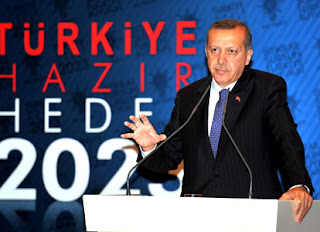
AA Photo from Hurriyet Daily News

Ahead of the AKP's expected victory on Sunday, Prime Minister Erdogan announced plans to alter the structure of his cabinet, a move many are reading as a step toward realizing Erdogan's ultimate ambition to establish a presidential system.

The new cabinet will contain 25 ministers, including the prime minister. Some ministries, such as the Ministry for Women and Family, will be eliminated or merged, while six more will be added. From Hurriyet Daily News:
If his ruling Justice and Development Party, or AKP, is returned to power in the June polls, Erdoğan said, the administration will have six new ministries, while the total number of ministries will be lowered from 27 to 25.

The prime minister said eight current state ministries will be abolished. The new ministries will be the Ministry of Family and Social Policies, the Ministry of European Union, the Ministry of Economy, the Ministry of Youth and Sports, the Ministry of Customs and Trade and the Ministry of Development. The Ministry of European Union will coordinate the affairs for Turkey’s EU bid.

Currently these areas fall under the responsibility of state ministers in Ankara; the new ministries will also have offices around the country.

“We will also create a deputy minister position” that will rank between the minister and the undersecretary, Erdoğan said, speaking at his party’s headquarters.

The new Cabinet will include 20 ministers plus the prime minister and four deputy prime ministers. Each of the 20 ministers will be assigned deputies.

The deputy ministers will not be parliamentary deputies, but will be appointed to their positions with the new government and will leave their posts if it is voted out of power. The deputy ministers will be experts in their sectors and will be selected for their ability to make the ministries operate faster and more efficiently, Erdoğan said. “It will be possible to bring them in from the private sector,” he added.

Each deputy minister will be appointed with the approval of the respective minister, the prime minister and the president. The appointees will not have to have university degrees, “and can even be elementary school graduates,” Erdoğan said, pointing to important businesspeople such as Vehbi Koç as examples.

“They will work as a political undersecretary, and the current undersecretaries will carry out the administrative functions,” the prime minister said.

Some ministries will be renamed or merged under the proposed restructuring. The Ministry of Industry and Trade will become the Ministry of Science, Industry and Technology, while the Ministry of Agriculture and Rural Affairs will be changed to the Ministry of Food, Agriculture, and Livestock. The Ministry of Environment and Forestry will meanwhile merge with the Ministry of Public Affairs and Settlement to become the Ministry of Environment, Forestry and City Planning.
One concern with the new plan is that each ministry will now have an undersecretary responsible for the technical aspects of the ministerial portfolio as well as a deputy prime minister responsible for the politics involved therein. What happens if the two ministers have conflicting views? Will the deputy ministers, who do not sit in parliament, be subject to parliamentary oversight?

Hurriyet Daily News columnist Izgi Gungor reviews some of the potential problems with the deputy minister scheme here, including the potential for further privatization given that the deputies will be appointed outside normal bureaucratic channels and that many of whom will be coming from the private sector. Privatization of public resources has been a keystone of Erdogan's political and economic agenda.

President Gul has expressed his opposition to the presidency, which Erdogan has expressed his intention to occupy should a presidential system come to be as the government moves forward to re-write a whole new constitution after Sunday's elections.


UPDATE I (6/9) -- Human Rights Watch echoes the concerns of many Turkish women's groups in response to the government's plans to eliminate the Ministry for Women and Family Affairs. The government is planning to create another ministry re-named the Ministry of Family and Social Policies. Women's groups have expressed concerns that women's issues are important only insomuch as they involve the family and this despite rising domestic violence and continuing problems related to underemployment and representation in politics.  Jenny White expounds on the problem here.

UPDATE II (6/10) -- The CHP has announced its intention to challenge the restructuring at the Constitutional Court. For more, click here.

Thursday, May 12, 2011

Progress on the Domestic Violence Front

Turkey has signed a new Council of Europe convention to prevent and combat violence against women. As documented by a report released by Human Rights Watch earlier this month, Turkey has been plagued by domestic violence over the years thanks in part to problems implementing existing law. Turkey pushed very hard for the Convention to be opened for signatures at the Council's recent ministerial meeting. From Hurriyet Daily News:
Reaching a consensus proved difficult as many countries expressed resistance to the far-reaching provisions of the convention, but Turkey adopted a negotiation position based on international standards, Acar told the Hürriyet Daily News in an interview.

“We did not hide behind any cultural, economic or political pretexts and we resisted those who wanted to water down the stipulations,” she added.

The convention is revolutionary in the sense that it accepts violence against women as a human-rights violation, according to Acar. “This is very important, because violence against women will no longer be seen as a social problem. This will strengthen women’s demands for access to judicial recourse as well as protection,” she said.

Also important is the fact that the convention has endorsed a wide-ranging definition of “violence,” Acar added.

“Violence is not only physical. It can be economic or psychological; stalking is, for instance, a type of violence,” she said. The convention also includes violence against immigrant women, a measure that was resisted by some countries.

The convention covers what are called “the 4 Ps”: prevention, protection, prosecution and policy.

“The fourth P is especially important for Turkey, since we lack an integrated policy on gender equality. This convention will be known as the Istanbul convention and that way Turkey will be known as a country championing the cause of combating violence against women,” Acar told the Daily News.

“Just as we endorsed a zero-tolerance policy on preventing torture, we need to endorse zero tolerance on violence against women. In this sense, this convention will be a new driving force for Turkish domestic efforts,” she said. “Because we really need a mentality change, especially as far as implementation is concerned. All the judges, prosecutors, police and health officials will have to be trained. And for that Turkey needs to ratify the convention as soon as possible to set a good example as well.”
And more from Bianet:
Some 20 to 25 percent of women across the European region suffer physical or sexual violence at some point in their lives, according to the explanatory memorandum accompanying the Convention.

The convention is the first legally binding instrument in the region that creates a comprehensive legal framework to combat violence against women through prevention, protection, prosecution, and victim support. It defines and criminalizes multiple forms of violence against women: physical, sexual and psychological violence, as well as forced marriage and female genital mutilation. The treaty also establishes an international group of independent experts to monitor its implementation at the national level.

The Convention addresses gaps in domestic violence legislation and implementation, such as weak laws, bad implementation of protection laws, lack of coordination, lack of access to justice, low funding for domestic violence responses, lack of shelters, and lack of prevention measures.

To implement the convention, countries will establish hotlines, shelters, medical and forensic services, counseling, as well as legal aid.
Progress at the top to be sure, but real change, of course, will be shown from below and Turkey's willingness and effectiveness to ensure that police officers and other state agents responsible for protecting women follow legal guidelines.

Thursday, May 5, 2011

"He Loves You, He Beats You"

Human Rights Watch has released a report on domestic violence, a problem that has been gaining increased attention in recent years. As HRW reports, police too often neglect their responsibilities to protect women against violence, which has led to a plethora of stories of women who ended up dead despite their efforts to seek police protection. Following a June 2009 decision of the European Court of Human Rights, it is a state obligation to protect women when they report such violence. As HRW's report documents, problems with implementation of the ruling continue. From the report's summary:
“It always happened at night,” Hamiyet M. told Human Rights Watch. For 24 long years, Hamiyet’s husband had abused her by severely beating her and raping her almost daily. When she finally summoned the courage to go to police in her town in eastern Turkey, they sent her home, twice. The beatings continued, in one instance proving so severe she wound up in hospital where she spoke with a police officer for a third time. Yet again, she received neither sympathy nor help. “Are we supposed to deal with you all the time?” the officer scolded.

Some 42 percent of all women older than 15 in Turkey and 47 percent of women living in the country’s rural areas—approximately eleven million women in total—have experienced physical or sexual violence at the hands of a husband or partner at some point in their lives, according to a 2009 survey conducted by a leading Turkish university.

Female domestic violence survivors, lawyers, and local experts on family violence interviewed for this report described husbands and family members inflicting brutal and long-lasting violence on women and girls that in some cases lasted for decades, affecting several generations of women. Researchers documented women and girls as young as 14 being raped; stabbed; kicked in the abdomen when pregnant; beaten with hammers, sticks, branches, and hoses to the point of broken bones and fractured skulls; locked up with dogs or other animals; starved; shot with a stun gun; injected with poison; pushed off a roof; and subjected to severe psychological violence. The violence occurred in all areas where researchers conducted interviews, and across income and education levels.

In recent years Turkey has taken important legislative steps towards addressing violence against women. But despite these impressive advances, most notably Law 4320 on the Protection of the Family (“Law 4320” or “protection law”), remaining gaps in the law and failures of implementation make the protection system unpredictable at best, and at times downright dangerous. Furthermore, this legislative process is undermined by the government’s failure to better prevent abuse in the first place, change discriminatory attitudes, and effectively address the barriers that deter women and girls from reporting abuse and accessing protection.

This report focuses on the civil remedies available in Turkey to survivors of domestic violence. These options—which aim to provide immediate protection from harm, create space for a victim to decide her course of action, and prevent an abuser hampering criminal or divorce proceedings with intimidation or threats—take two main forms. The first is physical protection in shelters, the second is civil protection orders—emergency measures intended to stop further abuse, which is common in domestic violence cases, including instructions to an abuser to stay away from the house and refrain from violence against the victim.

The research found that implementation of Law 4320 regularly falls short because enforcement officers, judges, and prosecutors neglect their duties, often due to lack of expertise or will to deal with cases of violence against women and girls in a manner that is effective and sensitive to the needs and human rights of victims. Women who do report family violence to police risk being turned away, and face poor enforcement of protection orders: indeed, some women have been murdered after obtaining a protection order against their killer. Shelters are lacking, and those that do exist often exclude certain groups of women, restrict movement and communications, and are vulnerable to security breaches. Environments in which women are supposed to report violence—particularly police stations and family courts—often lack the private space necessary to do so. In addition, differing understandings of the law—specifically, the scope of eligibility for protection orders—undermine its effectiveness and can exclude the most vulnerable victims of domestic violence.
Implementing Law 4320 was supposed to be a priority of the Ministry of Women and Family. Last March Selma Aliye Kavaf, who heads the ministry, said many women who reported abuse were not properly protected because the police to whom they reported did not in turn report to the Ministry, and so proper procedures were not followed. As far as I can tell, little progress has been made here. Further, under Turkish law, each municipality with a population of over 50,000 people is supposed to have a women's shelter, though this is still far from the case (see this post from last March). For news coverage of the report from Hurriyet Daily News, click here.

Sunday, April 24, 2011

Women, the Headscarf, and Discrimination in the Work Place

This month the Turkish Economic and Social Studies Foundation (TESEV), one of the country's leading think-tanks, released a study examining employment discrimination against women who wear the headscarf. While the headscarf has long been a controversial issue in the public arena (for more, click here and here), much less attention has been paid to the issue in the private realm. What obstacles are faced by women who wear the headscarf and do manage to graduate from university (or, for those who may choose to don it after graduation)? For the report, authored by TESEV's Dilek Cindoglu, click here.

The rate of women's employment in Turkey is lower than any other OECD  country--21.6%, and down from 34.3% in 1988. The average in the European Union is 57%. Female employment has been dropping for a variety of reasons, among them the decline in agricultural employment. However, apart from structural changes to the economy, a number of impediments prevent women from entering the workforce, including the low level of female education, the lack of adequate childcare facilities, sexual harassment, and conservative attitudes when it comes to women working and leaving the house/traveling about. Another is no doubt the systematic labor discrimination that women who choose to wear the headscarf face both in terms of getting a job and no doubt once they are in a job as well.

The headscarf has long been seen as an obstacle to women's employment, though camps on both sides of the issue face the issue differently. Pro-headscarf advocates argue that limitations on covered women entering university poses a serious hindrance to their position in higher-level unemployment, and that once out of university, women continue to face discrimination, and often, outright ridicule. Proponents of restrictions on headscarves, including some women's rights groups, argue the headscarf is a function of conservative, patriarchal attitudes, and that frequently it is the attitudes of covered women's families, most importantly, their husbands, that keep them out of the workplace. This study very much disputes this notion in documenting cases where women choose to work, and in many cases, where their employment is necessary to the livelihood of their family. Cindoglu, along with Ebru Ilhan, published a similar study on the subject last summer.

Last fall, Richard Peres wrote an excellent article in Today's Zaman discussing the issue, as well as the prospects for Turkey to adopt a remedy along the lines of the affirmative action policies the United States put in place for African Americans in the 1960s. From Peres's article (which I stumbled upon thanks to Jenny White at Kamil Pasha, who adds some thoughts of her own here):
In addition to professionals, women who wear headscarves face perhaps the largest and most difficult barrier in white collar jobs. Preference is given to uncovered women for the better positions in private industry, such as office and information workers, as well as sales positions. The reasons vary from simple prejudice against covered women to organizations not wanting to be viewed as fundamentalist. According to a report by AKDER in November 2008, “Even in sectors for production of commercial goods and services, the employment level of the women who wear the headscarf is low.”

I have a friend who wears a headscarf who had to go to Cyprus for her college degree. She is bilingual -- she helped me interview Turks for a book I am writing -- but has been unable to find a white collar job for over a year. Often when she shows up for an interview, she finds that the position has been mysteriously filled or is no longer available. She has little recourse but to keep trying or to migrate to another country.
. . . .

s Turkey ready to implement a remedy for discrimination against covered women like the American experience? I doubt it. The reason: The American civil rights movement was the result of a long political struggle that mobilized millions of people throughout the country to bring about change. African-Americans and women did not sit back and wait for one political party or another to effect change, or for an agency like the Higher Education Board (YÖK) to send a letter. They got organized, influenced elections directly, exposed discrimination, fought cases in court, ran for elections, and put real political pressure on state legislatures and the US Congress. Waiting for the government to act was not enough to bring about landmark legislation with real enforcement power and supportive agencies to handle and investigate complaints, and go to court on the behalf of complainants if necessary.
That said, there is a decent amount of activism on the issue, like this TESEV report, as well as from organizations like the Women’s Rights Association Against Discrimination (AK-DER). Nonetheless, I have met more than covered woman who has told me she does not participate in such activism because the cause seems hopeless, etc. Yet, last fall's relaxing of headscarf requirements at university and the amount of progress being made on the issue is likely to spark more activism and pressure.

If you should be in Washington, Cinodoglu will present the study at SETA-DC tomorrow at 12 p.m. Merve Kavakci will serve as discussant. Click here for event details.

Tuesday, April 12, 2011

"No Headscarves, No Vote!"

Merve Kavakci in 1999, shortly before being expelled from parliament.

Nicholas Birch has an excellent piece on Eurasianet about a new civil society campaign geared to promote the election of women who wear the headscarf and the ambivalent response the campaign has received from conservatives, including the AKP. An excerpt:
Turkish women's groups have been traditionally divided along ideological lines. But they are uniting behind the initiative, launched in March by a non-partisan group called Women Meet Halfway, to have women who wear headscarves placed high enough up on party lists so that they stand a decent chance of being elected.

"No headscarves, no vote," shouted sixty-odd women who gathered outside the parliament building in Ankara on April 8. "As it stands, our democracy is half-baked", said the group's spokeswoman, Nesrin Semiz. "Two-thirds of Turkish women cover their heads. Not one of them has a seat in parliament."

The campaign is generating an ambiguous reaction from an electoral constituency that, at least at first glance, would appear to be a natural ally: religiously conservative men.

In general, the conservative press is trying to ignore the campaign. Those columnists who have addressed it have tended to be disparaging. A columnist in the mass-market conservative daily Zaman, Mehmet Kamis, has described the headscarf issue as "meaningless."

"These elections are a vital opportunity for Turkey to create the foundations of civilian democracy," he wrote on April 2. "Why put that at risk with all this talk of headscarves." Kamis was alluding to the main plank of the governing Justice and Development Party’s (AKP) election campaign: the promise of a new "civilian" constitution.

The AKP has Islamist roots, and the wives of some top party leaders wear headscarves in public, but those same party leaders make no secret of wanting to win more than two-thirds of the seats in parliament. Such a total would allow the AKP to push through a new constitution on its own. Party leaders worry that strong backing for the headscarf issue could complicate their electoral goal. Yet, they also know that distancing themselves from the issue could create political problems.

. . . .

Supporters of Women Meet Halfway's campaign think fears of a repeat of 2008 or 1999 are unfounded. The Constitutional Court, which narrowly voted against closing the AKP in 2008, has since been packed with justices sympathetic to the governing party, campaign member Hilal Kaplan points out.

A secular party that lobbied hard for the court’s intervention against the AKP in 2008, meanwhile, has signaled that it will take no action, if women wearing headscarves are elected to parliament.

In any case, says Fatma Bostan Unsal, a founding member of the AKP who wears a headscarf and has put her name forward as a candidate, there is nothing in parliamentary regulations about headscarves -- only a requirement for women to wear "suits." Turkish courts stripped Kavakci of her position in 1999 not because of her headwear, but because she had become a US citizen "without the permission of the Turkish authorities."

Unsal says she will run as an independent if the AKP doesn't support headscarf-wearing candidates. With just under nine weeks to go until Turks go to the polls, she still doesn't know what colors she will be presenting herself under: Prime Minister Recep Tayyip Erdogan, the arbiter of who rises and who falls in the AKP, is keeping his options wide open.

But a ferocious attack last week on the headscarf campaign by one of Turkey's most prominent Islamist intellectuals has led some women to wonder whether all the high-minded talk of the need to protect the AKP from a repeat of 2008 isn't hiding something rather less savory. Writing in Zaman on April 2, Ali Bulac described the campaign’s leaders as "fifth columnists ... working from the start to destroy the Islamist movement from within."

Supporting the use of the headscarf is "a religious obligation of every believing man and woman," Bulac went on. But the campaigners "look down their noses at their own neighborhoods," and "have stripped the headscarf of its religious significance, reducing it to a simple issue of human rights inspired by feminism."
Hilal Kaplan has written in Taraf and elsewhere that it is a shame that covered women, which constitute a considerable percentage of people in Turkey, do not have even one representative in parliament.

Bulent Arinc said in February that while having a covered woman in parliament was desirable, no was not the time. Apparently the AKP as a whole agreed with him. Only one covered woman was nominated for parliament, and her name placed very low on the party list, lessening her chances of getting elected.

The last candidate who donned the headscard to be elected to parliament, Merve Kavakci in 1999 from the Virtue Party, was expelled from parliament and eventually stripped of her Turkish citizenship on the grounds that she had not disclosed her United States citizenship.  In 2007, Kavakci won a case at the European Court of Rights, which determined her expulsion from parliament was a human right violation.

For more on female electoral candidates and the headscarf, click here for a piece I wrote on the issue in 2008.

Party Lists Released . . . Game On.

Turkey's political parties have released their party lists ahead of June 12 parliamentary elections. The AKP's list considerably diminishes the power of National Outlook ("Milli Gorus") politicians and aims to gain votes in coastal centers where the party has not fared strongly.

Meanwhile, the MHP is sticking to its strategy of going for votes in both Turkey's coastal areas and Central Anatolia. The MHP suffered a tremendous loss in last year's Sept. 12 election when many of its supporters broke with the party to vote for the AKP-sponsored referendum. MHP leader Devlet Bahceli made the referendum a chance to challenge the AKP on its Kurdish opening, but at the end of the day, MHP's brand of ultra-nationalism seemingly increased support for the MHP, which is now hovering right at the 10% threshold required for parties to enter parliament.

The AKP will go after the MHP with full force in an effort to have the party fall under the 10% threshold. Should this happen, the AKP would almost certainly be guaranteed the super majority of 367 deputies it needs to conduct business without much compromise. It is a make-or-break year for the MHP. Turkish political parties that fall under the 10% threshold have a difficult time coming back, and the MHP would likely come out of the bruising with an even more ultra-nationalist attitude.

Significant to the party lists is the lack of minority representation. No party nominated an Armenian candidate as initially conjectured. Two Jews and two Syriacs were nominated, though all but one of these candidates have either been placed low on the party lists or are representing small parties and so have little chance of entering. Erol Dora, a Syriac, is running for the BDP from Mardin and stands a decnt chance of being elected. If Dora is elected, he will be the first Syriac member of parliament in the history of the Turkish Republic.

Women also got the short end of the stick. The CHP nominated the most women (at 20 percent), and has made gender equality, which the party considers to be under attack, a major plank in its platform. The AKP nominated 14 percent, and the MHP 12 percent. 12 women are running as independents, mostly from the pro-Kurdish BDP, which has by far the highest representation of women in parliament. Among these women is Leyla Zana, a hardline BDP candidate who is very divisive in Turkish politics.

There was some initial speculation that the AKP might attempt to nominate a female candidate who wears the headscarf, though it seems Deputy Prime Minister Bulent Arinc's February statement that now is not the time seemed to have held true in the end. Only one covered candidate was nominated, a school teacher from Antalya, and her name was placed toward the bottom of AKP's party list. For more on women's political representation (and the headscarf), click here.

Wednesday, March 9, 2011

A Sobering International Women's Day

Ayse Pasali, who was allegedly shot to death by her ex-husband, unsuccessfully sought official protection due to her husband's alleged physical abuse and threats to kill her. PHOTO from Radikal

From Bianet:
The Turkish Medical Association Women Doctors and Women's Health Branch indicated that violence against women in Turkey increased on the grounds of social insecurity caused by capitalism, male domination and the destruction of the social state. Other reasons for the increase of violence were a failing of the state to protect women and the impassiveness of the media regarding the whole topic.

The women's branch announced, "Apart from intensifying the struggle and strengthening solidarity, only very few tiny things have changed for women since the witch-hunting era in the middle ages. Migration and poverty becomes more and more an issue for women. Men dominate women and usurp and control their identity and body. This domination provides them with concrete, tangible benefits".

"Statistics suggest that women murders have increased by 1,400 percent in the last seven years. At least five women are killed every day by men by reasons of honour, virtue or morality. On 8 March this year we are demonstrating once more for our labour, our bodies, our identities and our freedoms."
Prof. Şahika Yüksel and Assoc. Prof. Ayşe Devrim Başterzi, who conducted the study, are not without ideas of how to address the problem, which include amending the Penal Code to eliminate "unjust provocation" as a mitigating factor. Under a recent decision by the European Court of Human Rights, Turkey is required to protect a woman's right to life in cases of domestic abuse, a legal duty Turkey has had difficulty upholding. Below are photos and summaries of the murders of eight women killed in the first two months of 2011 (thanks to Hurriyet Daily News).

Monday, February 28, 2011

A Liberal Democracy?

Jenny White calls attention to a recent incident in Ankara wherein a group of people advocating for organ donation got in a confrontation with police. From Kamil Pasha:
The governor of Ankara province wanted the stands handing out brochures to be removed from Yüksel Boulevard, one of Ankara’s main thoroughfares. A mass of police in full riot gear arrived to carry out his order and got into a discussion with a young woman at a stand promoting organ donorship. Young people gathered and surrounded her protectively, chanting “No to Fascism.” Watch the film. In seconds the police had moved in violently, as they have done with other protests and public civic actions in recent years, often by students and other young people. You can see them dragging people off (the news account said some were dragged away by the hair), throwing them about like paper dolls, and in the film if you watch carefully, you will see a policeman punching one of the young women hard in the face twice.

What was it that Erdogan said about the praiseworthy youth in Egypt demonstrating for their rights, that Mubarak should heed his people’s wishes?

Over-the-top police violence against men and women has been the norm in Turkey since I first went there in the 1970s. The problem has been police immunity and a continuing culture of disrespect for youth, for women, and for civil rights; a widespread acceptance and even approval of violence as a sign of masculinity and love of nation; and a lack of understanding of the principles of liberal democracy — making a safe space for alternative views and lifestyles. Democracy too often means I got the most votes, so everyone else should fall in line with my ideas and my values. A 2006 survey by Çarkoğlu and Toprak shows that the majority of the population values democracy and civil liberties, but shows little sensitivity toward others’ rights. Democracy is understood as a system that represents the views of the majority, rather than protecting the rights of minorities.
Radikal has posted a video of the incident.

Respect for difference and moving toward a liberal versus majoritarian understanding of democracy is one of, if not the, primary deficits of Turkish politics and one I have written about extensively. Events like the attack on the art galleries in Tophane last September to the beating of an Alevi man who sold alcohol at his store to the 1993 burning of the Madimak Hotel in Sivas (which left 37 people dead, mainly Alevis), and countless, countless others all stem from this basic need to respect difference and the rights of others.

On the government level, such questions are raised by restrictions on alcohol, "immoral broadcasting," the harassment and closure of LGBT groups, etc. Most of these posts are marked with "creeping conservatism," but they might also be labeled as "concerns for liberal democracy." And, conversely, respect for those who choose to drink alcohol should also be met with respect for those who choose not to drink alcohol just as respect for those who wear the headscarf should be met with respect for those who do not wear it. Too often disrespect is the story . . . over and over and over (like a broken record).

For more on the police, who should be first in line to be inculcated to respect the rights of others, see this December 2008 report from Human Rights Watch. See also many of the entries marked "police."

Saturday, July 17, 2010

Protecting Turkey's Soy

PHOTO from Radikal

Prosecutors have filed a case against Turkish actress Sevda Demirel after she became pregnant upon using an American sperm donor.

On March 6, the Turkish Health Ministry effectively made it a criminal offense for women to use a foreign sperm or egg donor to conceive a child using artificial insemination (see March 21 post). The law is premised in protecting Turkey's soy, or patrilineal bloodline.

Demirel is not the first Turkish actress to use a foreign sperm donor and attract this kind of attention, but she is indeed the first to be prosecuted under the new law. To add to the controversy, Demirel used an African American sperm donor.

For my analysis on the law, click here. Also, see Jenny White's commentary at Kamil Pasha.

Saturday, June 26, 2010

The Headscarf and Women's Employment

The Turkish Economic and Social Studies Foundation (TESEV) has released a new study authored by Dilek Cindoglu and Ebru Ilhan documenting discrimation faced by female employees wearing the headscarf. Bianet gives a summary of the results:

* According to research conducted by KONDA and MetroPOLL in 2008, 71-72 percent of all women cover their head, while only eleven percent of female university graduates wear headscarves. A study by World Bank and the State Planning Organization revealed that these women's participation in labour dropped from 50 percent in 1998 to 35 percent in 2006.

* The two working areas in which women are represented the most are as unpaid family workers in agriculture and as trained professionals.

* The women wearing headscarves at university are not a homogenous group. Religious affiliations of these women differ as well as their level of political interest, adoption and level of traditional values, the level of individual religiosity and their economic and social capital.

* The headscarf ban is the most basic field of conflict for young professionally trained women with headscarves.

* Wearing a headscarf at work is part of these professional women's religiosity and individuality. They are respected by their colleagues and especially by men in lower positions. The headscarf makes them feel safer on the street and at work.

* When women wearing headscarves have to include a photograph in their CV, they are more likely to face difficulty related to salary policies or when they are made redundant. They hear things such as "It is anyway a blessing to work here" or "You do not have to financially support a family", respectively.

* Employers want women wearing headscarves to be 'invisible'. They should either be 'invisible', take off their headscarf or should not publicly represent the company. This means that they are not participating in meeting with clients or in training courses and that they are kept away from work related to state offices.

* Employers focus on traditional patriarchal patterns thinking that even though the woman is working, she does not actually have to support the family. This way, employment of women wearing headscarves is being marginalized.

* Women wearing a headscarf in business perceive that they experience discrimination and obstructions almost entirely by reason of their "headscarf".

See also this report from Hurriyet Daily News that includes pieces of an interview with Cindoglu.
The headscarf has long been seen as an obstacle to women's employment, though camps on both sides of the issue face the issue differently. Pro-headscarf advocates argue that limitations on headscarved women entering university poses a serious hindrance to their position in higher-level unemployment, and that once out of university, women continue to face discrimination, and often, outright ridicule. Proponents of restrictions on headscarves, including some women's rights groups, argue the headscarf is a function of conservative, patriarchal attitudes, and that frequently it is the attitudes of headscarved women's families, most importantly, their husbands, that keep them out of the workplace.

This study very much disputes this notion in documenting cases where women choose to work, and in many cases, where their employment is necessary to the livelihood of their family.

Thursday, June 24, 2010

Keeping Daughters (and Sons) In School

A recent report put out by the Education Reform Initative takes a look at the nubmer of children who either do not go to school or do not go onto receive a seconday education. As expected, the document confirms that the percentage of girls not in school is much higher than that of boys, though the number not attending seconday school is quite high for both groups. Bianet summarizes the report's findings:
* In the age group of 15-19-year-olds, 26 percent of the boys and 50 percent of the girls neither are going to school nor to work. In international comparison, this ratio amounts to 8, respectively 9 percent in other OECD countries.

* Access to secondary education is dependent on significant regional disparities. 78 percent of the 14-17-year-olds are enrolled in high school in the Southern Marmara region, whereas this ratio reaches a mere 44 percent only in the South-East of the country.

* Also the parents' education level is an important influence: 17 percent of daughters of illiterate fathers and 94 percent of the daughters of university graduates go to a secondary school.

* 15 percent of all male high school students enrolled in the academic year of 2008/2009 dropped out of school. The proportion rises to 23 percent at vocational schools.

* A total of 360,000 students dropped out of high school in 2008/2009. Considering the number of school days, more than 2,000 students dropped out of school every day.

* In 2009, the per capita expenditure for secondary education amounted to TL 2,273 (€ 1,136), the figure for vocational and technical schools lay at TL 2,937 (€ 1,558) per student. For 2010, the budget is planned at TL 2,051 and TL 2,188 respectively. The reduction stems from increasing secondary education to four years and trying to make it more prevalent without allocating sufficient resources.

* Per capita expenditures for students significantly vary among different provinces: Public spending on secondary education per student in 2009 amounted to TL 1,379 (€ 690) in Istanbul and TL 3,508 (€ 1,754) in Amasya (northern Anatolia).

* In comparison to the previous year, 175,000 more children benefited from pre-school education in 2010. Three out of five 20-72-month-old children were enrolled.
Many families do not simply refuse to send their daughters or sons to schools because they see it as unnecessary, but because the children's labor is viewed as necessary for the family's sustenance. Too often, I suspect it is the daughters that make the biggest sacrifice in this regard. Interesting here also are the regional disparites in terms of the total amount spent on each student.

For a video from a campaign the Turkish daily Milliyet recently did to encourage families to send their daughters to school, click here.

Monday, June 7, 2010

Suicides in Agri

From Jenny White at Kamil Pasha:
Over the space of four days last week, four women and one man killed themselves in villages around the eastern city of Agri. Yesterday in the eastern city of Şanlıurfa, two more young women tried to kill themselves. This is a region infamous for violence against women, “honor killings”, and “suspicious suicides” in which “family councils” decide a girl should be killed and force the her to kill herself in order to save the family trouble with the law.

On Thursday of last week 20-year-old Saniye Çelik of Yanıkçukur Village hung herself in her home (a later news article says she shot herself with a rifle.) In the neighboring village of Yolcupınar, 18-year-old Özlem Demir and her 21-year-old aunt Şehriban Polat locked themselves in a room together and hung themselves with clothesline. Özlem Demir, it was said, was about to be forced into marriage with a much older man. Şehriban Polat had been married to Demir’s maternal uncle for for only 5 months. Her husband was away doing construction work in Izmir. Together, the women went to a place used as a summer house, placed a big stone against the door, and hung themselves. The police believe the suicides are suspicious. (Demir’s family denies that she was to be married to an older man, but rather a young man who hadn’t even done his military service yet. Polat’s husband says they had been married 7 months and had no problems.)

On Wednesday a professional teacher in Sabuncu Village 22-year-old Şahin Demir, killed herself. The following day the headman of Aşağı Küpkıran Village, 63-year-old Mehmet Karamızrak killed himself. (The Turkish news reported this as another woman’s suicide, but with a name like Mehmet that seems unlikely.)

This week’s suicide attempts are in the same region, near Şanlıurfa. Behiye Aktaş and Leyla Akbaş, both 21, swallowed pills to kill themselves, reportedly “because of family problems”.
White also links to a 2008 post by Turkey observer Gordon Taylor that explores both female and male suicides in the region, and includes a bit more of a Kurdish dimension to the phenomenon.

Friday, May 14, 2010

Nesrin Baytok in the Media

PHOTO from Milliyet

Frequently referred to as the "secretary" in media coverage and public discourse concerning the sex scandal that brought down CHP leader Deniz Baykal, Nesrin Baytok is a full-fledged parliamentarian and long-time meber of the CHP. The Turkish media's general treatment of Baytok and portrayal of Baykal as the "victim" in the sex scandal has garnered criticism from some Turks concerned that the incident could hinder Turkish women from entering politics and does a disservice to gender equality and the treatment of sex when it enters politics. From Hurriyet Daily News:
While the man involved in the scandal, Deniz Baykal, has become a hero-victim since resigning as leader of the Republican People’s Party, or CHP, the woman has been perceived as “the bad one,” according to activists. They said such discrimination is just because Baykal is a male, whereas parliamentary deputy Nesrin Baytok, alleged to be the woman in the video, is a female.

“We are strongly against the media’s treatment of the female deputy figure,” said Çiğdem Aydın, the chairwoman of the Association for Women’s Support and Education, or KADER.

Assuming a woman achieves such a high post by using her sexuality is neither just nor ethical, said Aydın, adding that she was very uncomfortable with the way the female figure has been treated in the media and in public debates.

“This wrong perception could ‘kill’ any future attempt by females to be involved in politics,” she said, adding that the prevalent attitude among the media, politicians and intellectuals is a stark indicator of how desperate the position of women in Turkish politics and society is.

The video in question, alleged to show Baykal and his then-secretary Baytok, was broadcast on the Internet on May 6 and led to Baykal’s resignation four days later. On the same day, Baytok made a brief statement to the press in which she said she would not resign, but did not offer any explanations. Since then, her only comments have been in an interview printed in the daily Akşam on Thursday, in which she said the video is part of a conspiracy and that her family has been very supportive.

“I’ve spent 20 years to come this far. I’m not giving up now,” she told the daily.

Among the critical voices against Baytok and her stance as a woman in politics, Sevilay Yükselir said the scandal was a kind of “reward” for Baytok.

Writing in her Friday column in the daily Sabah, Yükselir said Baytok was being paid back for not having allowed other potential politicians to take posts and for misusing her position.

Yükselir wrote the column in response to three female columnists in various newspapers who defended Baytok and said Baykal was not the only victim, but that Baytok was as well.

According to Pınar İlkkaracan, a human rights activist and psychologist, exploiting a female’s sexuality to humiliate her in public is common in Muslim societies. She also expressed concern for the way the woman’s figure was attacked so badly and that the male was brought to the center of attention.

“This was just because Baytok is a female and Baykal is a male,” she said.

İlkkaracan also said the discrimination by politicians, the media and intellectuals against the woman figure was more than evident. “We can easily notice how well-known people shared their sorrow with Baykal publicly, whereas Baytok was obliged to hide in silence due to the public offenses against her."

Monday, May 10, 2010

A Prize for Three?

Just in time for Mother's Day . . .

From Today's Zaman:
Prime Minister Recep Tayyip Erdoğan has once again expressed concern over the declining younger population in Turkey and suggested that his government may consider giving a “prize” to families that have at least three children.

The prime minister’s remarks came during a wedding ceremony in İstanbul on Saturday. He did not hint on what the prize might be.
According to Erdoğan, Turkey’s annual population growth rate should be at least 2.5 percent. “However, there is a mistake with our current situation. If we continue the existing trend, 2038 will mark disaster for us. Therefore, we should ameliorate our situation. Maybe we will implement a prize, who knows?” he said.

The prime minister made his first entreaty to Turkish women to give birth to at least three children in April 2008, in a statement that was met with both support and criticism.

“You know, my request is at least three children for each family. I never said three would be enough. I said I want every family to have at least three children. This country has generations that know the real direction of their country,” Erdoğan stated on Saturday. The prime minister complained that Turkey’s annual population growth rate is now around 1.5 percent.

“This figure should be over 2.5 percent. This would preserve the existing situation. Those countries that urged family planning or birth control in the past are expressing regret now and encourage their populations to have more children through financial incentives. However, the desired population increase does not occur. Here, we are warning you that there is a pending problem we are faced with. If we continue this way, our situation in 2038 will be worse. We should correct it,” Erdoğan added.
In March 2008, in commoration of International Women's Day, Prime Minister Erdogan instructed Turkish women to have at least three children, a move that earned him the scorn of many women's rights and equality groups. After the remarks, Gareth Jenkins took a critical look at Erdogan's democgraphy in relation to unemployment, though it seems the prime minister is still not buying the skepticism though Turkish unemployment/underemployment has grown even worse.

Saturday, May 8, 2010

Where Are the Women?

The State Personnel Department released figures last week on women's employment in the bureacracy, and the numbers are dismal. From Today's Zaman:
According to latest figures, sixty-six of each 100 public servants are male. There are 2.330,909 permanent positions within the Turkish public institutions. Only 1.769,730 of these positions are occupied while the remaining 561,179 seats still wait new employees to be hired. The data shows the government should concentrate on hiring female workers in the first place in a move to maintain balance between the two gender groups. All undersecretaries in Turkish ministries are male. Out of 79 deputy undersecretaries, only 2 are female. Out of 96 director generals in Turkish ministries, 91 are male. All of the 175 governors in Turkey are male. Out of 450 deputy governors, 12 are female. Out of 8,284 high level bureaucrats, 7,713 are male while only 571 seats are taken by female public servants.

Out of 989 district governors, 19 are female. The public services in which the female workers outnumbered males were allied health personnel and legal advisers and lawyers. Of the 108,364 allied health personnel 99,564 are female while 1,576 out of 2,639 legal advisers and lawyers are female. Some 46 percent of all teachers, 40 percent of all academics and 31 percent of all doctors in Turkey are female.

The male domination does not change when it comes to State Economic Enterprises (KİTs). There is not a single female regional manager among the existing 22 while only 3 out of 63 vice general managers are females. Out of 172 heads of departments only 7 are female. Out of 800 vice managers in KİTs 186 are female while 5,275 of 16,445 civil servants, secretaries and cashiers in KİTs are female workers.
Today's Zaman attributes the low numbers to restriction on women wearing headscarves at universities, which, while a factor, does not explain anywhere near the whole picture here. For more on the lowly status of women in Turkish government positions, see March 8 post.

Tuesday, April 27, 2010

Not a "Trivial" Matter

From Bianet:
"Women who have been exposed to violence for years call for help only as a last resort and ask to stay in women's shelters. Almost all of them come to us with serious fractures and physical and psychological injuries. Their lives were in danger several times".

With this explanation, Nebahat Akkoç from Ka-Mer, Zozan Özgökçe from the Van Women's Association and Harika Peker from the SELİS Women's Association reacted to a statement made by Oktay Taş, Provincial Manager of Social Services in Diyarbakır in south-eastern Turkey who said that "women apply for shelter for trivial reasons".

Ka-Mer is a Turkish women's group in Diyarbakır that finds shelter for and offers legal aid to women who have been threatened by their relatives. The SELİS Women's Association is active in the region of the Batman Municipality in the country's south-east.

Akkoç from Ka-Mer criticized that provinces make the places of shelter homes public. Peker from SELİS drew attention to problems experienced at provincial directorates for social service.

Özgökçe from the Van Women's Association underlined the fact that women are not only exposed to physical violence but become victims of economic, sexual and emotional violence as well. "Many women cannot talk about the violence they have experienced when they apply to us at first. The most severe traumata are forgotten and surface again years later".
For past posts on domestic violence, which is particularly bothersome in the southeast, click here.

I have seen nothing on where the Kurdish BDP stands on implementation problems of new domestic violence measures in affect throughout Turkey. Recently, the party has taken a stand against berdel marriages, a common custom among some of Turkey's Kurds that sometimes involves forced marriage.

Friday, April 16, 2010

Potentials and Pitfalls: Moving Forward with Constitutional Reform

The constitutional reform package is expected to be discussed in the General Assembly on Monday. Earlier this week, the parliament's constitutional commission approved all the articles in the package, following a few missteps by the AKP that occurred when the party introduced the proposal to parliament after visiting opposition political parties and listening to some input from government institutions and civil society groups. [For the package as it stood March 30 (revisions have been made since), click here.] [For background, see March 26 and March 7 posts.]

The CHP and the MHP have both opposed the package, while the Kurdish BDP has tried to use its leverage to make the package more comprehensive. Opposition from the CHP argues the package is little but an attempt by the AKP to consolidate its power, threatening the separation of powers so that it can assure its own dominance in electoral politics, and for some, realize an anti-secularist agenda. The MHP has stood by its position that the constitution should be amended, but that the process should follow the next set of parliamentary elections, currently slated for July 2011. In the interim, the MHP has proposed a compromise commission in which future amendments might be discussed. Some figures in the judiciary, most notably Supreme Court of Appeals Chairman Hasan Gerceker, as well as establishment judicial organizations such as Judges and Prosecutors Association (YARSAV), have been quite vocal in their opposition, not hesitating to register their objections publicly. [A bit of a sidenote, but revealing of some of the animosity at play here, is a recent lawsuit filed by Constitutional Court President Hasim Kilic after former Supreme Court of Appeals Chief Prosecutor Sabih Kanadoğlu referred to Kilic as a "goat."]

Liberals and reformers have widely supported the reform package as a small step in the right direction, though there is plenty of criticism that the package should go further and a fair amount of concern that the AKP is, at least in part, acting its own interests so as to protect itself from a future closure case. Some reformers have argued that the piecemeal reform process currently underway, especially given the perception that the government is acting in its own self-interests, is a waste of valuable political capital, and that the whole constitution should be amended. There are certainly both short and long-term interests at work here for the government, and of course, the short-term interest of saving itself from a possible closure case and giving government-friendly procescutors more control in the Ergenekon investigation is at the forefront of much of the criticism. The AKP government is particularly vulnerable to some of the arguments since the reform package was introduced soon after its standoff with the judiciary and military in February and rumors of a possible closure case. When the government did not include lowering the current 10 percent threshold parties must meet to enter parliament, it did little to endear itself with skeptics. Yet, despite the imperfection of reform efforts at hand and interests involved, there are plenty who are willing to go along with the AKP's efforts to see the proposed reforms into law.

Starting Monday, the package will be subject to a first round of discussions in parliament to be followed by a second. At the end of the second round, which is not expected until mid-May, a plenary vote will be held on each proposed amendment, followed by a vote on the reform package as a whole. The AKP currently controls 3/5 of the parliament, and should it get 3/5 of the vote on all of the amendments and the package vote (330 votes), the package will land on the desk of President Gul. At this point, President Gul will have 15 days to examine the amendments and send them to a popular referendum. Under newly passed law reducing the time frame in which a referendum can be held following such a move, a period of 60 days will pass wherein the CHP, should it get the support of 110 MPs (CHP holds 97 seats), may be able to appeal to the Constitutional Court to annul or stay some of the amendments in the package. However, such a move by the party would not cancel the referendum. Though there is still some question as to whether the CHP could do this, former President Sezer recently gave the government a bit of a victory when he weighed in that the CHP must wait for the referendum before making such an application. The referendum would not occur until, at the earliest, late July, meaning that there will be plenty of time for any number of developments in the interim. In short, we are in for a long, and likely tumultuous, next few months.

A bit of a stir occurred soon after the package was introduced to parliament when CHP leader Deniz Baykal requested that President Gul break the package into parts should it end up on his desk with 3/5 of parliamentarians support, but short of the 2/3 required for the amendments therein to come law. The CHP does not want to see the articles pertaining to the appointment of judges to the Constitutional Court and officials to the Supreme Council of Judges and Prosecutors (HSYK) become law, but again, these are at the heart of the reform process and are the principal articles drafted by the short-term interests most acknowledge to be the impetus behind the whole reform effort. While Gul has this authority, it is unlikely that he will make such a move. As to the possiblity of a similar "compromise" between the CHP and the AKP, the chances of a deal being brokered are slim to none. Curiously, Baykal has recently added more conditions to the "compromise" offer, asking that the key articles be dropped from consideration until the next parliamentary elections and making his offer all the less palatable. Some experts have argued that there is merit in breaking the referendum into parts, that all would likely pass refeerndum, and that such a happening would certainly add more legitimacy to the process (for example, see Ayse Karabat's reportage on a recent panel held by the Foundation for Political, Economic and Social Research (SETA)).

As to process, there is also concern about civil society not being more involved in the process, though the government did change some elements in the package -- most notably, those pertaining to rights/protections for women and children -- after hearing from some groups. The civil society end-of-things -- far from peace, love, and granola -- has not been without disturbances. A demonstration organized by the Platform for a Civil and Democratic Constitution ended with tear gas and clashes with police when things went awry last Saturday. The demonstration drew representatives and members of the BDP, the Socialist Democracy Party (SDP) along with the Human Rights Association (İHD), the Confederation of Trade Unions of Public Employees (KESK), Young Civilians, the Turkish Medical Association, the Peace and Democracy Movement and the '78'ers' Initiative.

Two pieces worth a read are Atilla Yayla's recent op/ed in Today's Zaman, and Bilgi University Professor Ilter Turan's analysis in a publication of the German Marshall Fund's On Turkey series. Yayla looks at constitutional reform efforts as a re-setting of the balances between democratic and bureacratic power, the latter of which has been dominant in Turkey's constitutional history. Turan's analysis is more holistic, and while drawing the same point, presents a balanced, concise analysis of the constitutional reform package and the process at hand.

Thursday, April 15, 2010

Hurdles to Dealing with Domestic Violence

From Bianet:
The report on Education regarding Co-operation between Institutions has been published as part of the Hürriyet ('Freedom') Campaign against Domestic Violence.

The report was prepared by the coordinator of the campaign, Neşe Hacısalihoğlu, and is based on data collected in 33 provinces and five counties between 9 September and 29 October 2009.

The Hürriyet Campaign against Domestic Violence was part of the 'Freedom is our Right' Train Project which travelled all over the country. Representatives of the governorship, municipalities, Social Services and Child Protection Institution (SHÇEK), the police, the gendarmerie, the National Education Department, the Health Department, universities, the Registration Office, the Social Welfare and Solidarity Foundation, bar associations and non-governmental organizations took part in the training program carried out in cooperation of several institutions.

The report reveals concrete data on difficulty experienced with police forces, the SHÇEK, at family courts, with bar associations, at health institutions, at schools and public education, with the social welfare and solidarity foundation, with the Registration Office, with municipalities and non-governmental organizations.

The report analyses problems experienced by the employees of these institutions and suggests feasible solutions.
The litany of problems Bianet extracts from the report is overwhelming, giving just some idea as to how difficult domestic violence is to effectively address. Impunity abounds, bureacracy and courts can exacerbate already grave situations (see criticisms of the Law on Family Protection), and a serious lack of services persists.

Sunday, March 21, 2010

Guarding Turkey's 'Soy'?

The Health Ministry has announced a regulation that would effectively make it a criminal offense to use a foreign sperm or egg donor to conceive a child using artificial insemination. From Hurriyet Daily News:
With domestic egg and sperm donations already banned, Turkish women seeking to become pregnant have now been prohibited from receiving similar fertility treatments abroad by a new regulation seeking to “protect the country’s ancestry.”

According to İrfan Şencan, the director of the Health Ministry’s Health Services Department, the recent amendment to the law was made to “protect the ancestry, to make the newborn’s father and mother known.”

. . . .

The new regulation says, “Spouses will only be able to receive cells belonging to each other. Using a donor in any [other] way is prohibited.” If a center in Turkey performs an operation using a sperm or egg donation taken from a member of an unmarried couple, or transplants an embryo, the facility will be closed indefinitely and all personnel working there will likewise be barred from working at similar centers.

Since sperm and egg donations and using a surrogate mother are both banned in the country, many Turkish people have been applying to centers abroad to have sperm or egg transplants performed, recent media reports have said. The new regulation bans this practice as well.

In addition, Turkish doctors and medical centers are also prohibited from leading or encouraging couples to have sperm or egg donations performed abroad, or even informing them about the possibility. Centers that recommend a foreign facility or mediate between Turkish couples and doctors abroad will be closed for three months for their first offense. Centers that continue to do so will be closed indefinitely by the governor’s office, according to the new regulation.

The amended law says that complaints about facilities that perform sperm or egg donations or send patients to either foreign or domestic centers for such procedures will be filed with the public prosecutor’s office, along with complaints against the woman and the donor.
A woman breaking the law faces a three year prison sentence. The new regulation did not go through parliament, but rather takes advantage of an existing law in Turkey's penal code (Article 231) that makes it a criminal offense to obfuscate a child's parentage. The BBC quotes women's rights activist Pinar Ilkkaracan:
This is completely against the philosophy of the reformed penal code.

We spent years fighting to improve the law so that it would properly protect women's autonomy over their bodies and sexuality.

This government has slipped this regulation in without any debate in parliament.
Motivation for the regulation is unclear, but there is plenty of speculation, that the law is partially inspired by a concern to protect Turkey's bloodline (soy). Following the Kocaeli earthquake in 1999, Turkey's health minister at the time banned foreign blood donations from Greece entering the country, citing concerns about protecting the integrity of Turkish blood. The decision was widely detested at the time, and still does not sit well with many Turks. Sencan rejects this as the reason, and in defense of the measure, cited similar regulations in "Christian countries." Perhaps religion is more behind the new law than race, though it is also likely both are at play here and the result is a further restriction on women's bodies. (From the reportage I've seen, it seems only women can be tried under the criminal provisions and not their husbands or partners who might have also been involved in the decision -- not that including husbands or male partners would make the law less of an exercise over a woman's body and reproductive decision making.)

Today's Zaman columnist Nicole Pope writes that the law will prohibit couples from conveiving children, and relaying the sotry of a friend who conceived using artificial insemination, discusses the concept of soy, patriarchal notions of family, and its impact on women.
In this traditional society, women are under great pressure to produce children. We all remember Prime Minister Erdoğan’s call for them to bear at least three offspring. For years, I witnessed the trials and tribulations of a friend who was unable to conceive. She had to contend with the jibes of in-laws who viewed her as imperfect because of her inability to bring the heir they expected. Relatives would even urge her husband to swap her for a more fertile “broodmare.” Thankfully he resisted, but one of his uncles discarded four “sterile” wives, causing them untold misery, without ever admitting that he could have been the source of the problem.

Eventually my friend and her husband managed to conceive through IVF, but they had to seek medical help in secret because they feared relatives would disapprove or even reject their offspring.

At the heart of the matter lies a patriarchal definition of the family, linked by blood ties that need to be protected and kept pure no matter what. Taken to its extreme, this approach is responsible for most of the violent attacks reported against women in this country, whether it is a young girl killed for refusing to marry the partner chosen by her parents or a wife punished by a violent husband when she seeks to leave an abusive relationship.
The focus on reproduction and traditional views of the family might also help explain Minister for Women and Family Selma Aliye Kavaf's recent comments on homosexuality being a "disease" in need of treatment. See also Jenny White's blog post on this subject, including comments, for more discussion of the new regulation.

Anti-Discrimination Proposal Sees Light of Day

The government has released a draft of its legislative proposal to enact a series of measures aimed at curbing discrimination based on "gender, race, colour, language, religion, belief, ethnicity, sexual identity, philosophical and political opinion, social status, marital status, health condition, disability, ages and similar essential basics." The proposal includes the establishment of an "Anti-Discrimination and Equality Commission" that would have the authority to receive, review, and rule on applications form individuals claiming to be discriminated against. The commission will have financial and administrative autonomy, the power to dole out fines up to 500,000 TL, and the right to file criminal complaints.

Significantly, the proposal also allows for cases of positive discrimination in the case of disadvantaged groups. The reform package currently under preparation is said to include provisions for positive discrimination, reform long sought after by women's groups as necessary to close Turkey's rather large gender gap in terms of employment and politics. See the above link for specific legal amendments some women's rights activists are pushing.