Monday, April 4, 2011

Erdogan Versus the Gulenists?

PHOTO from Zaman

Reflecting on Ergenekon lead prosecutor Zekeriya Oz's removal from the Ergenekon investigation, Turkish expert Gareth Jenkins points to a rift in the AKP. From Jenkins:
On the afternoon of March 30, 2011, Zekeriya Öz, the chief prosecutor in the controversial Ergenekon investigation, was abruptly removed from the case by the Turkish Justice Ministry. The decision came after a month in which allegations of links to Ergenekon had once again been used to try to silence critics of the exiled Islamic preacher Fethullah Gülen. On the morning of March 30, 2011, police acting on Öz’s orders had raided the homes and offices of seven theologians opposed to Gülen. On March 3, Öz had triggered domestic and international outrage by ordering the arrest of eleven journalists and academics who had been critical of Gülen and subsequently attempting to erase all copies of an unpublished book about him.

. . . .

There have long been allegations that not only the media coverage but also the Ergenekon investigation itself is being run by Gülen’s supporters. In August 2010, Hanefi Avcı, a right-wing police chief who had once been sympathetic to the Gülen Movement, published a book in which he alleged that a network of Gülen’s supporters in the police were manipulating judicial processes and fixing internal appointments and promotions. On September 28, 2010, two days before he was due to give a press conference to present documentary evidence to support his allegations, Avcı was arrested and charged with membership of an extremist leftist organization. He remains in jail. On March 14, 2011, Avcı was also formally charged with being a member of the alleged Ergenekon gang.

On February 14, 2011, four employees at an anti-AKP internet television channel called OdaTV were arrested as they prepared to broadcast footage showing police officers involved in the Ergenekon investigation apparently planting evidence at premises associated with one of the accused. All of the arrested staff from OdaTV have now been charged with membership of Ergenekon.

On March 3, 2011, eleven suspects, nine of them journalists, were detained in police raids ordered by Zekeriya Öz. The journalists included Nedim Şener, a reporter for the daily Milliyet who had won international press awards for his work on the alleged involvement of the security forces in political assassinations, and Ahmet Şık, a reporter for the daily Radikal. Şık had recently completed the first draft of a still unpublished book on the activities of Gülen’s supporters in the police force entitled İmamın Ordusu (“The Imam’s Army”).

Şener, Şık and the others arrested on March 3, 2011, are now in jail facing charges of belonging to Ergenekon. On March 25, 2011, the police raided the offices of Radikal and Şık’s prospective publisher. They deleted every digital copy they could find of Şık’s manuscript and displayed a court order warning that anyone found in possession of a copy would face prosecution as a member of Ergenekon.

Prosecutors refused to allow Şık’s lawyers to see a copy of the manuscript they had taken from his computer on the grounds that it had been produced by a “terrorist organization”. But this did not prevent them from leaking a 49-page police report on the book, including copious quotations, to pro-AKP newspapers, including Zaman, which duly published details on March 27, 2011.

However, Şık or someone close to him had already taken precautions. On March 31, 2011, a copy of Şık’s manuscript appeared anonymously on the internet. It immediately went viral, recording over 100,000 downloads in the first 48 hours.

. . . .

In this context, the removal of Zekeriya Öz from the Ergenekon case represents the most serious setback for the Gülen Movement since the AKP came to power. Publicly, the AKP insists that the judiciary is independent and that the decision to dismiss Öz was taken by the Supreme Board of Judges and Prosecutors (HSYK), which oversees all judicial appointments. Privately, officials report that the decision was taken by the government.

Although the Gülen Movement has always been broadly supportive of the AKP, its relationship with Erdoğan has often been problematic. This is partly because Gülen is a follower of the idiosyncratic Kurdish Islamist Said Nursi (1876-1960), while Erdoğan is a member of the much older, and highly institutionalized, Naqshbandi Sufi order; and partly a simple question of power. Erdoğan is aware that the support of the Gülen Movement provides considerable political benefits, both domestically and internationally. Its vast network of NGOs, businesses, schools and media outlets have made the Gülen Movement arguably the most powerful non-state actor in Turkey. Internationally, its schools and NGOs have laid the foundations for Turkey’s recent attempts to expand its influence in the Balkans and Africa. The movement has also been very active in the U.S., running more than 120 charter schools in 25 states, establishing NGOs in Washington, D.C., organizing conferences and providing funding to U.S. think tanks.

Erdoğan has always been wary of a power he cannot control. He has publicly supported the Ergenekon investigation, which has intimidated and weakened his political opponents. But he has not been driving the case; often only learning of arrests after the suspects have already been taken into custody. However, in recent months, what was once a political benefit has become an embarassment; particularly as the increasingly blatant persecution of critics of the Gülen Movement has coincided with mounting international criticism of Erdoğan’s growing authoritarianism. More urgently for Erdoğan, the most recent arrests came as the AKP was preparing its campaign for the June 12, 2011 general election, in which the party will attempt to emphasize its commitment to democracy and freedom of expression.

rdoğan has invested too much political capital in the Ergenekon investigation to allow it to collapse before the June 12, 2011 election. However, after the removal of Öz, prosecutors are likely to be under pressure from the AKP to avoid any more high profile arrests in the run-up to the polls.

Öz’s dismissal may also mark the beginning of a trial of strength within the AKP as Erdoğan begins to finalize the list of the party’s candidates for the June election. Erdoğan has already announced that he will attempt to introduce a new constitution after the election, replace the current parliamentary system with a presidential one and have himself elected president in place of the incumbent Abdullah Gül. Gül, who has the support of the Gülen Movement, has publicly opposed the change. As a result, Erdoğan is aware that, in order to push the new constitution through parliament, he needs a clear majority not only in the assembly but also within the AKP parliamentary party; which means reducing the number of AKP deputies who are sympathetic to Gül and/or the Gülen Movement.
Jenkins notes that just how the Gulen movement will react is yet to be determined. It is conjectured that Erdogan pushed for Gul's presidency in 2007 in an effort to push him out of the party's decision making. Though Gul is often seen by foreigners as more pro-Western, even more democratic than Erdogan, it is not difficult to find Turks opposed to the AKP who view Gul as the larger threat since he is thought to be allied with Gulen, who many view as the ultimate bogey man. On rifts within the AKP, the party's falling away from Erbakan's National Outlook Movement, as well as the rift between Gulen and Erbakan, become relevant here. It is a long history, but in short, the AKP represents a broad coalition, and the Islamists/former Islamists in the party are a diverse grouping.

For more on Sik an Sener's arrests, both of whom are still in prison, click here.

Friday, April 1, 2011

Still No Free Speech, Still Not a Good Thing (And Its Much, Much Worse for Kurds)

Ragip Zarakolu

Reporters Without Borders (RSF) points attention to six journalists who have been charged this month under Turkey's Anti-Terrorism Law. From the report:
The Anti-Terrorist Law will be 20 years old on 12 April. It quickly became a weapon that could be used relentlessly against journalists who dare to broach the problem of minorities. This month’s trials have offered further examples of the appalling and insane way it is used to imposesevere sentences on both writers and editors.

Ibrahim Cesmecioglu, the editor of the newspaper Birgün, and Hakan Tahmaz, one of its columnists, were convicted of “reproducing a statement or communiqué by a terrorist organization” under article 6 of the Anti-Terrorist Law for an August 2008 article headlined “A unilateral ceasefire would increase the problem.” It quoted Murat Karayilan, a representative of the outlawed Kurdistan Workers Party (PKK), who was interviewed in Qandil, in Iraqi Kurdistan.

Citing article 10 of the European Convention of Human Rights, the prosecutor ended up urging their acquittal on the grounds that they had exercised their right to cover a newsworthy subject. But the Istanbul court’s presiding judge nonetheless sentenced Tahmaz to 10 months in prison for writing the article and Cesmecioglu to a fine of 16,600 Turkish lira (1,600 euros) for publishing it.

The same court convicted Mehmet Güler, the author of a book entitled “The global state and the stateless Kurds” that was published in May 2010, and his publisher, Ragip Zarakolu, on 10 March on a charge of “PKK propaganda,” sentencing Güler to 18 months in prison and Zarakolu to a fine of 16,600 Turkish lira (1,600 euros).

In this case again, the prosecutor had described a prison sentence as “disproportionate and contrary to the requirements of a democratic society.” Their conviction was an example of judicial persecution inasmuch as both men were already convicted on the same charge in connection with another book in June 2010.

The journalist Ertugrul Mavioglu has meanwhile been charged with “PKK propaganda” for an interview with Karayilan published in three instalments in the newspaper Radikal from 28 to 30 October 2010. The case is due to be tried soon and its similarity with the Tahmaz and Cesmecioglu case suggests he will also be convicted. The charge carries a maximum sentence of seven years in prison.

After expressing a readiness to make concessions to the Kurds in 2009, the authorities seem to be reverting to a hard line in the Kurdish issue. The modest political opening seems to have had no impact on the way the courts treat journalists.

There was another example of indiscriminate repression at Newroz, the Kurdish New Year that is celebrated in the east of the country with demonstrations. On the night of 21 March, Necip Capraz of the local newspaper Yüksekova Haber was detained along with 10 other people in the southeastern city of Hakkari on suspicion of membership of the Turkish Assembly of the Union of Kurdistan Communities (KCK/TM), which is allegedly linked to the PKK.

Capraz underwent heart surgery a year ago and is in poor health. He was arrested exactly three years earlier after being the victim of violence while covering a pro-Kurdish demonstration. A well-known journalist in Turkey’s Kurdish southeast, he was awarded the Press Solidarity Prize in 2005 by the Association of Contemporary Journalists (CGD).
For more on Kurds and freedom of expression, see the Bianet website, which does an excellent job documenting cases. For a more systematic treatment of the issue, see past post. For more on Guler and Zarakolu's book, click here.

Thursday, March 24, 2011

A Slap in the Face . . .

Newroz did not pass without political incident this year, though it was less violent in years past. Two main disturbances occurred, one in the city of Batman in Diyarbakir province, a BDP stronghold, and the other in the town of Silopi in Sirnak province when a clash between police and Newroz observers resulted in BDP Istanbul deputy Sebahat Tuncel slapping a police captain.

The Batman incident involved a tent that was reportedly illegally setup outside the municipality building. Police tried to disassemble the tent, but met resistance. Approximately 70 people were detained in the clashes that followed.

The incident involving Tuncel occurred when a canister of tear gas reportedly hit Tuncel's leg. In a confrontation with police, Tuncel slapped a police captain, drawing criticism from Prime Minister Erdogan and Interior Minister Besir Atalay. The incident has been heavily covered in the Turkish press in recent days.

Violence in years past, for example in 2008, has been much worse.

How Turkey is Perceived in the Arab World

Though conducted between Aug. 25 and Sept. 27 last year, TESEV's recently released public opinion survey or perceptions of Turkey, Turks, and Turkish foreign policy in seven Arab countries and Iran takes on particular relevance given the democratic revolutions now sweeping the Middle East. At an event hosted and co-sponsored by the Center for American Progress, TESEV presented its  report, "The Perception of Turkey in the Middle East 2010," to a Washington audience.

Among its key finds are he highly positive attitudes toward Turkey held by all the countries in the survey, especially when compared with attitudes toward the United States and Europe. The findings add weight to the rather tired, but true argument that Turkey could act as a bridge between "East" and "West." However, more intriguing are the 66% of respondents who answered that Turkey could be a model for the Middle East, as well as the high support throughout the region that support Turkey's accession to the European Union and feel that it would have a positive effect on Turkey's role in the Middle East (64%). 78% of respondents thought Turkey could play a positive role in the Palestinian-Israeli conflict.

Most interesting is the large number of respondents who watch Turkish television series (78%). 76% of respondents said they had consumed a Turkish product, and when asked from which country in the region they would like to see foreign investment, 32% gave Turkey as a response. A significant portion of respondents (35%) also listed Turkey as a top tourist destination in the Middle East.

For the complete report, click here.

Tuesday, March 22, 2011

A Minority Rights-Based Approach to Cyprus

International Minority Rights Group International has published "Minority Rights: Solutions to the Cyprus Conflict." Here is a summary:
Attempts to resolve the ongoing conflict in Cyprus over the past forty years have been marked by one common feature: the systematic failure to recognize the presence of most minority groups on the island, and to involve them in conflict resolution processes and in drawing up plans for the island’s future status. This reflects the wider marginalization of minorities in both northern and southern Cyprus, who are effectively silenced within a discourse of competing Greek Cypriot and Turkish Cypriot nationalisms. Drawing on interviews with representatives from minority groups from both parts of the island, as well as on the wealth of literature that has grown up around the ‘Cyprus problem’, this report argues that minorities in Cyprus have a vital role to play in any future settlement, as well as in ensuring ongoing peace, prosperity and security on the island.
I have not yet had the opportunity to review the report, but thought I would go ahead and post it.

Monday, March 21, 2011

Newroz Festivities

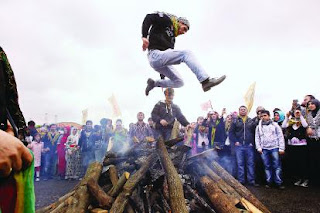
A scene from the Newroz festival in Istanbul's Kazlicesme district. Jumping over a fire to mark the coming of the new year is just one of many Newroz traditions. AA Photo from Hurriyet Daily News

Police are on high alert throughout Turkey this week as Newroz festivals get underway. Newroz marks the spring equinox and the beginning of the new year for Kurds, and as the Turkish government has emphasized of late, many other peoples from Central Asia to the Balkans.

In his Newroz remarks, President Gul expressed regret that the government had in past years banned Newroz celebrations. The government's emphasis on the holiday as something 'not just Kurdish' has also landed criticism from certain circles who argue the government is trying to somehow take the "Kurdishness" out of Newroz, though the government is right in its assertions that the holiday is observed by others than just just Kurds. The Central Asian heritage of the holiday, which some government officials have also put emphasis on in recent years, is even more controversial, though I have not thoroughly investigated the veracity of the statement.

The political significance of Newroz as a venue for Kurds to express their "Kurdishness," no doubt a politics of recognition here, plays out in this English-language story in Hurriyet Daily News of festivities in Kazlicesme, where BDP politicians turned the venue into a political stage at which to criticize the AKP.

Friday, March 11, 2011

"Progress This Is Not," Says EU Parliament


The European Parliament voted to approve its resolution on Turkey's progress toward accession this week. The resolution follows up on the annual progress report the European Commission issued in November, which documents how far Turkey has come over the past year in meeting EU requirements for membership (the 36 negotiating chapters of what is known as the EU acquis communitaire.

The resolution passed Wednesday is not an extraordinary measure, but an action taken by the Parliament every year that allows European MPs to comment on the progress report. The Parliament is routinely more stark in its criticisms than the progress report, and of course, is much more influenced by European politics -- in this case, European opposition to Turkish membership in some countries -- than the progress reports issued by the Commission.

The resolution this year was particularly strong, drawing attention to the recent arrests of journalists Ahmet Şık and Nedim Sener, whose case have drawn considerable international controversy and domestic criticism. The Parliament also noted concern with long arrest periods, an issue that has also attracted more attention in the Turkish press and among human rights groups. Parliamentarians also requested that Turkey lower its current 10% threshold, something the AKP has been reluctant to do since it would jeopardize the ruling party's ability to attain a parliamentary majority and thus more easily pass a new constitution. The whole resolution can be read here.

Prime Minister Erdogan responded strongly, arguing today that if Europeans do not want Turkey in the EU, they should just be honest about it. Instead of addressing the criticisms head-on and noting shortcomings on Turkey's part, the prime minister instead leveled his criticisms at European parliamentarians opposing Turkish membership. The deflection is a not at all a new tactic by the AKP, but the players have changed a bit.

Contrary to the nationalist era of CHP when the party was led by staunch Kemalist stalwart Deniz Baykal, Kemal Kilicdaroglu's CHP -- "the new CHP" as party officials are calling it -- has taken a more pro-European posture. CHP's office in Brussels, a development of the past two years, issued a statement criticizing the AKP for Turkey's stalled accession process and urging the government to take needed reforms. From Hurriyet Daily News:
“Despite the fact that the European Parliament and other EU institutions cannot analyze Turkey’s situation correctly, taking into consideration the whole of events and the cause-effect relationship, the scene painted by Brussels on the situation today is saddening,” Kader Sevinç, the Brussels representative of the main opposition Republican People’s Party, or CHP, told the Hürriyet Daily News & Economic Review in an interview.

Sevinç sent a written note to CHP leader Kemal Kılıçdaroğlu briefing him about the content of the report.

“Unfortunately, the CHP’s reservations about the government-led constitutional amendments proved right: Those responsible for the Sept. 12 [1980] military coup cannot be tried, judge and prosecutor appointments have been politicized, authoritarian tendencies have grown stronger, pressure on the media has increased, freedoms are being limited and social polarization is deepening,” Sevinç told the Daily News.

“We see in the report that the importance of these issues is becoming better understood by the European Parliament, which is directly elected by the EU public,” she said.

The Brussels chief criticized the AKP for not doing enough to open the three EU accession-negotiation chapters – those on competition, social policy and public procurement – that carry no political baggage.

“The government remains unwilling to open the social policy and competition chapters because there is a need for reforms on state aid, the unregistered economy, gender equality at work and child labor,” said Sevinç.

. . . .

Sevinç said the CHP was closely following Turkey’s accession process and had established a “shadow CHP team monitoring EU negotiations.” The team, led by Sevinç, is following each and every negotiating chapter in the Turkish-EU talks and briefing Kılıçdaroğlu about the progress made.
Whereas before the CHP would stay quiet in face of the EU criticism, the party is now using such opportunities in its opposition politics against the AKP. The resolution did recognize the constitutional referendum as a qualified step toward accession, but yes, the shortcomings are duly noted and Sevinc is astute in arguing that the new constitution has not brought about a more liberal Turkey.

UPDATE I (3/15) -- EU Rapportuer on Turkey Ria Oomen Ruijten defends the resolution here, calling the report critical but balanced. Meanwhile, worth a considered reading is Turkey watcher Aengus Collins' thoughtfully sober blog post on the AKP's recent majoritarian turn, something I have written about here extensively. An excerpt:
In 2002, however, the AKP was a new political force which risked a backlash from Turkey’s establishment. It went out of its way to counter concerns about its religious roots by pushing forward with political and economic reforms. But that was then. Today, the AKP no longer needs to burnish its European credentials as a means of forestalling a backlash from the establishment, because in the meantime it has consolidated its own position as Turkey’s new establishment. It is not unrivalled in this role, but it is clearly dominant. Both in successive electoral contests and in murkier episodes such as the failed judicial attempt to close the party in 2008 or the conduct of the Ergenekon and similar cases, the AKP has repeatedly secured the upper hand over those who would challenge it.

Moreover, the AKP has managed to do all of this in the name of democratisation. With Machiavellian aplomb, the party has turned democracy’s weak roots in Turkey to its advantage by loudly defining the concept on terms that work in its favour. In essence, this amounts to a crude majoritarianism which holds that an elected leader can and should do as he sees fit. The stronger his mandate, the less tolerable are constraints of any sort on his power, whether these stem from the military, the judiciary, the media, international organisations, or anywhere else. As the Financial Times noted in a recent editorial, the AKP government’s executive powers are now “increasingly untrammelled.”

It is against this backdrop that Turkey will head to the polls in three months’ time. Testing times lie ahead.

Something Wicked This Way Comes . . .

Internet freedom in Turkey is drifting closer to the Orwellian as the Prime Ministry's Information and Technology Board plans to implement new regulations on the Internet. From Ersu Ablak writing in Hurriyet Daily News:
After Aug. 22 we will have a totally different system. The government is so kind and father-like that it wants us to be fully protected from any kind of harm that the Internet can bring about. This is why they have decided to provide Internet services to us filtered from the source. It is too much hassle to ban websites one by one, therefore they will have bundles and lists. According to the current plans there will be four types of bundles available.

These will be called Standart Profile (Standart Profil), Children’s Profile (Çocuk Profili), Family Profile (Aile Profili) and Domestic Internet Profile (Yurtiçi İnternet Profili). All of these profiles will be censored to various degrees so that we will be protected just as our profile needs to be, because our government knows best.

Each profile will have two lists assigned; A black one and a white one. In the black list there will be websites that will be banned and in the white one there will be websites that are allowed to be surfed.

The government says that they ban websites at the source so that our children will be fully protected. There will be no room for the human error of parents. Banning websites will be fully automatic. However, the people who will be in charge of these practices and the standardization of establishing these lists are very vague. The government will be able to censor any website at will. You won’t even notice it.
The regulation is entitled “Rules and Procedures of the Safety of Internet Use” and was passed just this February. As if Turkey's current (2006) Internet law was not bad enough . . . let's hope the government turns an about course.

Also, on another note, as far as I can tell the ban on Blogspot (and this blog) is still on.

Thursday, March 10, 2011

Wildlife Is Not Immune from Ultranationalism

Vulpes Vulpes Kurdistanica

Turkey's environment ministry is changing the names of three species of animals bearing Turkish and Armenian names. From the BBC:
The environment ministry says the Latin names of the red fox, the wild sheep and the roe deer will be altered.

The red fox for instance, known as Vulpes Vulpes Kurdistanica, will now be known as Vulpes Vulpes.

Turkey has uneasy relations with neighbouring Armenia and opposes Kurdish separatists in Turkey.

The ministry said the old names were contrary to Turkish unity.

"Unfortunately there are many other species in Turkey which were named this way with ill intentions. This ill intent is so obvious that even species only found in our country were given names against Turkey's unity," a ministry statement quoted by Reuters news agency said.

Some Turkish officials say the names are being used to argue that Armenians or Kurds had lived in the areas where the animals were found.
Really? Yeah, really.

Wednesday, March 9, 2011

A Sobering International Women's Day

Ayse Pasali, who was allegedly shot to death by her ex-husband, unsuccessfully sought official protection due to her husband's alleged physical abuse and threats to kill her. PHOTO from Radikal

From Bianet:
The Turkish Medical Association Women Doctors and Women's Health Branch indicated that violence against women in Turkey increased on the grounds of social insecurity caused by capitalism, male domination and the destruction of the social state. Other reasons for the increase of violence were a failing of the state to protect women and the impassiveness of the media regarding the whole topic.

The women's branch announced, "Apart from intensifying the struggle and strengthening solidarity, only very few tiny things have changed for women since the witch-hunting era in the middle ages. Migration and poverty becomes more and more an issue for women. Men dominate women and usurp and control their identity and body. This domination provides them with concrete, tangible benefits".

"Statistics suggest that women murders have increased by 1,400 percent in the last seven years. At least five women are killed every day by men by reasons of honour, virtue or morality. On 8 March this year we are demonstrating once more for our labour, our bodies, our identities and our freedoms."
Prof. Şahika Yüksel and Assoc. Prof. Ayşe Devrim Başterzi, who conducted the study, are not without ideas of how to address the problem, which include amending the Penal Code to eliminate "unjust provocation" as a mitigating factor. Under a recent decision by the European Court of Human Rights, Turkey is required to protect a woman's right to life in cases of domestic abuse, a legal duty Turkey has had difficulty upholding. Below are photos and summaries of the murders of eight women killed in the first two months of 2011 (thanks to Hurriyet Daily News).

Thursday, March 3, 2011

Ahmet Şık and Nedim Sener Caught Up in Ergenekon Press Raids

Journalist Ahmet Şık has been detained in the Ergenekon investigation. Most ironically, Şık helped to expose the Ergenekon group as well as past coups against the government. Colleagues say it is highly unlikely he had anything to do with Ergenekon. More likely: He was working on a book on links between the Gulen Movement and the Turkish police . . . playing with fire indeed.

From Hurriyet Daily News:
Turkish police Thursday targeted more journalists as part of a controversial probe into alleged coup plots, among them a prominent award-winning reporter, Anatolia news agency reported.

Police were searching the homes of 11 people in Istanbul and Ankara, following a similar raid targeting the media last month that sparked an outcry over press freedom in EU-hopeful Turkey and drew a U.S. rebuke, Agence France-Presse reported.

A prosecutor issued a detention order for the suspects, and journalist Ahmet Şık was detained after his home was searched for six hours, daily Hürriyet reported on its website. Nine others, mostly journalists, were also detained, The Associated Press reported.

Şık already faces prosecution for co-writing a critical book about the crackdown on the so-called Ergenekon network, broadcaster NTV reported.

Police had reportedly discovered a draft book by Şık that allegedly focuses on the religious groupings within the police force on the hard disk of one computer seized in last month's raid on Oda TV, several news websites said.

Also among the suspects was Nedim Şener, an investigative reporter for daily Milliyet and author who last year received the International Press Institute's "World Press Freedom Hero" award for a book that put blame on the security forces in the 2007 murder of Turkish-Armenian journalist Hrant Dink.
Şık (use Turkish letters when spelling!) and Sener have both been in-and-out of the news in recent years, and neither can be loved much by the government. Radikal journalist Şık's most recent investigation of links between the Turkish police and the Gulen movement, a most controversial subject in Turkey, has certainly not won the journalist any friends, and many have speculated in the Turkish media that this was the reason for his arrest.

The government has taken a lot of domestic and international heat for its treatment of the press, and many have long accused the government of using the Ergenekon investigation to silence its critics, including journalists.
The current situation is “ridiculous and tragic,” said journalist Ertuğrul Mavioğlu, noting that Ahmet Şık, one of the journalists whose homes were searched, had been instrumental in opening the Ergenekon case in the first place. The diaries in Şık’s “Coup Diaries” story for weekly Nokta in 2007, an article that led to the magazine being shut down, were among the key evidence that led to the investigation, Mavioğlu said.

It is a very “immoral accusation to place Ahmet Şık next to the ‘deep state’ and Ergenekon,” said Mavioğlu, a journalist with daily Radikal and co-author with Şık of a two-volume book about the Ergenekon case. Speaking to the Daily News while in front of Şık’s house as the search continued, he said he cannot compare the situation to anything but McCarthyism.
For more reaction against the arrests, including a strong denunciation by CHP leader Kemal Kilicdaroglu and CHP deputy leader in charge of human rights (who I interviewed last summer), click here. For more on Sener and the trumped up charges he faced last year for leaking state secrets (that could be found in public documents), click here.

Shame, shame, the whole way round . . .


UPDATE I (3/4) -- The Turkish Journalists Association (TGD) has issued a statement in regard to the press raids (thanks to Bianet): 60 journalists are currently detained in prison; more than 2,000 journalists are being prosecuted. Investigations have been launched against 4,000 journalists. Death threats against journalists and trials carrying hundreds of years of imprisonment and are continuing.

. . . .

The government seems to remain a passive spectator of the threats against press freedom and journalists by giving the impression that they are not disturbed by the situation that the source of the threats is not being removed. Crimes of thought are on the rise again in this country with journalists being taken into custody, arrested and tried.

Head of the Turkey-EU Joint Parliamentary Commission Helene Flautre has made the following statement on the arrests: "The professional orientation and research carried out by the journalists do not give the impression that they are affiliated with nationalists and supporters of a coup like the Ergenekon organization, I think."

UPDATE II (3/5) -- The New York Times' Sebnem Arsu has the story here.

Erdonomics?

PHOTO from Hurriyet Daily News

A recent report by TurkStat, the Turkish government's statistical arm, reveals a growing division between rich and poor despite the high growth percentages and foreign direct investment numbers the government has been posting. While the rich have indeed been getting richer, the poor have gotten poorer. From Hurriyet Daily News:
The people in Turkey’s highest income group are 8.5 times richer than those in the poorest, up from 8.1 times in the previous survey, according to the “2009 Income Distribution and Living Conditions” report recently released by the Turkish Statistical Institute, or TurkStat.

The overall poverty rate in the country likewise increased from 16.7 percent in 2008 to 17.1 percent in 2009, the report said. This means a total of 12.97 million people living in poverty, up from 11.58 million a year earlier. According to TurkStat, the monthly income set as the official poverty line for a four-person household in Turkey was increased from 767 Turkish Liras in 2008 to 825 liras in 2009.

. . . .

According to TurkStat’s figures, the richest 20 percent of people in Turkey earned 47.6 percent of the country’s total income in 2009, while the poorest 20 percent had a share of only 5.6 percent.

“Of course, as the statistics demonstrate, the gap of more than eightfold is a sign of inequality. But compared to Western Europe, this ratio is better and I don’t see a worse deterioration,” Professor Seyfettin Gürsel, the director of Bahçeşehir University’s Economic and Societal Research Center, or BETAM, told the Daily News. He said increasing income taxes in an equitable way would enable the social transfer of wealth needed to help solve the problem of income inequality.

TurkStat’s survey showed that poverty rates increased in both urban and rural areas, to 15.4 percent and 16.1 percent, respectively. The 7.09 million urban poor in 2008 went up to 7.51 million, while the total in rural areas went up from 3.2 million to 3.49 million.

. . . .

Wages constitute the largest income source for the Turkish population, 42.9 percent, compared to entrepreneurial income, at 20.4 percent, the survey said. The breakdown of statistics by region and province showed that Istanbul residents continued to have the highest levels of disposable income in 2009, with an average of 12,795 liras annually in 2009, followed by the Western Anatolia region with 11,501 liras. Southeast Anatolia had the smallest amount of disposable income, an average of 4,655 liras. The number of poor people in Southeast Anatolia increased from 895,000 in 2008 to 999,000 in 2009, or 13.7 percent of the regional population.
For the report, click here.

The numbers come at the helm of an election year in which the CHP is challenging the government on its failure to grow the economy for everyone. Moving back to a social democratic agenda, CHP leader Kemal Kilicdaroglu has promised to work to bridge the wealth divide and provide better social services. The AKP, on the other hand, has put the emphasis on traditional welfare systems and pursued a neoliberal economic policy that has kept Turkey from pursuing another IMF loan while at the same time largely failing to adequately address income inequality, poverty, and the country's significant informal sector.

Part of the problem here is that Turkey lacks a proper tax infrastructure that would progressively address income inequalities and help solve for the growing inequality brought by high interest rates and an elite-oriented growth policy. From my post last February:
According to data from the Organization for Economic Cooperation and Development (OECD), the revenue Turkey collects from personal income taxes and profits stands at less than six percent of the total GDP, and has been declining steadily since 2000. (See "Public Finances" at the bottom of Turkey's OECD statistical profile.) This is the lowest among all OECD countries. As the Anatolia News Agency pointed out in its report Monday, a decline in personal income tax collections likely shifts the burden to workers and more vulnerable members of society. Though the Agency cites no sources, I would very much like to see more analysis of the problem.

Also worth taking note of are the remarkable revenues taken in on cigarette sales, which no doubt hit the families of smokers quite hard. (And, in Turkey, smoking is not only an "upper-class" addiction.)

According to the United Nation Development Program's Gini index calculations, Turkey stands between Peru and Ecuador in terms of economic inequality. All European Union member countries rank far ahead of Turkey according to Gini's equality measures, in addition to Croatia and Macedonia, the two other countries that have accession partnerships with the EU.
Kudos to the AKP for bringing the Turkish economy out of a sad time, but it is time to balance neoliberalism with economic and social rights and democracy that delivers. Perhaps the CHP can shake things up a bit. A counter-cyclical fiscal policy would also help -- some lessons from Chile? Finally acting like a social democratic party while paying significantly less heed to the nationalist/laicist rhetoric . . . actually focusing on democracy that delivers . . . what a concept!

Wednesday, March 2, 2011

Blogspot Banned . . . Again

PHOTO from Hurriyet Daily News

From Hurriyet Daily News:
A spat over rights to broadcast Turkish football matches has led a local court to issue a blanket ban on the popular blogging platform Blogger, angering Turkish Internet users with what experts said was a disproportionate response.

The court in the southeastern province of Diyarbakır banned the website, a property of Google Inc., in response to a complaint by the satellite television provider Digiturk, which owns the broadcast rights to Turkish Super League games. Matches broadcast on Digiturk’s Lig TV channel had been illegally posted by several Blogger users on their blogs.

“This is a disproportionate response by the court and undoubtedly has a huge impact on all law-abiding citizens,” cyber-rights activist Yaman Akdeniz told the Hürriyet Daily News & Economic Review on Wednesday, adding that millions of bloggers and blog readers would be affected by the Diyarbakır court decision.

“[I understand] there is a legitimate concern [regarding Digiturk’s commercial rights] but banning all these websites will not solve the issue. The decision opens the way to collateral damage,” said Akdeniz, who is also a law professor at Istanbul Bilgi University.

There are more than 600,000 Turkish bloggers actively using Blogger and some 18 million users from Turkey visited pages hosted by the site last month, Akdeniz said. The ban is expected to fully go into effect within a few days unless it is successfully challenged in court.

“If two people plan a criminal activity on the phone, should we ban the use of telephones all over the country?” asked Deniz Ergürel, the secretary-general of the Media Association.

“We believe this is a wrong approach to the issue and deprives millions of bloggers and Internet users from writing and sharing ideas online,” Ergürel, who is also a regular blogger, told the Daily News on Wednesday. He added that while the violation of Digiturk’s commercial rights should not be ignored, other solutions had to be found. “Even cursing, threatening or cheating over the phone is considered a crime, but this does not imply access to phones all over the country would be banned if there is a case against them,” he said.
Of course, this blog is a Blogspot/Blogger blog, and so for the time being, readers in Turkey are having to use proxy servers to gain access. There are many issues with how Turkey regulates the Internet, but at the heart of these broad "bans" is that the Telecommunications Board shuts off an entire website when only particular page or aspect of that page is troublesome. When we are talking about massive sites like YouTube and Blogspot, the orders become more than a little problematic, not to say ridiculous. For more on Turkey's Internet laws, click here. For more on Turkey's various disputes with Google, which operates Blogspot, click here.

 
UPDATE I (3/4) --  Google has petitioned the Turkish government to ends it blanket ban on Blogspot, calling on the Turkish government and firms concerned with copyright violations to use forms available on their website to seek redress for copyright violations rather than petitioning for the wholesale closure of websites. From a press statement the company has issued: “Instead of depriving all content owners from accessing Blogger services, we encourage them to make use of such a process. In this way, Blogger users from Turkey will be able to benefit from the services while we try to deal with the complaint.” Too much common sense? 

Tuesday, March 1, 2011

Erbakan Funeral Recalls an Earlier Era

AA Photo from Hurriyet Daily News

Former prime minister Necmettin Erbakan was buried today. Though they have significantly changed their views since, many AKP figures were students of the former Islamist leader, who was removed in power in Turkey's 1997 postmodern coup. A bit of background from my first post:
Shortly after Turkey’s last coup in 1997 (the 'post-modern' coup), Turkey’s Constitutional Court closed Erbakan's Refah Party (RP)and banned from politics its prime minister, Necmettin Erbakan, along with other Refah politicians (including Erdoğan who was then the mayor of İstanbul). RP was widely feared when it came to power in 1994's municipal elections and then entered parliament with a plurality of the vote in the next parliamentary elections. The party's ideology was an amalgam of political Islam and anti-imperialism and never did it espouse liberal democratic ideals. It was authoritarian to its core, anti-EU, and paid little heed to the concept of personal liberty.
Although the party moderated its radicalism once in parliament, it did so because it had to in order to maintain the coalition it had formed with the center-right. Despite this moderation, Erbakan was subject to a deluge of criticism when he made state visits to Iran and Libya, seeking to influence foreign policy, traditionally the domain of the president. Further, he urged children to attend religious schools, proposed the construction of mosques in secular centers, and most importantly, failed to control RP municipal authorities who began to pass very restrictive laws, shutting down cinemas, lingerie stores, and restaurants that refused to close their door during Ramazan.
Following the dissolution of RP, many of its members re-organized and established the Virtue Party (Fazilet Partisi—FP) in 1998. FP was in many ways a continuation of RP and although posting a strong showing following elections in 1999, faced problems soon after resulting from internal divisions among more Islamist sectors in the party and those who began to identify themselves as reformers. Erdoğan and Gül are members of the reform group and it is this group which formed AKP in 2001 just after the Constitutional Court’s closure of FP. Although some of the more radical actors within RP and FP entered AKP, Erdoğan dismissed with many of them upon coming to power.

Following the collapse of a divided parliament in early 2002, AKP swept to power in elections held in November that year. The party won a surprising 34 percent of the vote—enough to capture an absolute majority in Parliament. AKP's victory seems to have had more to do with reform than Islam. This is indicated by the losses of truly Islamist parties in 2002 and the years that followed. In contrast to AKP, the Felicity Party (Saadet Partisi—SP) was formed by the faction of more Islamist FP members and did quite poorly in the 2002 elections.
The SP is still a minor player in Turkish politics, and received a lot of attention last summer when the party sought to capitalize off of the Gaza flotilla incident. Erbakan lost control of the party soon after when the party's leadership chose not to elect his family members to the party congress. Though most of the AKP leadership has long ago drifted from Erbakan's National Outlook ideology, a synthesis of old-school Turkish nationalism and Islam, Erbakan's ideas remain part of AKP's history. His prime ministership will certainly be remembered as an important time for Turkish politics.