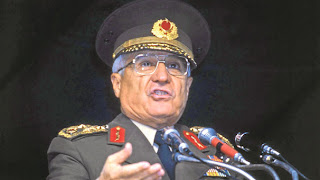
PHOTO from Hurriyet
One of the stories I overlooked last week was the Supreme Court of Appeals' rejection of a petition to hear the case of former Chief of General Staff Ilker Basbug. The court ruled that it could not hear Basbug's case because he had been charged with terrorism, and that therefore the specially-authorized court responsible for his launching his prosecution had jurisdiction.
Last month's news of Basbug's arrest caught nearly everyone by surprise, and ratcheted up questions as to just how far the specially-authorized courts charged with the Ergenekon and Sledgehammer investigations are willing to go. For background on Basbug and the controversy over whether it should be the Supreme Court or the specially-authorized court that brought the indictment, in addition to some background as to the division within the AKP thanks to pro-Gulen forces, click here.
At the same time, it appears specially-authorized prosecutors are also digging deeper into figures involved in the Feb. 28 process, the 1997 postmodern coup that brought about the demise of Erbakan's Islamist Refah-party and its governing coalition. Leading figures in the AKP have long resented the Feb. 28 process, and historical memory of the events continues to influence AKP politicians and its supporters (see Feb. 7 post).
The event is known as the Feb. 28 process since this is the date on which the National Security Council (MGK) met to begin a protracted process through the spring that ultimately resulted in the government's falling and a series of new laws and restrictions on Islamist political activity. Standards of education were changed to counter the rising popularity of imam-hatip high schools (religious high schools where students receive a mix of standard and theological curriculum), regulations on the headscarf were strengthened, the Refah party was closed, and numerous Islamist politicians, including the prime minister, banned from politics and tried in courts for offenses against the secular unity of the state.
According to Milliyet, four civilian officers working in the MGK at the time have been asked to give testimony as part of the investigation. The paper reports that the officers were working in the high ranks of the institution, and played a role in writing the various orders and memos that guided the coup.
At the same time, government officials are starting to talk about possible reform of laws allowing for specially-authorized courts and prosecutors. These developments follow the crisis with Hakan Fidan and apparent power move by elements supported by religious leader Fethullah Gulen. Yet it seems for the moment that Basbug's trial will go on despite President Gul's call for the former chief to have his case heard at the higher court. Critics of Erdogan have pointed out that the prime minister had no problem in saving Fidan from prosecution, but are willing to take no such measure to save Basbug despite the apparent cooked-up charges against him.
The specially-authorized court has accepted the 39-page indictment against Basbug in which he is charged with planning to topple the government multiple times, the last and most critical to the charges being through a plan to create numerous websites that would spread black propaganda ("psychological operations") against the government and foment the conditions for a coup. The indictment also alleges that when Basbug was Land Forces Commander he also planned to overthrow the government, but gave up when he realized he did not have the resources to carry through his plans.
Evidence in the indictment is shoddy at best, largely consisting of various accusations and innuendo, as well as circumstantial links to other figures charged with terrorism, including former Cumhuriyet columnist Mustafa Balbay. Basbug gave an interview to Balbay in 2004 on negotiations with Cyprus, but did so at the time anonymously.
Basbug has denied the charges in the indictment, saying that he did not even have a computer in his office and that if the military truly planned to overthrow the government, it had more powerful means at its disposal than websites.
Showing posts with label Military. Show all posts
Tuesday, February 21, 2012
Thursday, February 16, 2012
Uludere Probe Continues
PHOTO from Milliyet
Parliament's commission for human rights is expected to issue a report in the coming days as to what exactly happened in Uludere on the night of Dec. 28 when 35 Kurdish smugglers were killed in strikes carried out by unmanned drones. The government and security officials soon announced that the strikes were a tragic mistake, but so far evidence has been far from forthcoming.
The report follows a visit by parliamentarians to the site of the tragedy, as well as interviews they conducted with local officials, including local military commanders, and villagers. Some parliamentarians, in particular CHP deputy Levent Gok, have already spoken to the media about their findings. According to Gok, the strikes were conducted without the knowledge of local commanders on the ground or the local mayor, meaning the strikes were carried out by Ankara.
According to one local gendarme commander with whom parliamentarians spoke, forces were ordered to pull back one day before the incident, though apparently the band of smugglers was sighted at a military outpost from which one local gendarme officer reported that, if asked, he could have told officials higher up in the command chain not to strike.
Yesterday the military provided parliamentarians access to footage from the Heron drones responsible for the strikes that Gok and others report show the smugglers were clearly not PKK militants since there were more mules than people and they did not try to escape once attacked.
Parliament's commission for human rights is expected to issue a report in the coming days as to what exactly happened in Uludere on the night of Dec. 28 when 35 Kurdish smugglers were killed in strikes carried out by unmanned drones. The government and security officials soon announced that the strikes were a tragic mistake, but so far evidence has been far from forthcoming.
The report follows a visit by parliamentarians to the site of the tragedy, as well as interviews they conducted with local officials, including local military commanders, and villagers. Some parliamentarians, in particular CHP deputy Levent Gok, have already spoken to the media about their findings. According to Gok, the strikes were conducted without the knowledge of local commanders on the ground or the local mayor, meaning the strikes were carried out by Ankara.
According to one local gendarme commander with whom parliamentarians spoke, forces were ordered to pull back one day before the incident, though apparently the band of smugglers was sighted at a military outpost from which one local gendarme officer reported that, if asked, he could have told officials higher up in the command chain not to strike.
Yesterday the military provided parliamentarians access to footage from the Heron drones responsible for the strikes that Gok and others report show the smugglers were clearly not PKK militants since there were more mules than people and they did not try to escape once attacked.
Thursday, January 5, 2012
A Lot of Noise Against Coups (But Maybe Not the Right Type)
Former president and general Kenan Evren, leader of Turkey's 1980 military coup, could face trial at the age of 94. On Jan. 3, a prosecutor filed an indictment with an Ankara court alleging Evren, as well as former Air Force Commander Tahsin Sahinkaya, now 87, masterminded violent unrest later used to justify their military putsch. For more, in Turkish, click here.
PHOTO from Milliyet
The violence preceding the coup was some of the worst in Turkey's history, including a series of shootings against peaceful protestors gathered in public squares and assassinations of leftist figures, including the murder of Milliyet editor Abdi Ipekci with whose assassination the indictment against the two men alleges they are complicit. These attacks were carried out by rightist militias mainly in command of the infamous ultra-nationalist Grey Wolves, and combined with the series of detentions and military trials after the coup, decimated the Turkish left (for more, see here).
The charges against the generals are facilitated by constitutional amendments passed in the September 2010 referendum, and were some of the few amendments that enjoyed broad public support, including that of the CHP opposition. A past attempt to bring charges against Evren made by former prosecutor Sacit Kayasu resulted in the prosecutor's disbarment. There is another investigation ongoing into the use of torture during the coup years. The coup brought about the assassination of 571 people, and over 700,000 people were detained in its aftermath. Torture was rampant, prison conditions horrible, and black-listings widespread.
PHOTO from Milliyet
The violence preceding the coup was some of the worst in Turkey's history, including a series of shootings against peaceful protestors gathered in public squares and assassinations of leftist figures, including the murder of Milliyet editor Abdi Ipekci with whose assassination the indictment against the two men alleges they are complicit. These attacks were carried out by rightist militias mainly in command of the infamous ultra-nationalist Grey Wolves, and combined with the series of detentions and military trials after the coup, decimated the Turkish left (for more, see here).
The charges against the generals are facilitated by constitutional amendments passed in the September 2010 referendum, and were some of the few amendments that enjoyed broad public support, including that of the CHP opposition. A past attempt to bring charges against Evren made by former prosecutor Sacit Kayasu resulted in the prosecutor's disbarment. There is another investigation ongoing into the use of torture during the coup years. The coup brought about the assassination of 571 people, and over 700,000 people were detained in its aftermath. Torture was rampant, prison conditions horrible, and black-listings widespread.
Ozel Regrets "Terrorist" Label
PHOTO from Milliyet
Milliyet's Fikret Bila has run an interview with Chief of General Staff Necdet Ozel in which the head of the Turkish Armed Forces says he would not like to call PKK fighters "terrorists" since they, too, are citizens of Turkey.
According to Ozel, many PKK fighters have been deceived, a fact which the top general laments at the same time he gives casualty figures of how many terrorists have been killed in the past six months. Turkish forces in Turkey's near 18-year conflict with the PKK. That number is at 165, according to Ozel, while 112 have surrendered and another 50 have been captured.
Ozel's intimation that PKK fighters should not be labeled as "terrorists" has infuriated many Turks, and nationalist-minded bloggers are clamoring to criticize Ozel as ineffective, and many not simply vis-á-vis the Kurdish question, but in regard to the treatment of army generals who have been arrested in the ongoing Ergenekon investigations.
In the interview, Ozel also dismissed reports that the PKK has adopted a truce, arguing that the opposite is in fact true and that PKK operations have continued throughout the winter. He also said unequivocally that the Turkish Armed Forces were in no way involved in the negotiations between MIT and the PKK that seem to have ended at the end of 2009 or beginning of 2010. Ozel further states that he is against recognizing Kurdish as an official language or integrating it into school education and using it to administer public services.
The general goes on to state that the United States has provided assistance from northern Iraq, though the Kurdistan Regional Government (KRG) has done little to assist with the situation. Iraqi officials have told Ankara that there is little they can do (see an account of TRT's interview, in Turkish, with Iraq Vice President Tariq Hashimi on Oct. 30). Meanwhile Iraqi President Jalal al-Talabani and KRG president Massoud Barzani, much to the likely frustration of Turkish officials, continue to dialogue with the BDP, urging the party, albeit without much visible success, toward peace.
Milliyet's Fikret Bila has run an interview with Chief of General Staff Necdet Ozel in which the head of the Turkish Armed Forces says he would not like to call PKK fighters "terrorists" since they, too, are citizens of Turkey.
According to Ozel, many PKK fighters have been deceived, a fact which the top general laments at the same time he gives casualty figures of how many terrorists have been killed in the past six months. Turkish forces in Turkey's near 18-year conflict with the PKK. That number is at 165, according to Ozel, while 112 have surrendered and another 50 have been captured.
Ozel's intimation that PKK fighters should not be labeled as "terrorists" has infuriated many Turks, and nationalist-minded bloggers are clamoring to criticize Ozel as ineffective, and many not simply vis-á-vis the Kurdish question, but in regard to the treatment of army generals who have been arrested in the ongoing Ergenekon investigations.
In the interview, Ozel also dismissed reports that the PKK has adopted a truce, arguing that the opposite is in fact true and that PKK operations have continued throughout the winter. He also said unequivocally that the Turkish Armed Forces were in no way involved in the negotiations between MIT and the PKK that seem to have ended at the end of 2009 or beginning of 2010. Ozel further states that he is against recognizing Kurdish as an official language or integrating it into school education and using it to administer public services.
The general goes on to state that the United States has provided assistance from northern Iraq, though the Kurdistan Regional Government (KRG) has done little to assist with the situation. Iraqi officials have told Ankara that there is little they can do (see an account of TRT's interview, in Turkish, with Iraq Vice President Tariq Hashimi on Oct. 30). Meanwhile Iraqi President Jalal al-Talabani and KRG president Massoud Barzani, much to the likely frustration of Turkish officials, continue to dialogue with the BDP, urging the party, albeit without much visible success, toward peace.
Tuesday, January 3, 2012
Fallout
PHOTO from Taraf
Local governor Naif Yavuz was assaulted when visiting the village of Gulyazi from where many of the victims of the air strike in Uludere haled. There are reports that BDP deputy Hasip Kaplan stoked the mob, and that he gave reports to Yavuz not to visit the area because residents were armed and angry. Meanwhile most Turkish newspapers continue to demand an apology for the strikes, and CHP leader Kemal Kilicdarglu has promised to take the matter to parliament.
Despite the mass outrage, Deputy Prime Minister Bulent Arinc has said that it is premature for the government to apologize, though it deeply regrets the incident, and the government seems to be reluctant to admit full responsibility. Arinc said today that the trek on which the smugglers were traveling was a well-known PKK treading ground, and that they would have easily looked like PKK fighters. Meanwhile Taraf is reporting that the Turkish Armed Forces acted on information provided by Turkish intelligence (MIT), and carried reports earlier that the attack might have been carried out following intelligence received from a PKK informant.
Prime Minister Erdogan and Chief of General Staff Necdet Ozel met yesterday to discuss the initial findings of the Turkish Armed Forces' investigation.
Local governor Naif Yavuz was assaulted when visiting the village of Gulyazi from where many of the victims of the air strike in Uludere haled. There are reports that BDP deputy Hasip Kaplan stoked the mob, and that he gave reports to Yavuz not to visit the area because residents were armed and angry. Meanwhile most Turkish newspapers continue to demand an apology for the strikes, and CHP leader Kemal Kilicdarglu has promised to take the matter to parliament.
Despite the mass outrage, Deputy Prime Minister Bulent Arinc has said that it is premature for the government to apologize, though it deeply regrets the incident, and the government seems to be reluctant to admit full responsibility. Arinc said today that the trek on which the smugglers were traveling was a well-known PKK treading ground, and that they would have easily looked like PKK fighters. Meanwhile Taraf is reporting that the Turkish Armed Forces acted on information provided by Turkish intelligence (MIT), and carried reports earlier that the attack might have been carried out following intelligence received from a PKK informant.
Prime Minister Erdogan and Chief of General Staff Necdet Ozel met yesterday to discuss the initial findings of the Turkish Armed Forces' investigation.
Sunday, January 1, 2012
Tragedy in Sirnak
PHOTO from Radikal
A Turkish air strike in the Turkey-Iraq border district of Uludere in Sirnak province early in the morning on Dec. 29 has resulted in the deaths of 35 people who were smuggling diesel from Iraq to Turkey. All are Turkish Kurds, and they do not appear to in any way be affiliated with the PKK or PKK activity. The strike is a great embarrassment to the government, military, and intelligence services, which in recent months have worked to facilitate a coordinated, rapid attack strategy. The 35 killed were targeted by unarmed Heron drones (not U.S. Predator drones based at Incirlik). Those killed were hauling diesel with mules, and according to initial statement by government and military officials, appeared to be PKK forces crossing into Turkey from Iraq.
Deputy AKP vice chair Huseyin Celik has characterized the strikes as an "operational accident," and Erdogan and other government officials have expressed deep regret for the incident, vowing a full investigation into the incident. In a statement made over the weekend, Erdogan said that innocent civilians might have been intentionally attacked from the air before (a reference to Dersim), but that this does not happen today and that the government will not stand for it. Turkish Armed Forces Chief of General Staff Necdet Ozel is conducting an investigation into the incident, and is expected to report to the government in the next few days.
Turkish newspapers resound that the state must apologize for the mistake, and sentiment is nearly universal that all efforts should be made to investigate the tragedy and avoid similar incidents in the future. That said, it is yet to be seen whether the results of the investigation will be shared with the public and those responsible policies and officials held to account. Now that the government has firmer control of the military and is at the head of efforts to coordinate efforts between it and Turkish intelligence, headed by MIT head Hakan Fidan, the investigation and policies to follow will be a critical test of AKP leadership.
A Turkish air strike in the Turkey-Iraq border district of Uludere in Sirnak province early in the morning on Dec. 29 has resulted in the deaths of 35 people who were smuggling diesel from Iraq to Turkey. All are Turkish Kurds, and they do not appear to in any way be affiliated with the PKK or PKK activity. The strike is a great embarrassment to the government, military, and intelligence services, which in recent months have worked to facilitate a coordinated, rapid attack strategy. The 35 killed were targeted by unarmed Heron drones (not U.S. Predator drones based at Incirlik). Those killed were hauling diesel with mules, and according to initial statement by government and military officials, appeared to be PKK forces crossing into Turkey from Iraq.
Deputy AKP vice chair Huseyin Celik has characterized the strikes as an "operational accident," and Erdogan and other government officials have expressed deep regret for the incident, vowing a full investigation into the incident. In a statement made over the weekend, Erdogan said that innocent civilians might have been intentionally attacked from the air before (a reference to Dersim), but that this does not happen today and that the government will not stand for it. Turkish Armed Forces Chief of General Staff Necdet Ozel is conducting an investigation into the incident, and is expected to report to the government in the next few days.
Turkish newspapers resound that the state must apologize for the mistake, and sentiment is nearly universal that all efforts should be made to investigate the tragedy and avoid similar incidents in the future. That said, it is yet to be seen whether the results of the investigation will be shared with the public and those responsible policies and officials held to account. Now that the government has firmer control of the military and is at the head of efforts to coordinate efforts between it and Turkish intelligence, headed by MIT head Hakan Fidan, the investigation and policies to follow will be a critical test of AKP leadership.
Wednesday, June 23, 2010
The Aftermath -- Martial Law Coming Anytme Soon?
Responding to yesterday's attack on a military convoy in Istanbul's Halkali district, MHP leader Devlet Bahceli has called to designate the predominantly Kurdish southeast an emergency rule region (OHAL), a move that would essentially ring martial law to the region. Bahceli's proposal is unlikely to garner much support, though it does speak to the level of animosity and polarization that has emerged in the wake of increased PKK violence.
Bahceli issued the call during his party's parliamentary group meeting yesterday just a few hours after leading his party in boycotting a vote on a long-coming measure to amend the Anti-Terrorism Law so that Kurdish childred aged 15-18 will no longer be tried as adults.
At Monday's security summit, no mention was made to OHAL, and Chief of General Staff Ilker Basbug firmly rejected the possibility of imposing OHAL in a speech he gave Monday -- less than 24 hours before yesterday's bombing. However, with the National Security Council (MGK) set to meet tomorrow to discuss the security situation in the region, top government and military officials are now saying all options are on the table.
Parts of the southeast were first placed under martial law (provided for by the 1982 non-civilian Turkish constitution) in 1987, which did not disappear from the region until 2002. Much of the day-to-day violence during what some have coined the "dirty war" in the southeast occurred in conjunction with security measures taken under the auspices of OHAL, and the isolation of the region from the rest of Turkey under OHAL's unique governerning/security schemes is largely attributed to worsening the region's alienation from the rest of Turkey and contributing to a sense of victimization.
Other than OHAL, which despite Bahceli's hawkish rhetorical utterings is still a far possibility, the MGK will discuss the short and medium-term security solutions proposed in Monday's summit, namely the restructuring of military/security forces (including their greater professionalization) and increased coordination/cooperation with the United States and the Kurdish Regional Government (KRG). From Hurriyet Daily News:
In other news, police have detained 27 suspects thought to be involved in yesterday's bombing.
UPDATE I (6/27) -- For some thoughts from security experts and civil society/opinion leaders on imposing OHAL, see this short news feature from Today's Zaman.
Bahceli issued the call during his party's parliamentary group meeting yesterday just a few hours after leading his party in boycotting a vote on a long-coming measure to amend the Anti-Terrorism Law so that Kurdish childred aged 15-18 will no longer be tried as adults.
At Monday's security summit, no mention was made to OHAL, and Chief of General Staff Ilker Basbug firmly rejected the possibility of imposing OHAL in a speech he gave Monday -- less than 24 hours before yesterday's bombing. However, with the National Security Council (MGK) set to meet tomorrow to discuss the security situation in the region, top government and military officials are now saying all options are on the table.
Parts of the southeast were first placed under martial law (provided for by the 1982 non-civilian Turkish constitution) in 1987, which did not disappear from the region until 2002. Much of the day-to-day violence during what some have coined the "dirty war" in the southeast occurred in conjunction with security measures taken under the auspices of OHAL, and the isolation of the region from the rest of Turkey under OHAL's unique governerning/security schemes is largely attributed to worsening the region's alienation from the rest of Turkey and contributing to a sense of victimization.
Other than OHAL, which despite Bahceli's hawkish rhetorical utterings is still a far possibility, the MGK will discuss the short and medium-term security solutions proposed in Monday's summit, namely the restructuring of military/security forces (including their greater professionalization) and increased coordination/cooperation with the United States and the Kurdish Regional Government (KRG). From Hurriyet Daily News:
In line with the results of Monday’s state summit, the system of intelligence gathering and how this information is coordinated among security institutions will also be reviewed at the MGK meeting. Hakan Fidan, the new head of the National Intelligence Organization, or MİT, will brief the council about these efforts.More as it happens . . .
In the operational dimension, the MGK will review the results of recent cross-border operations into northern Iraq, where the training camps of the outlawed Kurdistan Workers’ Party, or PKK, are located. The military plans to carry out more cross-border operations as needed.
The council will also discuss potential measures to stop the further spread of terrorist activities to urban and tourist areas ahead of the beginning of the tourism season.
. . . .
Discussions at Thursday’s MGK meeting will also address the foreign connections of the PKK and will likely focus on Massoud Barzani, the head of the Regional Kurdish Administration in northern Iraq, who some have accused of doing too little to contain the outlawed group. During his landmark visit to Turley in early June, Barzani refrained from acknowledging the PKK as a terrorist organization but pledged his full support to Turkish officials in their fight against terror.
Though Barzani issued a condemnation of Saturday’s deadly attack, some Turkish officials are still far from being satisfied with his level of support.
Turkish officials are also planning to hold more meetings with the United States to review the countries’ current cooperation on intelligence sharing. Prime Minister Recep Tayyip Erdoğan’s meeting next week with President Barack Obama is expected to focus on the joint fight against terrorism.
In its meeting, the MGK will likely emphasize the need for societal unity in the fight against terror and call for the participation of all political parties, nongovernmental organizations and the media.
In other news, police have detained 27 suspects thought to be involved in yesterday's bombing.
UPDATE I (6/27) -- For some thoughts from security experts and civil society/opinion leaders on imposing OHAL, see this short news feature from Today's Zaman.
Monday, June 21, 2010
New Security Measures?
At a security summit called by President Gul in response to the attacks over the weekend, government and military officials announced that "short and medium-term solutions," in contrast to "daily and temporary solutions," would be found in order to address perceived intelligence failures.
A statement after the meeting announced that military and intelligence personnel in the southeast will be restructured and that greater effots will be made to attain inteligence from the Kurdish Regional Government (KRG) and the United States. Importantly, sweeping security measures associated with a declaration of a state of emergency (OHAL) in the southeast were not brought up, and firmly rejected by Chief of General Staff Ilker Basbug, who did not attend the summit, but addressed the violence and the military response in a speech delivered in Canakkale.
Prime Minister Erdogan, Defense Minister Vecdi Gonul and Interior Minister Besir Atalay, as well as senior military commanders and the head of the intelligence agency, participated in the meeting. From Hurriyet Daily News:
After the summit, Gul also met with opposition leaders. CHP leader Kemal Kilicaroglu repeated his calls for economic solutions to the conflict, again eschewing any discussion of Kurdish demands on the cultural/minority rights front, while MHP leader Devlet Bahceli used the attacks to call for total annihilation for the PKK.
A statement after the meeting announced that military and intelligence personnel in the southeast will be restructured and that greater effots will be made to attain inteligence from the Kurdish Regional Government (KRG) and the United States. Importantly, sweeping security measures associated with a declaration of a state of emergency (OHAL) in the southeast were not brought up, and firmly rejected by Chief of General Staff Ilker Basbug, who did not attend the summit, but addressed the violence and the military response in a speech delivered in Canakkale.
Prime Minister Erdogan, Defense Minister Vecdi Gonul and Interior Minister Besir Atalay, as well as senior military commanders and the head of the intelligence agency, participated in the meeting. From Hurriyet Daily News:
The threefold anti-terror strategy announced Monday will see Turkey review current operations, intensify cooperation with neighboring countries and work to boost the nation’s morale while psychologically weakening terrorist groups.Among those critical of the military response is AKP parliament speaker Mehmet Ali Sahin, who said over the weekend that the parliament had a responsibility to exercise review over the military and that he was waiting for an adequate explanation of what happened at Hakkari.
The government’s announcement, however, was not met with full support from opposition parties, which called such “daily and temporary measures” insufficient to stop the bloodshed.
“The fight against terror was widely assessed and in light of recent developments, additional short- and mid-term measures were decided to be taken,” read a written statement issued following a security summit chaired Monday by President Abdullah Gül with the participation of top civil and military officials, including the heads of the intelligence service and the newly established civilian anti-terror unit.
Twelve troops died over the weekend in clashes with the PKK, largely as a result of the outlawed group’s assault on a military outpost in the Şemdinli district of Hakkari province. Forty-six Turkish troops have been killed in the last two months, prompting renewed concerns about the threat the PKK poses to the country.
Participants in the summit agreed to review the intelligence-gathering operations and structure of the military personnel serving in the country’s Southeast, where the PKK is very active. This decision was seen as an acknowledgement that security officials are aware of the lack of information on the moves of terrorist groups, though the military and the National Intelligence Organization, or MİT, have denied allegations of the existence of such gaps.
The military has also been criticized for sending new recruits to a region where the fight against the PKK, which is listed as a terrorist organization by Turkey, the United States and the European Union, requires more expertise. Military experts suggested deploying only the best troops to the region and strengthening the military outposts in the area
The second part of the new strategy calls for intensifying coordination with neighboring countries and others related to the fight against the PKK, a change that is likely to bring more talks with Iraq and especially Massoud Barzani, the head of the Regional Kurdish Administration in northern Iraq. During his landmark visit to Turkey in early June, Barzani was given strong evidence and information on the PKK’s moves in his region. Though some progress has been observed, Turkish diplomats said they are still far from satisfied with Barzani’s support for anti-terrorism efforts.
The subject is also expected to be part of Prime Minister Recep Tayyip Erdoğan’s likely meeting with U.S. President Barack Obama during the G-20 summit in Toronto on June 26 and 27. “The joint fight against terror will be on our agenda if this meeting is set,” a diplomat told the Hürriyet Daily News & Economic Review on Monday.
Before relations soured following Israel’s attack on a Gazi-bound aid flotilla, Turkey received crucial support from Israel in its fight against the PKK and the Turkish military still uses Israeli-made drones to provide intelligence about the terrorist group.
The third part of the strategy calls for a solid psychological “war” to keep up the nation’s morale without giving courage to the terrorists through press headlines. “The media should be more sensitive in informing the public opinion,” the statement issued Monday said.
According to government sources, the meeting Monday will be followed by others to review the state of the fight against the PKK, and will be accompanied by meetings with opposition parties to try and secure the entire country’s support.
After the summit, Gul also met with opposition leaders. CHP leader Kemal Kilicaroglu repeated his calls for economic solutions to the conflict, again eschewing any discussion of Kurdish demands on the cultural/minority rights front, while MHP leader Devlet Bahceli used the attacks to call for total annihilation for the PKK.
Sunday, June 20, 2010
Semdinli Attack to Raise Specter of Violence
A PKK attack in Semdinli (Hakkari) killed 11 Turkish soldiers yesterday, the largest death toll to be inflicted in a single attack. Another soldier was killed today in another attack in Palu (Elazig). In the wake of the attacks, some Turkish politicians began calling for new military/security measures, the most reactionary of them arguing for a return to martial law in the southeast. Turkish television is reporting that President Gul has called for a security summit to be held tomorrow.
As PKK attacks on Turkish soldiers continue to increase in the southeast (see Kurdish Timeline), the chance of success for the the kind of political solutions and roadmaps for peace discussed last year look increasingly bleak. PKK attacks on Turkish soldiers, mostly conscripts, only augment popular support for military action, making whatever will the government had for finding a political solution weaker and more difficult to put into action.
At a funeral service for the soldiers held today , Prime Minister Erdogan strongly denounced the PKK , declaring that PKK fighters will “melt in their own darkness, dry up in their own swamps, drown in their own blood.” Meanwhile, AKP opposition figures held the AKP's initaitives toward the Kurds responsible for escalating the violence.
Anger with the PKK also provides an opportunity for Turkish politicians to score points with strong populist-minded rhetorical denunciations of the terrorist group. Such an environment also strengthens the PKK in a political sense, which benefits from a militarization of the conflict since more moderate voices are squeezed out. The PKK wants to engage in dialogue with the government on its own terms (now centered on demands for "regional autonomy"), and though the government is now less likely to do so, the organization can now claim that the moderates have failed and the organization was correct in arguing that the Turkish state is intent "to eliminate" the Kurdish political movement.
Saturday's attack prompted additional Turkish military operations into northern Iraq. KRG news sources are reporting that a young girl died in the Turkish bombing.
UPDATE I (6/21) -- In contrast to Erdogan's sweeping comments yesterday that PKK members wil "drown in their own blood," EU Chief Negotiator Egeman Bagis made a surprising statement addressing the deaths of the 12 PKK militants who are reported to have died in retaliatory attacks. From Hurriyet Daily News:
As PKK attacks on Turkish soldiers continue to increase in the southeast (see Kurdish Timeline), the chance of success for the the kind of political solutions and roadmaps for peace discussed last year look increasingly bleak. PKK attacks on Turkish soldiers, mostly conscripts, only augment popular support for military action, making whatever will the government had for finding a political solution weaker and more difficult to put into action.
At a funeral service for the soldiers held today , Prime Minister Erdogan strongly denounced the PKK , declaring that PKK fighters will “melt in their own darkness, dry up in their own swamps, drown in their own blood.” Meanwhile, AKP opposition figures held the AKP's initaitives toward the Kurds responsible for escalating the violence.
Anger with the PKK also provides an opportunity for Turkish politicians to score points with strong populist-minded rhetorical denunciations of the terrorist group. Such an environment also strengthens the PKK in a political sense, which benefits from a militarization of the conflict since more moderate voices are squeezed out. The PKK wants to engage in dialogue with the government on its own terms (now centered on demands for "regional autonomy"), and though the government is now less likely to do so, the organization can now claim that the moderates have failed and the organization was correct in arguing that the Turkish state is intent "to eliminate" the Kurdish political movement.
Saturday's attack prompted additional Turkish military operations into northern Iraq. KRG news sources are reporting that a young girl died in the Turkish bombing.
UPDATE I (6/21) -- In contrast to Erdogan's sweeping comments yesterday that PKK members wil "drown in their own blood," EU Chief Negotiator Egeman Bagis made a surprising statement addressing the deaths of the 12 PKK militants who are reported to have died in retaliatory attacks. From Hurriyet Daily News:
State Minister Egemen Bağış has said he shares the grief of the families of both soldiers and terrorists who died during military clashes with the outlawed Kurdistan Workers’ Party, or PKK.
“Unfortunately, eight of our soldiers were martyred today in the morning hours. We have [also] learned that 12 of our youth, who were born and grew up on this land, lost their lives during the shootout. Fire has fallen upon 20 homes, and I share the grief of the 20 families,” Bağış, who is also Turkey’s chief EU negotiator, said Saturday at a meeting at the Van Chamber of Industry and Commerce of Van.
The total body count in the weekend attacks by the PKK, listed as a terrorist organization by Turkey, the United States and the European Union, was 20 at the time Bağış spoke.
Reminded Sunday by daily Milliyet reporter Mehveş Ehvin that government officials do not regularly say these things, and asked whether he is worried about the reactions such comments might receive during these sensitive times, Bağış responded: “We have not said [these things] for 30 years. What has happened?”
Friday, June 18, 2010
Aydemir Continues to Fight for Conscientious Objection
The case of conscientious objector Enver Aydemir has become a rallying cry for activists pushing Turkey to recognize a right to conscientious objection from military service. Of the 47 countries in the Council of Europe, Turkey joins Belarus and Azerbaijan as the only three countries that do not recognize conscientious objectors.
This week an Ankara court heard the cases of 19 supporters of Aydemir currently on trial under a variety of charges related to a demonstration they held on Jan. 6 in which the group issued a press release. Among the charges were alleged violations of Article 315 of the Turkish Penal Code (TCK), making it illegal to discourage or alienate the public from military service. The charge is often brought against conscientious objector and those who defend them. Two of the 19 charged in Ankara were convicted under the provision.
After claiming conscientious objector status in 2007, Aydemir was detained and held for three months in prison as a deserter. After giving a speech in Istanbul this December at the Covention of the Platform of Conscientious Objection for Peace, Aydemir was detained and arrested once more and subject to another three months in a military prison.
Following this second detention period, Aydemir was jailed once more when he was taken back to his military unit and refused to wear a uniform. Released from an Eskisehir prison on June 9, the Turkish military issued an "incapability report," stating that Aydemir was unable to serve due to a social personality disorder.
In a press release issued in association with the Human Rights Association in Istanbul, Aydemir and his attorneys argued that Turkey's failure to recognize the legal validity of Aydemir's conscientious objector status constituted a violation of international law.
Despite the European Union raising the issue with Turkey in accession negotiations, the Copenhagen Criteria does not address the subject and Turkey has not signed relevant international law creating such a right. However, in 2006, in the case of Osman Murat Ulke, the European Court of Human Rights did find that the way Turkey punishes conscientious objectors by basically stripping citizenship rights constutes a violation of the European Convention on Human Rights and Fundamental Freedoms.
For other cases of conscientious objector status, including the EU position on the issue, see past posts.
UPDATE I (6/27) -- On Saturday, Sendogan Yazici became the 121st Turk to claim conscientious objector status. From Hurriyet Daily News:
This week an Ankara court heard the cases of 19 supporters of Aydemir currently on trial under a variety of charges related to a demonstration they held on Jan. 6 in which the group issued a press release. Among the charges were alleged violations of Article 315 of the Turkish Penal Code (TCK), making it illegal to discourage or alienate the public from military service. The charge is often brought against conscientious objector and those who defend them. Two of the 19 charged in Ankara were convicted under the provision.
After claiming conscientious objector status in 2007, Aydemir was detained and held for three months in prison as a deserter. After giving a speech in Istanbul this December at the Covention of the Platform of Conscientious Objection for Peace, Aydemir was detained and arrested once more and subject to another three months in a military prison.
Following this second detention period, Aydemir was jailed once more when he was taken back to his military unit and refused to wear a uniform. Released from an Eskisehir prison on June 9, the Turkish military issued an "incapability report," stating that Aydemir was unable to serve due to a social personality disorder.
In a press release issued in association with the Human Rights Association in Istanbul, Aydemir and his attorneys argued that Turkey's failure to recognize the legal validity of Aydemir's conscientious objector status constituted a violation of international law.
Despite the European Union raising the issue with Turkey in accession negotiations, the Copenhagen Criteria does not address the subject and Turkey has not signed relevant international law creating such a right. However, in 2006, in the case of Osman Murat Ulke, the European Court of Human Rights did find that the way Turkey punishes conscientious objectors by basically stripping citizenship rights constutes a violation of the European Convention on Human Rights and Fundamental Freedoms.
For other cases of conscientious objector status, including the EU position on the issue, see past posts.
UPDATE I (6/27) -- On Saturday, Sendogan Yazici became the 121st Turk to claim conscientious objector status. From Hurriyet Daily News:
In a press conference in front of the Turkish Radio and Television’s Istanbul Radio building on Saturday, Yazıcı, supported by the “Conscientious Objection Platform for Peace,” said he was refusing to touch a weapon so as to “contribute to a peaceful world for my children.”It will be interesting to see if increased dangers in the southeast (and other parts of the country), as well as opposition to the state's response to the recent upsurge in PKK violence, make claiming conscientious objector status a more frequent phenomenon and just how the Kurdish conflict might transform the issue, for better or worse.
Yazıcı, a 36-year-old with two children, said he was aware of the consequences of his action, but was happy to be a part of the conscientious objection movement.
Addressing journalists after Yazıcı, Ezgi Aydın, a member of the platform, said the recent military operations in the southeast are making families and the youth worried about their future.
“Conscientious objection is a right,” she said. “We call on everyone to claim their rights. Use your free will not to kill or be killed – do not spill your brothers’ blood.”
Saturday, May 15, 2010
Leaving the Past Behind: Re-setting Greek-Turkish Relations?
AFP Photo from The GuardianBefore Prime Minister Erdogan's arrival in Greece on Friday, Turkish Foreign Minister Ahmet Davutoglu called the prime minister's visit a "revolution" in Turkish-Greek relations. No doubt eager to use the visit as a means to demonstrate its "zero problems with neighbors" foreign policy, the Turkish government hyped the visit for weeks before with talk of disarming the Aegean and ensuring a new era of cooperation in which tension between the two neighbors would become a thing of the past.
Last month, Turkey and Greece signed five "confidence-building measures," including one that assured regular joint parliamentary meetings between them, the first of which resulted in 21 bilateral cooperation agreements signed Friday.
Coupled with Turkey's EU Chief Negotiator Egeman Bagis' call in March for both countries to reduce arms procurements, Erdogan's visit and April's confidence-building measures do indeed signal a will by some politicians in both countries for mutual cooperation between the two countries, but the fundamental problem of territorial disputes and continued aerial confrontations between the two countries' air forces, as well as different approaches to reconciliating Cyprus, will continue. For further explanation of these, see Hurriyet Daily News columnist Mehmet Ali Birand's column in which Birand excerpts snippets from an interview he conducted with Greek Prime Minister Georges Paprendreou.
In Athens, Erdogan reiterated Bagis' earlier call for arms reduction, as well as proposed that both countries file flight plans with NATO and with each other in effort to avoid dogfights over disputed airspace over the Aegean wherein Greek planes continue to fly with full payload, another issue Erdogan broached.
However, such moves seem difficult in Greece, where some Greek nationalist politicians have warned that Greece should not be duped into falling victim to what are sometimes characterized as Turkish tricks just because Greece's economy is in dire straights (in fair part, due to military spending efforts to keep up with Turkey -- see April 27 post).
It is also not clear whether there is such will on the Turkish side. On the morning of Erdogan's visit, the Turkish miitary flew six F-16s into disputed air space, resulting in mock dog fights with the Greek pilots. Bagis had told Greek television before the meeting that the continued dog fights were also a problem for the Turkish government, hinting that the military and the government are not necessarily on the same page.
The cooperation agreements signed pertained to areas ranging from immigration to tourism to technology and trade. One of the more important deals brokered pertains to Turkey's facilitation of the return of illegal immigrants who have re-located from Turkey to Greece, an issue that has long annoyed Greece. All in all, 10 Turkish cabinet ministers travelled with Erdogan to Athens to participate in the joint meeting, haled as a "high-level cooperation council."
Also along for the ride were an approximate 100 Turkish business people, key to Ankara and Athens stated goal of expanding bilateral trade and investment opportunities, likely to be the hardest immediate concrete result of the meeting.
UPDATE I (5/22) -- Greece has rejected Erdogan's proposal that Greek planes fly without payload when on patrol in the Aegean. Greek deputy Foreign Minister Dimitris Droutsas told Greek newspaper Imerissia, "Greek warplanes are armed because they are scrambled to face an unknown threat, because the Turkish side does not file flight plans to enter the Athens Flight Information Region."
Sunday, May 9, 2010
JITEM Cases Merged
From Today's Zaman:
The Diyarbakır 6th High Criminal Court ruled yesterday to combine two cases, one known as the “JİTEM case,” which has 11 defendants, and another case involving five defendants including Mahmut Yıldırım, better known to the public by the codename “Yeşil,” and Abdülkadir Aygan, a former member of the outlawed Kurdistan Workers’ Party (PKK) who later became an informant for the Turkish government. Previously, the Diyarbakır 3rd High Criminal Court had ruled that it lacked jurisdiction over the JİTEM case, which involved several murders, bombings and acts of sabotage in the eastern provinces of Diyarbakır, Mardin, Batman and Şırnak.For background on JITEM, see Jan. 29 post. See also Yigal Schleifer's reporting on JITEM from last August.
Tuesday, April 27, 2010
"Southeast Anatolia Syndrome" Warrants Concern
In the wake of the attacks on Ahmet Turk and Taner Yildiz, Today's Zaman's Ayse Karabat recently took a look at PTSD as a social problem plaguing young men returning from military service in the heavily Kurdish southeast. Some mental health specialists have used the term "Southeast Anatolia Syndrome." From Karabat:
In a case earlier this year, stories about the syndrome appeared in the Turkish press following the murder of a Kurdish man in an Ankara bar. The assailant was a police officer who allegedly suffered from psychological trauma following military service in the southeast.
According to experts, forming support groups and legitimizing comments supporting the attack comes as no surprise; such a situation cannot be explained only by the outburst and madness of a young man. The main reason behind it is deeper, they say, adding that a social trauma has been affecting the country for many years.No doubt another obstacle to conflict resolution efforts . . .
Individual and Social Mental Health Association Chairman Selçuk Candansayar, a psychiatrist, underlined that over the past few decades -- ever since the first armed PKK attack -- the society has internalized violence as a method of deflecting anger. “Over the last 25 years, whoever was in power legitimized the use of violence as a way of showing anger. During all these years many wrong messages have been given to the society. One of those messages was ‘If you are really angry, you can resort to violence.’ Such a massage also leads to further violence,” Professor Candansayar told Sunday’s Zaman.
He added that presenting Çelik’s attack as an individual act will serve the interests of groups that benefit from violence. “Such a situation gives several messages, including that attacks draw attention and that it is legitimate to continue with them, and that it is normal to show one’s reaction through violence. Furthermore, it helps groups that make use of violence recruit new members,” he says.
Metin Bakkalcı from the Turkish Human Rights Foundation (TİHV) also points to the 25-year-long trauma resulting from the Kurdish problem, trauma that has turned into a phenomenon that is being transferred from one generation to the next. According to him, calculating only the number of soldiers who served in southeastern and eastern Anatolia is enough to get an idea of the scope of the trauma facing society.
“Just think, approximately 200,000 soldiers serve in areas involving armed conflict every year. This means there are at least 3 million people who have been directly affected by the situation. If you consider their families, the number is even bigger,” Bakkalcı said.
Bakkalcı has a point. A very rare study conducted in 1995 found that many young men in Turkey who completed tours of duty in the Southeast during their compulsory military service might have been afflicted with the Southeastern Anatolia Syndrome. The report notes that 25 percent of soldiers surveyed who are suspected of having the syndrome suffer from antisocial personality disorder in addition to other problems such as acute depression, schizophrenia, agoraphobia, social phobias, panic disorders and general anxiety.
One of the authors, Mehmet Sungur, in a previous interview with Sunday’s Zaman said not much progress has been made on the issue since a report titled “Common Features of [Posttraumatic Stress Disorder] PTSD Cases Amongst a Group of Military Staff Referred from the Southeast Region of Turkey” was first published in the Journal of Cognitive Psychotherapy in 1995.
The Southeastern Anatolia Syndrome, like the Vietnam Syndrome, is in fact PTSD and is characterized by the typical psychological symptoms that emerge following a distressing event that is outside the range of usual human experience. Soldiers in southeastern Anatolia frequently encounter life-threatening conditions due to their clashes with the PKK.
Sezgin Tanrıkulu, a former chairman of the Diyarbakır Bar Association, pointed out that not only soldiers who served in predominantly Kurdish areas and their families but also many Kurds are victims of various traumas. He said 4,000 villages were evacuated, with those displaced having to cope with difficult living conditions in the cities. There were 17,000 extra-judicial killings whose perpetrators have yet to be found in addition to a couple of thousand people who remain missing.
“This trauma is really worrying because it is polarizing the society. This polarization did not materialize overnight but took many years to form. Anger and outrage have turned into violence as a method of expressing one’s self,” Tanrıkulu told Sunday’s Zaman.
He says even if a magical solution is found today, it will take many years to overcome the trauma. And in any case, he adds, effective programs to deal with the matter will have to be instituted.
Bakkalcı agrees, adding that implementing legal, social and economic measures to solve the Kurdish problem will not be sufficient. “Programs must be put in place to find a real solution to these social problems. And these programs should be developed not only by mental health workers but through a multidisciplinary approach,” Bakkalcı said, adding that the TİHV is working on such projects and will try to address problems faced by soldiers suffering from Southeastern Anatolia Syndrome, relatives of missing persons and families of those killed extra-judicially.
Candansayar also thinks society needs programs to overcome these traumas but notes that problems in traumatized societies can only be solved through the common efforts of both the groups that are angry and those that they are angry with. “Leaders should be able to show the society that violence is not the solution because they were the ones who made the public think violence was legitimate in the first place,” he said.
In a case earlier this year, stories about the syndrome appeared in the Turkish press following the murder of a Kurdish man in an Ankara bar. The assailant was a police officer who allegedly suffered from psychological trauma following military service in the southeast.
Saturday, April 24, 2010
The Military Service Debate
An upcoming meeting between Prime Minister Erdogan and Chief of General Staff Ilker Basbug could produce new measures that would allow more Turkish men to pay to significantly reduce their military service. At the moment, college graduates are required to serve six months in the armed forces while other men are required to serve 18 months. Turkish citizens who have worked outside the country for at least three years can do complete their military servide with only 21 days of basic training. To read more on past provisions that have allowed some Turkish men to shorten their military service, as well as some insight into the debate, see this story from Hurriyet Daily News' Isil Egrikavuk. Such measures have been implemented throughout the Turkish Republic, including after the 1999 Iamit earhtquake as a means of raising state revenue. However, the Turkish Armed Forces (TSK) has argued that allowing some to shorten their term is implausible given a purported 2/3 shortage of men currently in service and the political/morale problems that could result given the TSK's operations against the PKK.
UPDATE I (4/25) -- Friday's meeting between Erdogan and Basbug resulted in no compromise agreement to allow for paid military service. From Hurriyet Daily News:
No deal was reached on the issue, as the written statement released after the meeting said the circumstances were not suitable for shortened military service by payment. At the same time, however, they did agree that the period of military service could be shortened in general.
Başbuğ and Erdoğan discussed new structural changes to fix the duration of military service to a period of 12 months and professionalize the forces to make the fight against terrorism more effective, according to Sunday media reports.
Professionalizing the military has been a Turkish Armed Forces, or TSK, objective since 2007.
There are three different types of military service under the current system; non-university graduates over the age of 20 complete 15 months of service as ordinary soldiers while university graduates join the forces for 12 months as higher-ranking reserve officers or six months as ordinary soldiers.
The planned amendments anticipate 12 months of military service for all male citizens.
UPDATE II (5/1) -- A recent survey of college students conducted by MetroPOLL found that "45 percent of university students said they did not want to see a change in compulsory military service, while 40.4 percent expressed a desire for the establishment of a professional army, which would allow them to avoid service in the military. Also of interest are Hurriyet Daily News columnist Joost Lagendijk's comments from his column of a few days ago.
Friday, April 16, 2010
The Stalwart Returns to Brussels
CHP leader Deniz Baykal made the rounds in Brussels this week, meeting with the Progressive Alliance of Socialists and Democrats, a delegation of the Friends of Turkey in the European Parliament and EU Enlargement Commissioner Stefan Fule. European parliamentarians, especially from the left, have long been critical of the CHP, questioning its social democratic credentials and nationalist discourse (see Feb. 11, 2009 post). The Socialist International (SI), of which the CHP is a member, has been particularly vocal in its criticisms (see July 25 post). During the meetings, Baykal was again asked to justify past positions of his party, and according to Today's Zaman, questioned the legitimacy of the Ergenekon investigation by pointing to Gareth Jenkins' report from last year. Today's Zaman is not without its own angle, but the paper's reportage of some of these European criticisms gives a glimpse into the discomfort and frustration felt by some European politicians toward the CHP. According to the paper, Greek Socialist MEP and European Parliament Vice-President Stavros Lambrinidis' questioning of Baykal was particularly pointed while MEP Emine Bozkurt asked Baykal what the party planned to do to repair its bad reputation in Europe. The Progressive Alliance of Socialists and Democrats released a statement emphasizing the need for an end to military interventions in politics. Today's Zaman quotes from the statement: “The army cannot protect the secular state and democracy. Any involvement of the Turkish army in political life is unacceptable and counterproductive. This message must be clearly understood by everyone in Turkey."
Yet, as in Turkey, there is considered skepticism about the AKP's tactical maneuvering when it comes to the constitutional reform process.
Progressive Alliance of Socialists and Democrats leader Schulz was more respectful in a press conference he held with Baykal. Asked about the partial constitutional amendment, Schulz, accompanied by Baykal and Öymen, said there were elements in the package which he thought would bring Turkey closer to the EU but noted at the same time that he was concerned about the possibility of some tactical elements in the reform package. Schulz also made it clear that he did not favor the idea of putting all the elements in one package, implying that it would be better if certain proposed amendments were considered separately.
Friday, March 26, 2010
Turkey's Madisonian Dilemma: The Constitution and Why "Neighborhood Pressure" Matters
On Monday the AKP made public its proposed package of constitutional amendments over stark protestations from opposition parties and some figures in the judicary who have issued public statements against the package. There is dissent about both the content of the amendments, as well as allegations about the AKP's intentions and the means the party is employing to push the package into law.
For several in Turkey who view the AKP as a sinister force bent on consolidating its own power and, for some people, pushing through an "Islamist" agenda, the constitutional package is nothing more but an attempt to aggrandize executive powers, shifting the separation of powers in its favor by diminishing the role of the judiciary. Yet, for others, the package is the only hope for meaningful reform, especially in regard to the judiciary, which has consistently used its authority to annul legislation and threaten political parties with closure. A majority in Turkey, in some polls well upward of 60 percent, think a new constitution is necessary, but that support does not necessarily translate into support for the proposed constitutional package, which the AKP admits is less than perfect, but the only means to reform in a political climate where drafting a new constitution is but a pipe dream. Yet, in either scenario, there is little doubt that the current momentum behind the constitutional package and the AKP's firm commitment to seeing it passed is related to the current polarization between it and the judiciary, including the possibility of yet another closure case (see Feb. 20 post). Going the route of the constititutional package means that the AKP has put itself on the track of advancing incremental reforms versus seeking a complete overhaul, which it had promised to do in 2008 before being faced with the closure case it survived by the skin of its teeth. (For a bit of background, see Feb. 5 post and March 7 post.) The party presented the constitution to opposition parties on Tuesday and Wednesday.
What's in the Package?
The most significant areas of reform include new law on the closure of political parties and a re-design of the Constitutional Court and the Supreme Council of Judges and Prosecutors (HSYK), the latter of which the European Union has consistently stated is in sore need of reform in order to shore up the independence of the judiciary. The number of judges on the Constitutional Court would be increased from 11 to 19, each judge serving a 12-year term and being ineligible for re-election therafter. The vast majority of the judges, 16, would be appointed by the president, who thanks to a constititional amendment passed in 2007, is now popularly elected. Three judges would be appointed by parliament. Some AKP supporters have pointed to this as a significant area of compromise since it is common in many systems to have constitutional judges appointed by parliament to begin with.
The majority of HSYK members would be increased to 21 and its powers reduced, a move that has establishment figures in the judiciary in a fervor. The HSYK currently consists of seven members -- five from the Supreme Court of Appeals and the Council of State, and two from the Justice Ministry (the Minister, who heads the Council, and the undersecretary). An additional 10 provisional members would be appointed. Of the 21, four would be chosen by the president, one by the Constitutional Court, three by the Supreme Court of Appeals, one by the State Council, seven by judges and prosecutors from among judges and prosecutors of the highest rank, and three by administrative judges and prosecutors of the highest rank. The re-structuring of appointments gives more power to the president and to lower ranks of the judiciary. Also importantly, decisions by the HSYK to remove a prosecutor (as happened in the case of Erzurum prosecutor Osman Sanal) would be subject to further appeal.
In terms of making it more difficult to close political parties, another move long recommended by the European Union and the Council of Europe, political party closures would require parliamentary approval. Instead of the Chief Prosecutor of the Supreme Court of Appeals preparing an indictment to be pursued at the Constitutional Court, the Chief Prosecutor would instead be required to petition a parliamentary commission setup for the express pruposes of dealing with potential closures. All parties with a parliamentary group would be equally represented in the commission, and a 2/3 secret vote would be required before a case could be launched at the Constitutional Court. Evidence used and rejected in past closure cases could not be used again. And, in terms of political bans on politicians pursued in line with closures cases, and which are more politically destructive than party closures, any imposed ban would be reduced from five to three years and banned parliamentarians would be able to retain their seats (and, presumably, their immunity) until the end of their term. One significant lacuna here is the lack of inclusion of the Venice Criteria, which define reasons why political parties can be closed. Officials from the Venice Commission have largely welcomed the package of amendments despite the exclusion of the criteria.
One other amendment would also make radical changes to the current order of things by allowing for the trial of military officers in civilian courts. As a result of new amendments, decisions by the High Military Council could be challenged in civilian courts and the body would be theoretically subject to standards of judicial independence. The Constitutional Court annulled a law passed last summer to try military officers in civilian courts.
Other items in the package would open up political parties finances to auditing by the Court of Accounts, limit the reasons for which a citizen could be banned from international travel, protect personal data, and remove provisional Article 15, which granted immunity to individuals involved in the 1980 coup of which Turkey's current constitution is a product. The last move is largely symbolic and has broad support across political parties, though some have argued for prosecutions of who are by this time some very old generals. Also of potential significance are laws pertaining to labor, women, and children, which many critics suggest were, along with amendment of Article 15, as "sweeteners." Civil servants would be given the right to collectively bargain, though not to strike. An arbitration commission would be established to settle disputes, the decisions of which would be final. This is unlikely to gain much support from Tekel workers and others who are staunchly opposed to the neoliberalism of the AKP. Also, disciplinary decisions reached by boards of public agencies would be subject to judicial review. As to women, measures assuring positive discrimination would be introduced, though some women's groups have demanded that the operative term here should be "actual equality."
Addressing the Madisonian Dilemma
The AKP's plans to push the package through by referendum should it not be approved by an unlilely 2/3 majority of parliament raises important questions about majoritarian democracy and those whoare very much afraid that their rights are threatened by the more devout Sunni Muslim majority the AKP is thought to represent. Though the AKP constantly claims that it represents all citizens of Turkey, passing constitutional reforms that enhance executive power and diminish the role of the judiciary, however much needed, is a sensitive issue and should not be dealt with lightly. American constitutional theorist Robert Bork refers to the need to resolve the tension between values associated with what he refers to as competing moral demands for civility and toleration. Canadian political theorist Colin Farrelly expounds:
UPDATE I (3/26) -- The Turkish Union of Chambers and Commodity Exchanges (TOBB), the Turkish Confederation of Employers’ Unions (TİSK), the Confederation of Turkish Real Trade Unions (Hak-İş), the Confederation of Turkish Labor Unions (Türk-İş), the Turkish Tradesmen and Artisans’ Confederation (TESK), Turkish Public Workers’ Labor Union (Kamu-Sen) and the Turkish Union of Agricultural Chambers (TZOB) have released a joint statement in which the unions said they would lend conditional support to the constitutional package, through they stressed a need for a new constitution. TUSIAD also expressed its desire for a new constitution, which some EU officials have said will prove a prerequisite for Turkish accession. TUSIAD stressed the importance of lowring the 10 percent threshold political parties must meet in order to form a parliamentary group -- a measure left out of the reform package, and which some have used as evidence that the AKP is concerned only with strengthening its own position. The fragmentation of opposition parties, many of which have not and are unlikely not to reach this threshold, has benefitted the AKP, especially in the 2002 elections that saw the party into power. The package will be presented to the parliament on Monday.
For several in Turkey who view the AKP as a sinister force bent on consolidating its own power and, for some people, pushing through an "Islamist" agenda, the constitutional package is nothing more but an attempt to aggrandize executive powers, shifting the separation of powers in its favor by diminishing the role of the judiciary. Yet, for others, the package is the only hope for meaningful reform, especially in regard to the judiciary, which has consistently used its authority to annul legislation and threaten political parties with closure. A majority in Turkey, in some polls well upward of 60 percent, think a new constitution is necessary, but that support does not necessarily translate into support for the proposed constitutional package, which the AKP admits is less than perfect, but the only means to reform in a political climate where drafting a new constitution is but a pipe dream. Yet, in either scenario, there is little doubt that the current momentum behind the constitutional package and the AKP's firm commitment to seeing it passed is related to the current polarization between it and the judiciary, including the possibility of yet another closure case (see Feb. 20 post). Going the route of the constititutional package means that the AKP has put itself on the track of advancing incremental reforms versus seeking a complete overhaul, which it had promised to do in 2008 before being faced with the closure case it survived by the skin of its teeth. (For a bit of background, see Feb. 5 post and March 7 post.) The party presented the constitution to opposition parties on Tuesday and Wednesday.
What's in the Package?
The most significant areas of reform include new law on the closure of political parties and a re-design of the Constitutional Court and the Supreme Council of Judges and Prosecutors (HSYK), the latter of which the European Union has consistently stated is in sore need of reform in order to shore up the independence of the judiciary. The number of judges on the Constitutional Court would be increased from 11 to 19, each judge serving a 12-year term and being ineligible for re-election therafter. The vast majority of the judges, 16, would be appointed by the president, who thanks to a constititional amendment passed in 2007, is now popularly elected. Three judges would be appointed by parliament. Some AKP supporters have pointed to this as a significant area of compromise since it is common in many systems to have constitutional judges appointed by parliament to begin with.
The majority of HSYK members would be increased to 21 and its powers reduced, a move that has establishment figures in the judiciary in a fervor. The HSYK currently consists of seven members -- five from the Supreme Court of Appeals and the Council of State, and two from the Justice Ministry (the Minister, who heads the Council, and the undersecretary). An additional 10 provisional members would be appointed. Of the 21, four would be chosen by the president, one by the Constitutional Court, three by the Supreme Court of Appeals, one by the State Council, seven by judges and prosecutors from among judges and prosecutors of the highest rank, and three by administrative judges and prosecutors of the highest rank. The re-structuring of appointments gives more power to the president and to lower ranks of the judiciary. Also importantly, decisions by the HSYK to remove a prosecutor (as happened in the case of Erzurum prosecutor Osman Sanal) would be subject to further appeal.
In terms of making it more difficult to close political parties, another move long recommended by the European Union and the Council of Europe, political party closures would require parliamentary approval. Instead of the Chief Prosecutor of the Supreme Court of Appeals preparing an indictment to be pursued at the Constitutional Court, the Chief Prosecutor would instead be required to petition a parliamentary commission setup for the express pruposes of dealing with potential closures. All parties with a parliamentary group would be equally represented in the commission, and a 2/3 secret vote would be required before a case could be launched at the Constitutional Court. Evidence used and rejected in past closure cases could not be used again. And, in terms of political bans on politicians pursued in line with closures cases, and which are more politically destructive than party closures, any imposed ban would be reduced from five to three years and banned parliamentarians would be able to retain their seats (and, presumably, their immunity) until the end of their term. One significant lacuna here is the lack of inclusion of the Venice Criteria, which define reasons why political parties can be closed. Officials from the Venice Commission have largely welcomed the package of amendments despite the exclusion of the criteria.
One other amendment would also make radical changes to the current order of things by allowing for the trial of military officers in civilian courts. As a result of new amendments, decisions by the High Military Council could be challenged in civilian courts and the body would be theoretically subject to standards of judicial independence. The Constitutional Court annulled a law passed last summer to try military officers in civilian courts.
Other items in the package would open up political parties finances to auditing by the Court of Accounts, limit the reasons for which a citizen could be banned from international travel, protect personal data, and remove provisional Article 15, which granted immunity to individuals involved in the 1980 coup of which Turkey's current constitution is a product. The last move is largely symbolic and has broad support across political parties, though some have argued for prosecutions of who are by this time some very old generals. Also of potential significance are laws pertaining to labor, women, and children, which many critics suggest were, along with amendment of Article 15, as "sweeteners." Civil servants would be given the right to collectively bargain, though not to strike. An arbitration commission would be established to settle disputes, the decisions of which would be final. This is unlikely to gain much support from Tekel workers and others who are staunchly opposed to the neoliberalism of the AKP. Also, disciplinary decisions reached by boards of public agencies would be subject to judicial review. As to women, measures assuring positive discrimination would be introduced, though some women's groups have demanded that the operative term here should be "actual equality."
Addressing the Madisonian Dilemma
The AKP's plans to push the package through by referendum should it not be approved by an unlilely 2/3 majority of parliament raises important questions about majoritarian democracy and those whoare very much afraid that their rights are threatened by the more devout Sunni Muslim majority the AKP is thought to represent. Though the AKP constantly claims that it represents all citizens of Turkey, passing constitutional reforms that enhance executive power and diminish the role of the judiciary, however much needed, is a sensitive issue and should not be dealt with lightly. American constitutional theorist Robert Bork refers to the need to resolve the tension between values associated with what he refers to as competing moral demands for civility and toleration. Canadian political theorist Colin Farrelly expounds:
Civic liberalism takes seriously what Robert Bork (1990) calls the ‘Madisonian Dilemma’. This is the dilemma between the moral demands of the virtues of toleration and civility. Respect for toleration leads us in the direction of limited government, government that does not unjustly interfere with individual liberty. This concern for individual rights provides the normative basis for constitutionalism. This can be contrasted with the moral demands of civility, demands which leads us to majority rule and the idea of self-government. If we take only the moral dimensions of these two virtues into account, it seems that we cannot resolve the Madisonian Dilemma. For we have two contradictory prescriptions- limited government and self-government. But civic liberalism inspires a public philosophy that gives due attention to both the moral and pragmatic dimensions of these virtues. It does not seek to give an absolute priority to any of the moral demands of toleration or civility. Rather, it seeks to reconcile the diverse demands of toleration, civility and fairness. As such, civic liberalism does not see the Madisonian Dilemma as paradoxical. This apparent dilemma reinforces the case for invoking a virtue-oriented approach rather than a principle-oriented approach to government. Civic liberalism defends a virtue-oriented conception of liberal democracy that takes both sides of the Madisionian Dilemma seriously. A public philosophy that takes the complexities of the Madisionian Dilemma seriously is one that will seek to steer a middle path between judicial and legislative supremacy.Steering such a path in Turkey is no easy task, but it is a road about which the Turkish government, judiciary, and most importantly, Turkish citizens should think hard on and debate fervently. Much of the criticism of the AKP's constitutional package centers precisely on this lack of debate, which is only compounded by the self-interests of the AKP that would be advanced by the package (for example, see this piece from "The Bosporus Straight"). The AKP's previous attempt to draft a new civilian constitutional was also subject to such criticism, though the latter argument about the AKP's self-interests could not gain near as much traction since the draft came after the party's huge electoral victories in 2007. Yet, replete with the liabilities that come with a lack of public consultation and consensus-seeking, a lack of public discourse opens the package up to serious, and some case, warranted criticism, however difficult discourse and consultation-seeking is given the recalcitrance of opposition parties, the lack of coalition building and dialogue in Turkish civil society, and the authoritarian nature of political parties and the policymaking process. At an event last night, one woman broke into near tears as she conveyed her fears, however valid they may be, that the AKP was leading Turkey down a path contrary to its "republican" and "secular" heritage. Rather than dismissing such fears as paranoid or delusional, or placing this woman in the position of being the member of an "elite" who does not want to lose power in a system that has historically benefitted members adhering to her values and ideological orientations more than devout Sunni Muslims, the AKP should take steps to allay these fears by addressing them head-on, addressing the limitations of state power and majoritarian democracy when it comes to values and lifestyles shared by a minority. Here, "neighborhood pressure" again becomes part of the discourse, and rather than dismissing the term and the validity of the phenomenon, the AKP should do everything in its power to engage citizens who fear what is perceived by many as its creeping conservatism. From my Aug. 1, 2008 post following the Constitutional Court's narrow decision not to close the AKP:
For those skeptical to affirm AKP's center-right identity, the party must move away from the intra-party authoritarianism that characterizes all of Turkey's political parties, open its eyes and ears to the complaints of liberal reformers, and renew its commitment to constitutional reform—change that seeks to expand personal liberties and redefine Turkish citizenship along lines much more agreeable to contemporary understandings of democratic pluralism.So far, the party has done very little in this regard. For those fearful of AKP's more Islamist tendencies, the judiciary and the military, and for that matter, the state's laicist understanding of secularism, exist to protect civil liberties and freedoms (including to do such things as drink alcohol, not wear the headscarf, watch Western films, etc.). Until conservative Turkish governments can assuage fears that liberties and freedoms are not at risk, measures that reduce the power of the military or the judiciary will continue to be strongly resisted and seen by many as part of a hidden, alternative agenda. However much the AKP compares itself to center-right parties in Europe, few in Germany think the Christian Democrats are out to turn Germany into a strictly-conceived "Christian state." While the validity of perceptions that the AKP is out to do so might be open to question, this does not negate the need of the government to address the, and in doing, pursue the deliberation and dialogue necessary to resolve the Madisonian dilemma in the context of Turkish constitutional democracy.
UPDATE I (3/26) -- The Turkish Union of Chambers and Commodity Exchanges (TOBB), the Turkish Confederation of Employers’ Unions (TİSK), the Confederation of Turkish Real Trade Unions (Hak-İş), the Confederation of Turkish Labor Unions (Türk-İş), the Turkish Tradesmen and Artisans’ Confederation (TESK), Turkish Public Workers’ Labor Union (Kamu-Sen) and the Turkish Union of Agricultural Chambers (TZOB) have released a joint statement in which the unions said they would lend conditional support to the constitutional package, through they stressed a need for a new constitution. TUSIAD also expressed its desire for a new constitution, which some EU officials have said will prove a prerequisite for Turkish accession. TUSIAD stressed the importance of lowring the 10 percent threshold political parties must meet in order to form a parliamentary group -- a measure left out of the reform package, and which some have used as evidence that the AKP is concerned only with strengthening its own position. The fragmentation of opposition parties, many of which have not and are unlikely not to reach this threshold, has benefitted the AKP, especially in the 2002 elections that saw the party into power. The package will be presented to the parliament on Monday.
Thursday, March 25, 2010
Abramowitz and Barkey on the AKP and the Future of Turkey
In an insightful piece in The Wall Street Journal, former Ambassador to Turkey and Century Foundation Senior Fellow Morton Abramowitz and Carnegie Endowment for International Peace Vistiting Fellow Henri Barkey give a brief summary analysis of recent goings-on in Turkey. From the piece:
Shortly after the 2002 AKP electoral victory, elements of the Turkish military, including senior commanders, began worrying that the AKP would transform Turkey from the secular democracy inherited from Ataturk to a more religious and authoritarian state. Some, as we now know, began plotting against the new government. Their fears turned out to be correct, not because the AKP has turned Turkey into an Islamic state—it has not and is not likely to—but because it has gone very far in eliminating the military's role in Turkish political life. That is an extraordinary achievement, although it is not AKP's alone. Rather, it is the result of a profound and long-coming societal change—namely, the emergence of a conservative and pious middle class.
Shaken by the arrests, a tough response from the Turkish military cannot be ruled out. Senior judges and prosecutors remain squarely in the military's camp even if their subordinates do not, and the military may rely on the Turkish judiciary to somehow check the AKP, as it has tried to do before. Even if that succeeds, it would be a Pyrrhic victory and, in the end, be unlikely to change the course of Turkish politics' steady civilianization. The Turkish military will, of course, not lose its importance. It is a formidable force in an unstable area and Turks cherish its patriotism and its contributions to the country's security. It will retain much of its independence and remain a thorn in the side of the AKP. But its days as a kingmaker of governments are coming to an end.
The military's past attempts at interfering in political issues, ranging from the selection of the president to judicial processes, have served to undermine its own legitimacy, while helping the AKP win a second electoral victory in 2007. Still, the paralysis and distraction engendered by the court cases against the military have also taken a toll on the AKP. The party remains the most popular and powerful, but it is more vulnerable than ever, with its poll numbers dropping.
The AKP has done much to modernize and democratize Turkey—something only a pious and conservative party could have achieved. However, its increasingly combative style and its modus operandi of picking domestic fights rather than carrying out meaningful economic and political reforms have helped reduce its popularity. Its all-powerful prime minister, Recep Tayyip Erdogan, has turned into an increasingly authoritarian leader, contemptuous of criticism. Mr. Erdogan's proclaimed activist foreign policy in the Middle East, especially his softness on the Iranian nuclear program and harshness on Israel, has won him domestic and occasional foreign plaudits, but it has also contributed to his sense of invincibility. Neither will his international efforts, however popular at home, compensate for rising unemployment and stalled reform efforts. A party cannot live by foreign policy alone, especially when it also sets the stage for serious overreaching and the alienation of friends and allies. Mr. Erdogan's remarkable outburst threatening to expel all "100,00 Armenians living illegally in Turkey" in retaliation for the adoption of resolutions in some countries recognizing the 1915 Armenian Genocide, is likely to call into question Turkey's sincerity in reconciling with its neighbor Armenia, and has even earned him criticism at home.
Turks will make up their own minds about how to deal with the AKP. Turkey's tragedy has been the absence of a serious opposition to challenge the AKP. The resulting vacuum has usually been filled by the military. The inability of the opposition to focus effectively on economic or judicial reforms may be a major boon to the ruling party, but it has seriously undermined Turkish democracy.
Despite Turkey's impressive strides under AKP rule and the praise it has received from the West, the U.S. and other Western countries still have to put their money where their mouths are. While a genuinely free-market party, the AKP is not a liberal party in the traditional sense—Mr. Erdogan rules his party with an iron fist. Nor does the AKP appear to have much time for the needs of those who oppose it. It has ignored the legitimate fears of pro-secular groups, especially women, and it is intent on subduing the media rather than reforming it. It has also yet to effectively tackle the major cleavages in Turkish life: It made a start on the Kurdish issue but has lost its appetite; has long ignored the need to overhaul its authoritarian constitution and unfair election practices; and has failed to make clear to the public whether it is a truly secular party, as it proclaims.
Turkey will only move forward if the AKP reshapes itself and acts on its promises to make Turkey a better-functioning democracy. That will not be easy, since politics in Turkey have been a zero-sum game this past decade. The West has praised the AKP until now, but it does Turks no favors by shying away from declaring that major changes are essential for Turkey to be a part of the EU and the wider democratic world. If the AKP doesn't hear and heed that message, it may engender precisely what Turkey's Western friends would loathe to see: The re-emergence of an authoritarian society, or even the military's political comeback.
Sunday, March 21, 2010
More Detentions, More Confusion, and Plenty of Talking
AFP Photo from Hurriyet Daily NewsMore Ergenekon-related drama unfolded this week when 28 active and retired military personnel were detained. These detainess are reported to be linked to retired police chief Ibrahim Sahin who was charged in 2009 as an Ergenekon conspirator, though the detentions were not explicitly linked to the Ergenekon investigation. On Friday, an Istanbul court indicted 33 suspects accused of being part of the Cage Plan, including three retired admirals.
The week started with a bang when the Sunday edition of Milliyet ran an interview with Chief of General Staff Ilker Basbug, wherein Basbug said Operation Sledgehammer (see Jan. 25 post) was the most serious of the various coup plans and confirmed that the military was conducting a "comprehensive and multi-dimensional" probe of Colonel Cicek, who is accused of masterminding the "Action Plan Against Reactionary Forces." Meeting with journalists on Monday, Basbug gave a highly-charged speech in which he told reporters he was in "a challenging mood" and, according to Today's Zaman, warned journalists they could face charges for reporting stories that undermine relations between superior and junior officers under Article 95 of the Military Penal Code. Star columnist Mehmet Altan responded to Monday's speech with claims that Basbug could be charged under Turkey's Penal Code for interfering with the Ergenekon investigation and influencing the judiciary. Basbug has rejected claims in the media that some military officers threatened to resign in reaction to the detentions and arrests of colleagues, and harshly criticized a recent seizure by police of a civilian truck carrying hand grenades for the military. Police seized the truck on March 10 on a tip that the truck was carrying weapons to be used in violence to be carried out in the southeastern city of Mus during Newroz, though t was later announced that the military had clarified the incident and that no investigation would be launched. Basbug also defended his relationship with President Gul and Prime Minister Erdogan, saying there is nothing inappropriate in the state of civil-military relations and that future disputes would be settled within the same framework of the meeting the three held following last month's mass detentions and arrests of top officers. Baykal's remarks follow criticism from CHP leader Deniz Baykal, who has openly questioned what he refers to as the "bargaining" between the government and the military.
For a good briefing of the Ergenekon investigation (up to March 9) and some background into past military coups, see Bilgi University Professor Ilter Turan's analysis released in conjunction with the German Marshall Fund's "On Turkey" series.
UPDATE I (3/23) -- Another 10 people were arrested yesterday. From Bianet:
Accordiong to CNN Türk, Erikel is the lawyer of Lieutenants Noyan Çalıkuşu, Eren Mumcu, Önder Koç,Hasan Hüseyin Uçar, Mehmet Ali Çelebi ile Neriman Aydın, Kemal Aydın, Durmuş Ali Özoğlu, İbrahim Özcan and Hamza Demir, defendants in the second Ergenekon case. The lawyer was said to be among the ten people arrested and being interrogated on Monday.
Auditing the Military
A subcommittee of the Parliamentary Planning and Budget Commission has begun debating a proposal to more fully audit the military and allow for the Court of Accounts to examine military spending. On March 10, representatives of the Turkish Armed Forces conveyed their opposition to the proposal in a formal report to the subcommittee. Today's Zaman translates some of the TSK's report:
Efficiency and economy, which are the essence of performance auditing, cannot be sought at the same time in the TSK’s auditing. This situation is in contradiction with the spirit of defense services. The performance of the TSK can only be overseen by military personnel who are competent in this field. The efficiency and effectiveness of the armed forces can be ensured with education. The efficiency of the education is measured by drills. The efficiency of the drills can only be assessed by professional military experts.The TSK also objects to measure in the proposal that would allow the Court of Accounts t review its inventory, as well as give the Court oversight of military facilities such as military clubs, canteens, museums and orduevis (dining facilities for members of the military). According to the TSK, the latter are non-profit organizations, and thus are not subject to auditing. In regard to the former, as with other legal efforts to provide for civilian auditing of military activity, the TSK cites state security. The auditing of military institutions is constantly cited as necessary to satisfying EU political standards for accession. From the 2009 Progress Report:
As regards auditing, under the Constitution the Court of Auditors can carry out external expost audits of military expenditure. However, these audits are based on accounting records and take the form of desk reviews. Auditors are not allowed to conduct on-the-spot checks.
Moreover, the court remains unable to audit movable assets belonging to the military, pendingadoption of the draft Law on the Court of Auditors. Last year, the Court of Auditors decided that it has a mandate to audit the SSDF. However, implementation has not yet started.
Concerning internal auditing, the 2003 Public Financial Management and Control Law, which provides for internal audits of security institutions, has not been implemented yet.
Tuesday, March 2, 2010
Pondering Transitional Justice in Turkey . . .
From Today's Zaman's Ayse Karabat:
Nowadays my dream is to be able to pay a visit to the recently opened Museum of Memory and Human Rights in Santiago, Chile.
I am looking at the pictures from the museum and reading every piece of information that I can find about it. Most comments suggest that the museum, which is dedicated to the 31,000 murder, torture and kidnapping victims of the 1973-90 military dictatorship of Gen. Augusto Pinochet, will contribute much to Chilean society in both healing the wounds and also in teaching the value of democracy to the younger generation.
Confronting the past also prepares the ground for reform and consensus in society. I think if there had not been a truth and reconciliation commission in South Africa it would be very difficult for South Africans to live together.
If Turkey were able to confront its past, if it were able to establish a Sept. 12 coup museum, if it were to have the courage to look closely at recent events, I seriously doubt that we would have the Ergenekon case now or if we would be dealing with the Sledgehammer plot. Most likely, we would not have been suffering because of the Kurdish question either.
One of the basics of those commissions is that they investigate a specific period of history, and they are usually based on the principle of amnesty for confession. But in South Africa, the experience of confessing did not automatically bring amnesty; those who gave the orders were not pardoned.
But still, I really wonder what would happen if we made a law in Turkey that said those who committed crimes against humanity and democracy must come forward and confess whatever they did and give the names of those who gave the orders.
I think we would hear many confessions and these confessions would lead to healthy discussions on a new constitution. Suddenly, we would be able to understand each other better, and certainly, the very long journey we have to make to improve our democracy as a way of life and culture would be shortened.
But we are facing a huge problem here: Some of the crimes are so fresh, and new ones are being uncovered every day. It will be difficult to set the period for the implementation of amnesty for confession.
Still, to start from one point, for example, the Sept. 12 coup, might help a lot. Then I can fulfill my real dream: to pay a visit to the museum(s) of memory and human rights in Turkey.
Subscribe to:
Posts (Atom)