Monday, February 28, 2011

Ceasefire Ends as BDP Takes Harder Line Ahead of Elections

The PKK has ended its Aug. 13 ceasefire ahead of parliamentary elections expected in June. It is yet to be seen what effect increased PKK violence will have on the Kurdish vote in the southeast.

The AKP won nearly half of the vote in the region in the 2007 parliamentary elections, but has suffered a serious loss of support since. 2009 local elections saw many municipalities fall to the pro-Kurdish Peace and Democracy Party (BDP), which has wisely used the victories to consolidate support by building social welfare programs and instituting governance structures apart from Ankara. Following a large bout of violence last summer, the PKK declared a ceasefire ahead of the Sept. 12 referendum, which the BDP called on Kurds to boycott. Voter turnout was consequently quite low in much of the mostly Kurdish southeast.

The ceasefire was extended in November, ahead of winter when the PKK seeks refuge in the mountains of northern Iraq and fighting generally stays at a minimum.

Selahattin Demirtas, BDP's co-chair, issued a statement after the PKK announcement in which the hardline politician (there are less militant figures in the BDP, such as Ahmet Tuk and Aysel Tugluk) declared that the Turkish government was unwise not to take advantage of the ceasefire and the peace process. Demirtas threatened further unrest, sounding a note similar to that of fellow BDP hardline and former co-chair Emine Ayna before the violence really got going last summer.

Meanwhile, Sezgin Tanrikulu, a long-time Kurdish rights advocate and now deputy leader of the opposition CHP, which is now seemingly attempting to make headway on the Kurdish issue by bridging the divide between the AKP and the BDP, denounced the violence and called on the government to take aggressive steps to solve the issue.
Sezgin Tanrıkulu, deputy leader of the Republican People’s Party, or CHP, spoke to the Hürriyet Daily News & Economic Review on Monday and said they are in favor of solving all problems with an understanding of “total freedom, peace and negotiation,” not with guns. “All political parties should approach the problem apart from daily concerns, with having a big responsibility and common rapprochement. In this context in order to tackle the threshold in the elections that prevents just representation, we proposed a ‘commission of realities’ to be built, for the rebuilding of the justice,” Tanrıkulu said.

Tanrıkulu said they view it as “unfortunate” that the governing party has resisted their proposals, which they believe would have served democracy. Tanrıkulu claimed the governing party was acting with “short-term fears and calculations” in this context.

“We believe in order to let the people’s will be reflected in the ballot boxes, the election period should not be dragged into an environment of violence and conflict. Because of that, we once again express our call for an end to the violence,” Tanrıkulu said.
Tanrikulu has proposed a truth commission eventually be established to help in conflict resolution efforts. When I interviewed him last May ahead of the violence and before his BDP appointment, Tanrikulu spoke of the need to bridge a common ground between Kurdish civil society and the government and fast given the potential for violence brought about by the failed expectations the Kurdish opening engendered.

Meanwhile the BDP is taking an ever harder line. Demirtas announced that the party may elect candidates currently on trial for membership in the KCK, the so-called urban wing of the PKK. Those currently under arrest or detention include 12 elected mayors from the BDP. From Hurriyet Daily News:
Demirtaş also cautiously hinted that the BDP might consider nominating some figures from the Kandil Mountains in northern Iraq, where the outlawed PKK has camps.

“We are not enforcing any limitations. And we are not saying that they must be from there. If their legal circumstance permits it, we will consider their applications,” he said. Demirtaş added that the party has “not set aside a quota for those from Makhmour, Habur or prison,” referring to the Makhmour refugee camp in northern Iraq and the controversial group of returnees who entered Turkey through the Habur border gate in October 2009.

The BDP currently holds 20 seats in Parliament, a figure Demirtaş said the party aims to double in the June general elections.

“Our goal is to double the number of our group and reach 40 deputies in Parliament. This is a realistic goal for us,” he said. “We can have four deputies from Istanbul. We will also have deputies from Adana, Mersin and İzmir for certain. We are also assertive in Bursa, Manisa, Aydın and Kocaeli.”
In the interview with Hurriyet Daily News, Demirtas also speaks of the possibility of forming a coalition with the AKP, as well as addresses the CHP's attempts to address the issue, which are a new development for the party. In the 2000s, CHP adopted a hard, nationalist posture on the Kurdish issue.

A Liberal Democracy?

Jenny White calls attention to a recent incident in Ankara wherein a group of people advocating for organ donation got in a confrontation with police. From Kamil Pasha:
The governor of Ankara province wanted the stands handing out brochures to be removed from Yüksel Boulevard, one of Ankara’s main thoroughfares. A mass of police in full riot gear arrived to carry out his order and got into a discussion with a young woman at a stand promoting organ donorship. Young people gathered and surrounded her protectively, chanting “No to Fascism.” Watch the film. In seconds the police had moved in violently, as they have done with other protests and public civic actions in recent years, often by students and other young people. You can see them dragging people off (the news account said some were dragged away by the hair), throwing them about like paper dolls, and in the film if you watch carefully, you will see a policeman punching one of the young women hard in the face twice.

What was it that Erdogan said about the praiseworthy youth in Egypt demonstrating for their rights, that Mubarak should heed his people’s wishes?

Over-the-top police violence against men and women has been the norm in Turkey since I first went there in the 1970s. The problem has been police immunity and a continuing culture of disrespect for youth, for women, and for civil rights; a widespread acceptance and even approval of violence as a sign of masculinity and love of nation; and a lack of understanding of the principles of liberal democracy — making a safe space for alternative views and lifestyles. Democracy too often means I got the most votes, so everyone else should fall in line with my ideas and my values. A 2006 survey by Çarkoğlu and Toprak shows that the majority of the population values democracy and civil liberties, but shows little sensitivity toward others’ rights. Democracy is understood as a system that represents the views of the majority, rather than protecting the rights of minorities.
Radikal has posted a video of the incident.

Respect for difference and moving toward a liberal versus majoritarian understanding of democracy is one of, if not the, primary deficits of Turkish politics and one I have written about extensively. Events like the attack on the art galleries in Tophane last September to the beating of an Alevi man who sold alcohol at his store to the 1993 burning of the Madimak Hotel in Sivas (which left 37 people dead, mainly Alevis), and countless, countless others all stem from this basic need to respect difference and the rights of others.

On the government level, such questions are raised by restrictions on alcohol, "immoral broadcasting," the harassment and closure of LGBT groups, etc. Most of these posts are marked with "creeping conservatism," but they might also be labeled as "concerns for liberal democracy." And, conversely, respect for those who choose to drink alcohol should also be met with respect for those who choose not to drink alcohol just as respect for those who wear the headscarf should be met with respect for those who do not wear it. Too often disrespect is the story . . . over and over and over (like a broken record).

For more on the police, who should be first in line to be inculcated to respect the rights of others, see this December 2008 report from Human Rights Watch. See also many of the entries marked "police."

Thursday, February 24, 2011

CHP Holds Kurdish Workshop in Van

CHP leader Kemal Kılıçdaroğlu holds a locally made vase in the eastern city of Van. DHA photo from Hurriyet Daily News

The CHP's position on the Kurdish question has been evolving in the past few months since Kemal Kilicdaroglu became the party's leader and consolidated his power within the party.

CHP deputy leader Sezgin Tanrikulu and others have been leading the "new CHP" on the issue. Tanrikulu has gone so far to call for truth commissions, a long way from where the party was in July when it was still defining the Kurdish problem as economic in origin and shy to address minority rights/cultural issues.

Now the party has seeimgnly jumped ahead of the AKP, which is still talking about "one nation, many identities" -- a problem since most Kurdish nationalists, though eschewing the term "nationalist" (milliyetci), define themselves as a unique people ("halk") apart from the Turkish people. From Hurriyet Daily News:
The [CHP] held a three-day workshop over the weekend in the eastern province of Van, where its representatives listened to local actors – including representatives of nongovernmental organizations and opinion leaders in the region – on the Kurdish question.

Participants in the workshop generated a series of proposals that include potentially controversial moves to issue a general amnesty and an apology to the Kurdish people.

CHP leader Kemal Kılıçdaroğlu said Thursday that the solution proposals did not reflect the party’s official opinion or its report on the Kurdish problem, but the views of participants.

Speaking to CNNTürk on Thursday, CHP deputy leader Sezgin Tanrıklu likewise said what has been characterized in the media as a “solution document” was not the party’s final report on the workshop. The proposals made by local actors in the region would help the CHP create its road map on the Kurdish issue, Tanrıkulu said.

The text from the workshop called for the creation of a new constitution without any reference to ethnicity and including a new constitutional definition of citizenship. It also said the CHP should apologize to Kurdish people for the negative events experienced in the southeastern and eastern regions during the party’s time in government.

Other proposed solutions included a general amnesty for people accused of terrorism-related offenses with the outlawed Kurdistan Workers’ Party, or PKK, the abolishment of obstacles blocking mother-tongue education and the inclusion of elective Kurdish courses in secondary education curricula.
TESEV conducted a similar series of workshops in 2008, after which they published a report summarizing and chronicling Kurdish demands (see the "Key Documents" section of the sidebar). The CHP's position is still in the making, but just where the party goes ahead of June elections is a critical development to follow over the next few months.

Tuesday, February 15, 2011

Parliament Passes Broadcast Media Bill

Deputy Prime Minister Bulent Arinc speaking after the law's passage. AA Photo from Hurriyet Daily News

The Turkish Parliament has passed a comprehensive law on broadcast media that gives the Supreme Board of Radio and Television (RTUK) and the Turkish government broader authority to restrict media rights. Although there are positive measures in the law such as the allowance of broadcasts in languages other than Turkish (something already done in practice), the new law raises serious concerns about the government's ability to restrict programming with which it does not agree or finds morally objectionable. From Hurriyet Daily News:
The new measures also give the prime minister the authority to temporarily halt broadcasting. The law further restricts the sale of alcohol and tobacco by banning all marketing of tobacco and alcohol products.

The new regulation is also designed to protect children by banning advertisements for alcohol, tobacco products, drugs, gambling and “anything that encourages minors toward violence and abuse.”

Risqué images are banned on TV, along with content that is against the equality of sexes or objectifies women.

Movies or news bulletins that go over their allotted broadcast time will have the opportunity to cut to commercial once every 30 minutes. The broadcast of religious events, however, may never be cut for commercial.
The law also allows foreign companies to hold up to 50% of the shares in Turkish media firms, a move that has raised concerns with nationalists and those who fear the kind of large foreign investment that companies like Rupert Murdoch's New Corporation have made in past years.

RTUK, which is part of Deputy Prime Minister Bulent Arinc's portfolio, has already been heavily criticized for restricting programming that government officials find morally and/or politically objectionable. For a litany of such cases, click here. For an earlier law the Parliament passed this year restricting the marketing and sale of alcohol, click here.

Oda-TV Journalists Arrested

DHA Photo from Hurriyet Daily News

From Hurriyet Daily News:
The offices of a news portal and the homes of its owner and several staff members were raided Monday by Istanbul police based on suspected links to the alleged Ergenekon gang.

The operations against Oda TV, which is among the fiercest critics of the ruling Justice and Development Party, or AKP, were sanctioned by Public Prosecutor Zekeriya Öz, who heads the Ergenekon investigation.

Police raided the house of Soner Yalçın, a daily Hürriyet columnist and the founder of Oda TV, the office of the web portal and the homes of the website’s editors Barış Pehlivan, Barış Terkoğlu and Ayhan Bozkurt.

Oda TV news editor Terkoğlu was taken into custody after a search at his house. A small group in front of his house applauded him as he was taken to the police station, the Doğan news agency, or DHA, reported.

An Istanbul court ruled Monday that Yalçın, Bozkurt and Pehlivan should also be taken into custody. They were expected to be taken to the police station later Monday.
A number of journalists opposed to the government have been arrested in the Ergenekon investigation over the past two years. Whether the journalists are indeed linked or not is difficult to ascertain, but Turkish journalist associations have stood in solidarity with the journalists to demand that they receive fair trials and ensure that the investigation is not being used as a witch hunt against journalists in the opposition.

Tuesday, February 8, 2011

Some Progress on the Dink Front

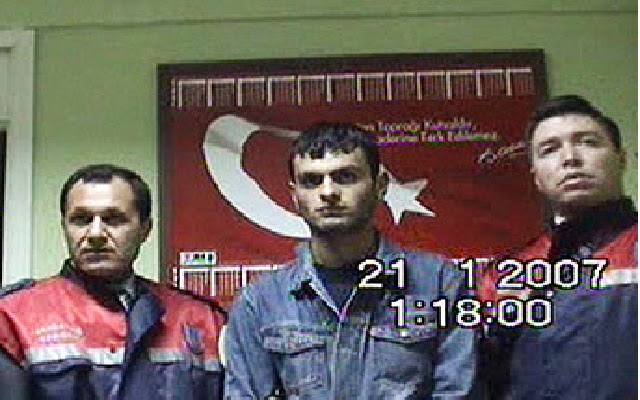
Dink assassin Ogun Samast posing with police officers who arrested him just two days after Dink's murder.

The Istanbul Chief Prosecutor's Office have granted the request of Dink family lawyers that an investigation be launched into the involvement of high-level security officials into the 2007 assassination of Turkish Armenian journalist Hrant Dink. From Hurriyet Daily News:
This is an extremely good, positive development. I hope there will be a result [from] this,” Dink family lawyer Fethiye Çetin told a crowd of journalists during the court recess. She said they were expecting the investigation as they had applied to the prosecutor’s office Jan. 17, demanding that rulings made on the case by the European Court of Human Rights be implemented in Turkey.

The Dink family recently made a new plea for state, police and gendarmerie officials not questioned during the initial investigation to be brought into the scope of the case, basing their request on the European court decision finding Turkey guilty of failing to protect Dink and his freedom of speech and of not properly investigating civil servants suspected of being negligent in the murder and its investigation.

. . . .

The 28 public officials whose testimonies are expected to be taken by Public Prosecutor with Special Authority Mustafa Çavuşoğlu in the coming days include former Istanbul Gov. Muammer Güler; Ramazan Akyürek, the former top head of police intelligence; former Istanbul Police Chief Celalettin Cerrah; Ahmet İlhan Güler, the former Istanbul head of police intelligence; former Trabzon Police Chief Reşat Altay; Col. Ali Öz, the former Gendarmerie Trabzon regiment commander; and Metin Yıldız, the former Trabzon head of gendarmerie intelligence.
Last week President Gul announced that the State Audit Board (DDK) open a separate investigation into Dink's murder. Both investigations are indicators that the government is getting serious about resolving the facts behind Dink's murder. For more on Dink, see past posts.


UPDATE I (2/10) -- Interior Minister Besir Atalay is denying reports that the Istanbul Chief Proescutor's Office has opened up an investigation. Meanwhile newly released phone records verify long-time allegations that police exchanged text messages in the months prior to Dink's assassination. Previous evidence existed that police exchanged phone messages with Tuncel just two hours before Dink's assassination.

UPDATE II (2/15) -- In a new development in the ongoing Dink trial in Istanbul, the Trabzon Chief Prosecutor's Office has announced that it would allow the Istanbul court to question Trabzon police officers in communication with Tuncel up to the day of Dink's murder. Previous requests had been denied.

Sunday, February 6, 2011

When Turkey Meant Jazz . . .

And a welcome connection between Turkey and the city in which I now find myself . . .

From National Public Radio:
The Embassy of Turkey and Jazz at Lincoln Center announced a series of six jazz concerts today, to be held throughout 2011 at the residence of the Turkish ambassador in Washington, D.C.

Wait, what? Why would the biggest jazz institution the world has ever seen work with the Turkish embassy? What kind of backroom dealings transpired to make this seemingly arbitrary alliance happen?

A hint: They happened in the '30s and '40s.

Perhaps you know of Atlantic Records, one of the most important record labels for jazz and R&B from 1947 onward. John Coltrane and Charles Mingus recorded seminal work for Atlantic; so did Ray Charles, Aretha Franklin and Sonny and Cher.

Atlantic was co-founded by Ahmet Ertegun, who was later joined by his older brother Nesuhi Ertegun (the big jazz buff of the company). The Ertegun brothers were the two sons of the second Turkish ambassador to the U.S., Mehmet Munir Ertegun; they were in their teens when their father accepted the position in Washington, D.C. in 1935. The brothers were huge music fans, and threw themselves into the city's jazz scene.

Wednesday, February 2, 2011

More KCK Detentions, More Unrest

A street theater group puts on a show in protest of the ongoing KCK trial in front of the Diyarbakir Greater Municipality Building and within view of the courthouse. DHA Photo from Hurriyet Daily News

Police detained six alleged members of the KCK, the PKK's so-called urban wing, in Van yesterday as the KCK trial continued with a bit of street theater in front of the courthouse. From Hurriyet Daily News:
Police simultaneously raided various addresses in the Erciş district of eastern Van province and detained six including Ramazan Alver, Erciş branch head of the pro-Kurdish Peace and Democracy Party, or BDP.

. . . .

The lawyers of KCK defendants asked for the recusal of the judges hearing the case during Tuesday’s hearing in the southeastern province of Diyarbakır at the 6th Court of Serious Crimes. A group of people protested the hearing through a theatrical play held in front of the municipality building, located nearby the courthouse.

The KCK case has 152 suspects on trial, of which 104 are under arrest and 19 are on the run. The arrested suspects include 12 elected mayors from the BDP.

The case is in a deadlock because the suspects have demanded to give testimony in Kurdish since the first hearing but have been prevented from doing so by the court.

BDP co-leader Selahattin Demirtaş had stated the suspects would not attend the hearing Tuesday, which raised tension. Meanwhile, the 23 female suspects under arrest resisted being transferred to the courthouse but were later persuaded to do so.

The request for the recusal of the judges will be heard by the 4th Court of Serious Crimes of Diyarbakır.
The recusal request raises the ante a bit while the BDP continues to score political points. Why does someone not just blink already? The BDP has everything to gain from the current stalemate. Meanwhile, the court's recalcitrance and the Turkish government's absolute silence on the subject is only aggravating concerns. Perhaps a draft proposal creating the right to defend oneself in one's native language. Too much to hope for I know, but still . . .

Saturday, January 29, 2011

More Chaos at the KCK Trial

DHA Photo

More chaos ensued under the auspices of the KCK trial in Diyarbakir yesterday when defendants, still not granted permission to defend themselves in Kurdish, continued in their efforts to speak Kurdish in the courtroom. No doubt their microphones were silenced by judges, and their remarks recorded as "incomprehensible," as has been the case in past hearings.

Neither side is blinking on the issue: the court stubbornly refuses to allow the 151 defendants on trial to defend themselves in Kurdish despite the fact that there is precedent for such while the defendants and the BDP are using the issue to raise their own profile and ignite protests across the country. From Hurriyet Daily News:
During the afternoon session, the court said the hearing would continue without defendants in the Kurdish Communities Union, or KCK, case because they reportedly destroyed the discipline in the hall during the morning protest.

Ahead of the afternoon session, the defendants had said they would not attend the second hearing unless they were forced to do so by the gendarmerie, in which case they said they would refuse to sit in court, the pro-Kurdish Fırat news agency reported.

Once in court, the defendants’ lawyers said they did not want to make a defense without their clients, leading them to begin walking out. After the action was greeted by applause from the gallery, the court ordered everyone out and postponed the case until Feb. 1.

More than 100 defendants were standing trial once more for the case, which is investigating the alleged urban wing of the outlawed Kurdistan Workers’ Party, or PKK. The defendants include 96 people under arrest well as seven without arrest. A total of 153 people are implicated in the case, including the mayors and local politicians of several southeastern Anatolian provinces. Prominent Diyarbakır Mayor Osman Baydemir is on trial but is not under arrest.

After the court rejected the defendants’ request to speak in Kurdish during the morning session, the suspects demanded to leave the hall but were prevented from doing so by gendarmerie officers, Doğan news agency reported. The defendants, together with members of the gallery, consequently gave derisive applause for five minutes, leading the court to adjourn for a recess.

Nejdet Atalay, the mayor of Batman, spoke in Turkish in the court, saying: “This trial will take its place in history as a dishonorable example of democracy. What is being judged here is Kurds, the representatives of Kurds and the Kurdish issue.”
See past posts for more background.

In another court case, a Diyarbakir court has issued a bizarrely inhumane ruling denying compensation to a Kurdish family whose son was run over by a police vehicle. According to the decision of the court, "The sadness of the death of a [younger] person for his mother and father will not be the same as the sadness of the death of someone who came to a [greater] social status and age.” See Jenny White's comments at Kamil Pasha for more detail.

Monday, January 24, 2011

Human Rights Watch Releases World Report

Human Rights Watch (HRW) has released its 2011 World Report, documenting a "mixed record" of human rights in Turkey over last year. The report points to continued problems resulting from the Anti-Terrorism Law, as well as the little headway made in improving the human rights situation for Kurds despite the government's expressed intention to do so. For the full report, click here. For an interview with Ankara Human Rights Association chair Ozturk Turkdogan, click here.

Wednesday, January 19, 2011

For Hrant, For Justice

It was four years ago today that Turkish Armenian Hrant Dink was gunned down in the street and the botched investigation and unwieldy series of trials since have only added to the despair of the loss. On Monday, Dink family lawyers filed another petition with the Istanbul Chief Prosecutor's Office seeking an investigation into the event surrounding his death and implementation of the European Court of Human Rights decision Dink lawyers won last September. The Court found that the Turkish government had failed to conduct an effective investigation into his death, fell short of protecting his right to life, and had violated his rights to freedom of expression.   From Hurriyet Daily News:
The family demanded investigations of the police and gendarmerie officials allegedly responsible for the murder, either directly or by neglecting their duties. In their application, they argued that the European court’s decision canceled the authority of certain domestic laws that had previously blocked the path of putting such officials on trial.

Dink, a Turkish citizen of Armenian origin, was murdered in front of the office of the weekly Armenian-Turkish newspaper Agos on Jan. 19, 2007. Confessed killer Ogün Samast was transferred to a juvenile court in October, and his trial separated from the main murder case, due to a legal change he benefited from because he was under the age of 18 on the day of the assassination.

Yasin Hayal, who is accused of abetting the murder, and Erhan Tuncel, a former police informant who claims innocence on the grounds that he told security forces everything he knew months before the murder, are still on trial under arrest. The only suspects left after three years of the trial, they will be released next year if they are not convicted by that time under a recent legal change that limits arrest periods without conviction to a maximum of five years.

From the beginning, lawyers for the Dink family have stated that the murder was not the work of “three to five nationalist youth,” but even the official inspector’s reports concluded that the National Intelligence Organization, or MİT, should be investigated were not enough to allow the questioning of high-ranking suspects from the police, gendarmerie and the MİT.
As they have every year since the first anniversary of Dink's murder, thousands gathered on the street where he was shot to call for the government to hold those responsible to account. For more on Dink and his family's attempts to uncover the details of his assassination, see past posts. For an excellent documentary produced in 2009 on the event surrounding the murder and the subsequent attempts by authorities to cover up their involvement, click here.

Monday, January 17, 2011

Saving Archaic Greek in Turkey

Thanks to Jenny White and 3quarksdaily.com . . .


For more on Turkey's Pontic Greek population, click here. Interestingly, since the Pontic Greeks converted to Islam, they do not have minority status in Turkey since such standing was based on religion.

Istanbul as Weimar Berlin?

Claire Berlinski has an extended essay in City Journal comparing Istanbul to Weimar Berlin. From her piece:
What is a Weimar City? It is a city rich in history and culture, animated by political precariousness and by a recent rupture with the past, vivified by a shocking conflict with mass urbanization and industrialization; a city where sudden liberalization has unleashed the social and political imagination—but where the threat of authoritarian reaction is always in the air.

Weimar Cities are not freaks of nature. They may be expected to arise under certain social, political, and historical circumstances. World War I destroyed both Imperial Germany and the Ottoman Empire. The remnants of both entities succeeded in imposing alien new social orders on themselves, fragile experiments in democracy. The Turkish Republic has lasted far longer than the Weimar Republic, but the stories do not differ in the fundamentals; they have merely been telescoped or expanded by contingent events.

With the rise to power in 2002 of the Justice and Development Party, or AKP, the Turkish Republic has experienced a fresh convulsion. The AKP opened the Pandora’s box of political Islam. It has presented its reforms as an exercise in liberalization. In a sense, this is true: religion as a political force had, since the founding of the Republic, been repressed. In another sense, it is not true at all: this particular political force is one that, by its nature, tends ultimately to erase liberal reforms. “Democracy is like a streetcar,” Recep Tayyip Erdoǧan, now prime minister, said infamously in 1995. “When you come to your stop, you get off.”

Turkey is now in the throes of two revolutions. The social transformations over which Mustafa Kemal Atatürk presided have not yet been assimilated; simultaneously, something new—and old—has rushed up to challenge them. The ancient order is thus disappearing doubly. Cultures, it would seem, react in particular ways to the disappearance of ancient orders. The febrile characteristics of Weimar Cities appear at just such times—the in-between times. As fever is a sign of disease, so it is a sign of social dislocation.
I offer this essay not so much because I agree with it in its entirety, but for the different reactions it provokes.

Sunday, January 16, 2011

Still No Blinking on Kurdish Language Defense

AFP Photo

The KCK trial continued Friday with neither side blinking on the defense in Kurdish issue. The court continued to turn off microphones as defendants attempted to speak in Kurdish, and the defendants refused to acquiesce in their demands. Some of the 151 defendants on trial argue they are better able to defend themselves in their mother tongue, though of course the issue, thanks also to the court's recalcitrance, is also being used as political fodder for Kurdish nationalists. In the end, the court decided to postpone the trial until Tuesday.

Meanwhile, protests in Diyarbakir and Istanbul got underway. In Diyarbakir, police blocked access to routes leading to the courtroom in Yenisehir, which lays just outside the city's historic walls that gave refuge to the many Kurds fleeing from the death and destruction that defined the 1990s. In Istanbul, an estimated 200 young people initiated clashes with police following a peaceful demonstration of 2,000 plus people on Istiklal Cadessi. The 200 young are no doubt among the city's thousands of impoverished Kurds that have immigrated into the city, live just off of Istiklal Caddessi, and are easily manipulated by forces who seek violent solution and seek to provoke.

According to Milliyet journalist Namik Duran, similar cases have allowed the use of Kurdish. Given the stakes here and the consequences for violence, why be so stubborn?


UPDATE I (1/18) -- Still no blinking as the trial continues. BDP leader Selahattin Demirtas announced that 1,000 families have announced their intention to join his party and that some of their children "to the mountain" (a metaphor for joining the PKK) as a result of the Kurdish language defense issue.

Monday, January 10, 2011

New Alcohol Laws and Turkey's 'Madisonian Dilemma'

The Turkish parliament has passed a new law increasing restrictions on alcohol sales and marketing. The new law restricts alcohol advertisements at sporting events and youth-centered events (e.g., some concerts), prohibits unauthorized caterers from serving alcohol at special events, imposes a ban on alcohol being used in promotional sales, and raises taxes on raki, an anise-flavored Turkish liquor.

The law heightens concerns that the ruling AKP is legislating its moral values. As Jenny White notes, restrictions on alcohol and high taxes are nothing new.

Legal restrictions on alcohol again raise the question of just how far the AKP is willing to regulate public morals, though AKP politicians routinely sound the note that regulations are concerned with public health and safety and are not an imposition of its own particular moral view. All the same, AKP politicians routinely make statements that emphasize their majority rather than liberal values. For more on AKP's majority politics, see my take on the party's need to resolve Turkey's 'Madisonian Dilemma' and assuage the fears who are now given evermore reason to think that the party is determined to legislate according to its own particular Islamic bent.